Canvaloop raises $1.5M to scale alternative, agricultural-waste-derived textile fibre in India
A Surat startup converting banana and hemp crop waste into textile fibre uses just 10 liters of water per kg. Cotton needs 9,000. A $1.5M raise is its shot at real scale.
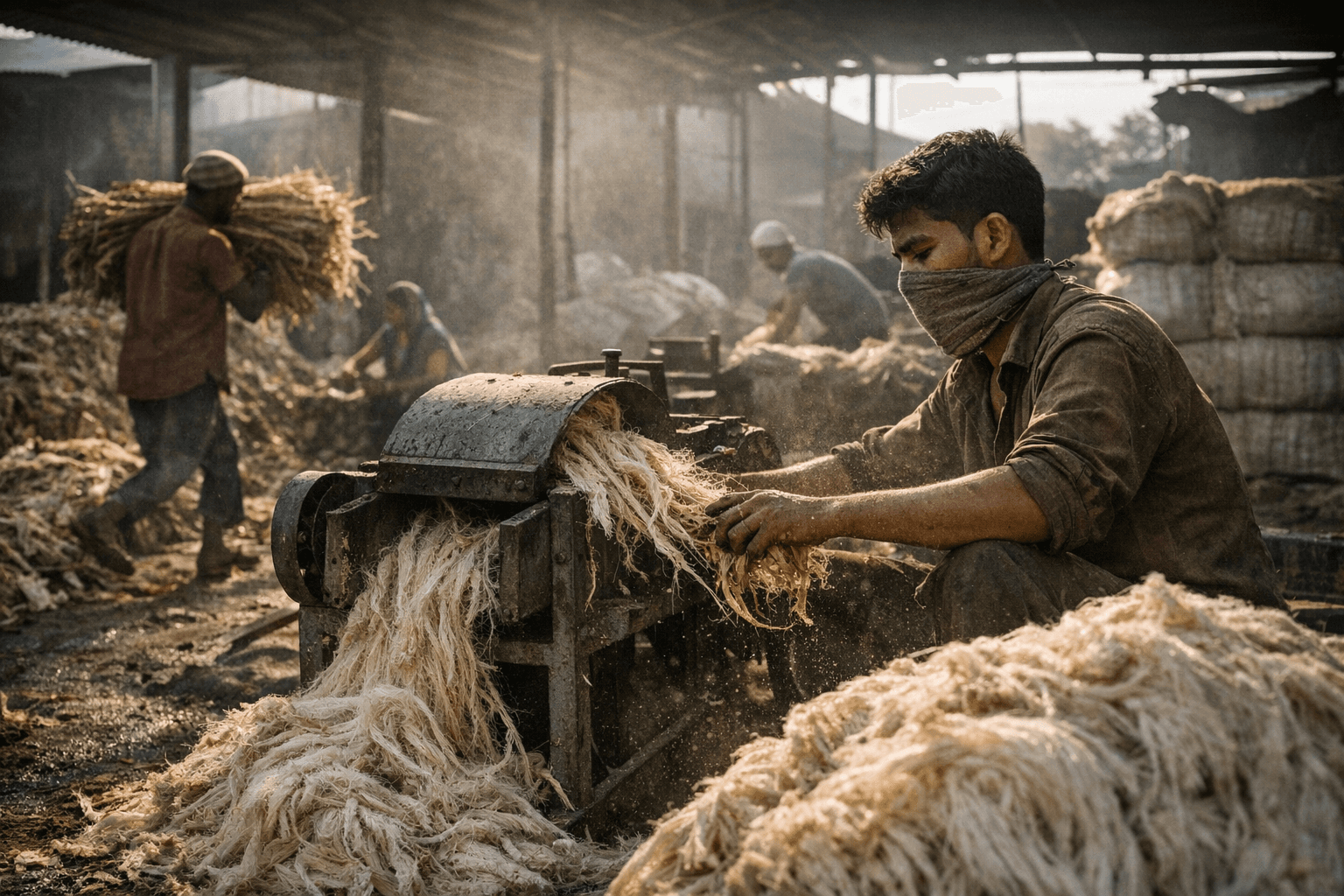
The number that stopped textile sourcing desks: Canvaloop's agricultural-waste fibre requires just 10 liters of water per kilogram to produce. Cotton, the industry's default, demands 9,000.
That 900-fold gap sits at the center of the Surat-based biomaterials startup's $1.5 million raise, secured in late March from Gujarat Venture Finance Limited (GVFL) and Rockstud Capital, equivalent to approximately ₹13.3 crore. The funding will be deployed to expand monthly production capacity from 30 tonnes to 300 tonnes, a tenfold jump that moves Canvaloop from compelling proof-of-concept into territory where mainstream brands can actually build a supply relationship rather than a sample-room curiosity.
Founded in 2020 by Shreyans Kokra, a chartered financial analyst who returned to his family's four-decade textile business with a specific mission to decarbonize it, Canvaloop converts crop residues including hemp, flax, banana, pineapple, nettle, and oilseed waste into spinnable, textile-grade fibre. The process is a proprietary three-step chemo-mechanical system: biochemicals and enzymes first break down the raw agricultural material, then mechanical treatment produces a cottonized output that retains the original plant's anti-UV and anti-microbial properties. No solvents enter the system. Heat comes from bio-waste. All process water cycles back. The closed-loop claim is traceable, not just marketed.
That auditability matters. Brands demanding supply chain transparency have grown skeptical of sustainability credentials that evaporate under third-party scrutiny. Canvaloop's closed-loop architecture is built to withstand that pressure: feedstocks are agricultural crop residues that would otherwise be burned as stubble, a practice responsible for significant seasonal air quality crises across India's farming regions. The processing chemistry avoids the solvent baths associated with conventional viscose and Lyocell production, where chemical recovery rates and wastewater treatment are persistent compliance weak points.
The resulting fibre is 100% biodegradable and engineered to run on existing spinning infrastructure without mill retrofits, the commercial argument that has historically stalled alternative fibre adoption. Mills configured for cotton don't want to make capital expenditures for a material with uncertain volume. Canvaloop's plug-and-play positioning removes that friction, meaning a purchasing director can bring it into a seasonal brief without renegotiating every upstream contract.
Where the fibre competes best is against cotton in mid-weight apparel and home textiles where breathability matters and where the water and pesticide costs of conventional cotton are increasingly indefensible to ethical buyers. Against viscose, with its wood-pulp feedstock and chemical-intensive wet-spinning process, Canvaloop's crop-waste origin offers a more traceable, lower-toxicity alternative. Against recycled polyester, the biodegradability advantage is decisive: synthetic blends shed an estimated 1,900 microplastic particles per wash cycle, entering waterways with no mechanism for recovery or breakdown. Canvaloop's cellulosic fibres carry no such liability.
Kokra described the raise as "an important milestone," and said the company has "believed that sustainability has to be built for real adoption, at the speed, quality, and scale the industry demands." GVFL Managing Director Mihir Joshi framed the investment as backing Canvaloop's progression "from a local waste-to-fibre pioneer to a global supply chain backbone," characterizing the startup as evidence of the scalable deep-tech sustainability work emerging from Gujarat. The capital will also fund continued R&D into regenerative fibres, Canvaloop's next material category.
The company gained broader public visibility through an appearance on Shark Tank India. With GVFL, a state-linked institutional venture fund, now on the cap table alongside Rockstud Capital, the credibility behind the 300-tonne target carries more weight than a pitch deck alone.
A $1.5 million round does not transform global textile supply chains overnight. But scaling from 30 to 300 tonnes monthly is precisely the capacity step that converts an alternative fibre from a sustainability talking point into something a brand's fabric development team can actually spec. That is where the real test of whether agricultural waste can replace what cotton and viscose currently occupy will be run, and Canvaloop has now funded the attempt.
This article was produced by Prism’s automated news system from verified source data, official records, and press releases, then run through automated quality and moderation checks before publishing. The system is built and supervised by the people who set the standards it runs under. Read our full AI policy.
Did this article answer your question?


