FAB Show 2026 Draws Record Trade Attendance With Sustainability and Innovation Focus
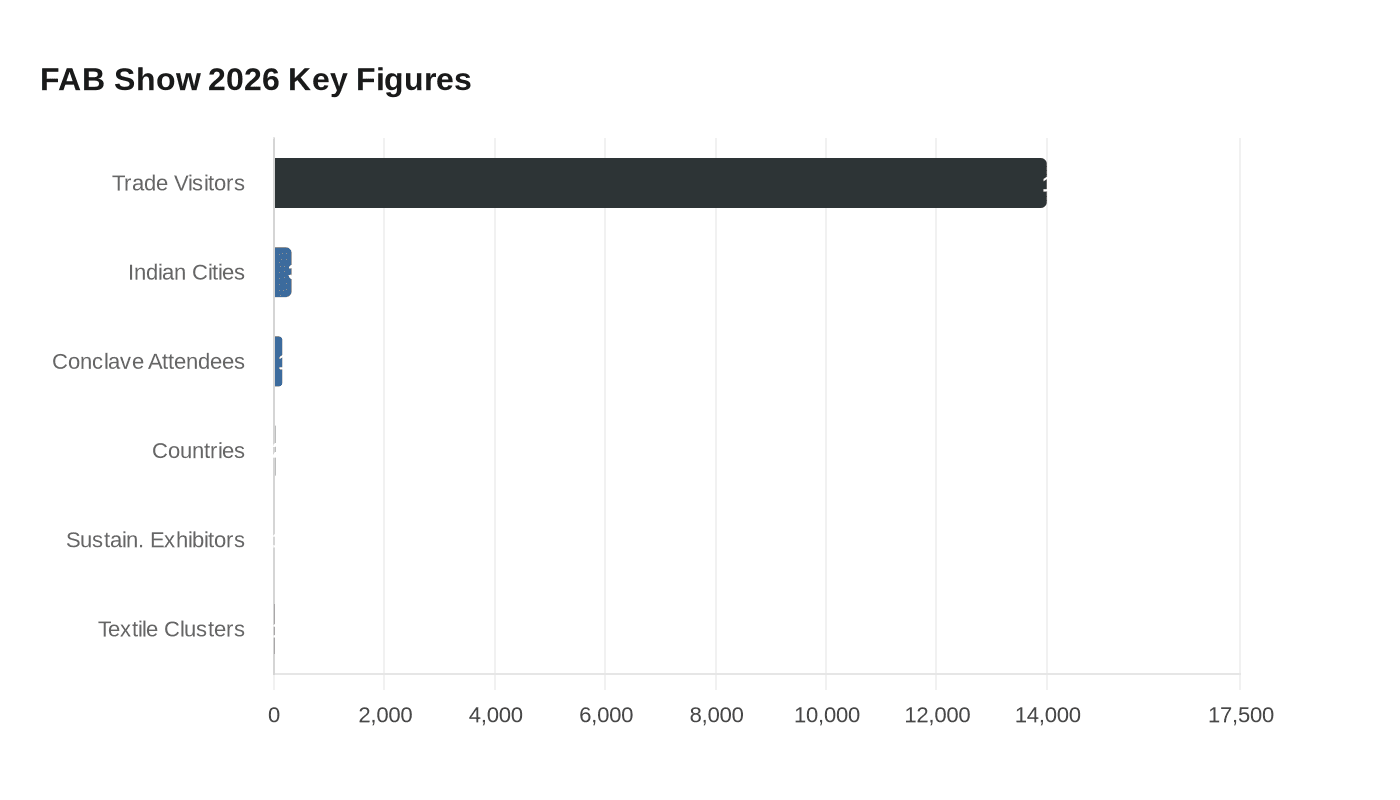
India's biggest fabric sourcing show wrapped with record turnout: 14,000 trade visitors, buyers from 27 countries, and sustainability moving from pledge to supply-chain requirement.
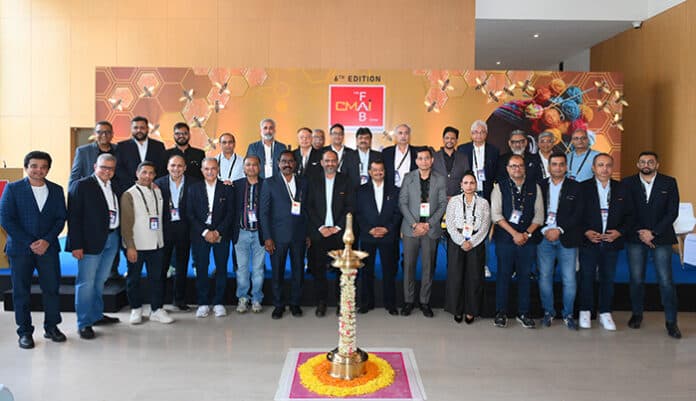
The conversation around sustainable sourcing has shifted from aspiration to audit trail at India's largest textile trade event. FAB Show 2026, the 6th edition of the Fabrics, Accessories & Beyond Show organized by the Clothing Manufacturers Association of India (CMAI), closed April 4 at the Bombay Exhibition Centre in Mumbai with record trade attendance and a floor that looked markedly different from editions past: certification consultants, AI-driven compliance tools, and eco-credentialed fabric mills competed for floor space alongside traditional trim and accessory suppliers.
More than 14,000 trade visitors from over 320 Indian cities moved through the nearly two-lakh-square-foot hall across three days, joined by buyers from 27 countries including the US, UAE, Bangladesh, Egypt, Mauritius, and China. Buyer pre-registrations climbed 12 percent over the previous year, a number that signals genuine commercial urgency rather than institutional loyalty. "FAB Show has become a vital sourcing platform for India's garment industry," said Santosh Katariya, President of CMAI. "As supply chains grow more complex and cost-sensitive, access to reliable suppliers and innovative materials under one roof is critical."
That urgency is partly regulatory. Brands sourcing from India are increasingly operating under tightening European Union frameworks requiring restricted-substance compliance, traceable recycled-content claims, and product-level environmental disclosures. What FAB Show 2026 revealed is that Indian suppliers are actively repositioning to meet those requirements rather than waiting for mandates to land.
The clearest signal was the show's newly minted International Pavilion, making its debut this edition alongside participation from ten domestic textile clusters including Surat, Ahmedabad, Bhilwara, Jaipur, Ludhiana, Erode, and Tiruppur. Export houses, textile export houses, and international textile suppliers turned out in unusual numbers for inauguration day, a turnout that organizers read as confidence in the Indian supply chain's readiness. The pavilion reflects a deliberate strategy to position India's garment ecosystem not just as a cost-competitive manufacturer but as a credentialed sourcing destination.
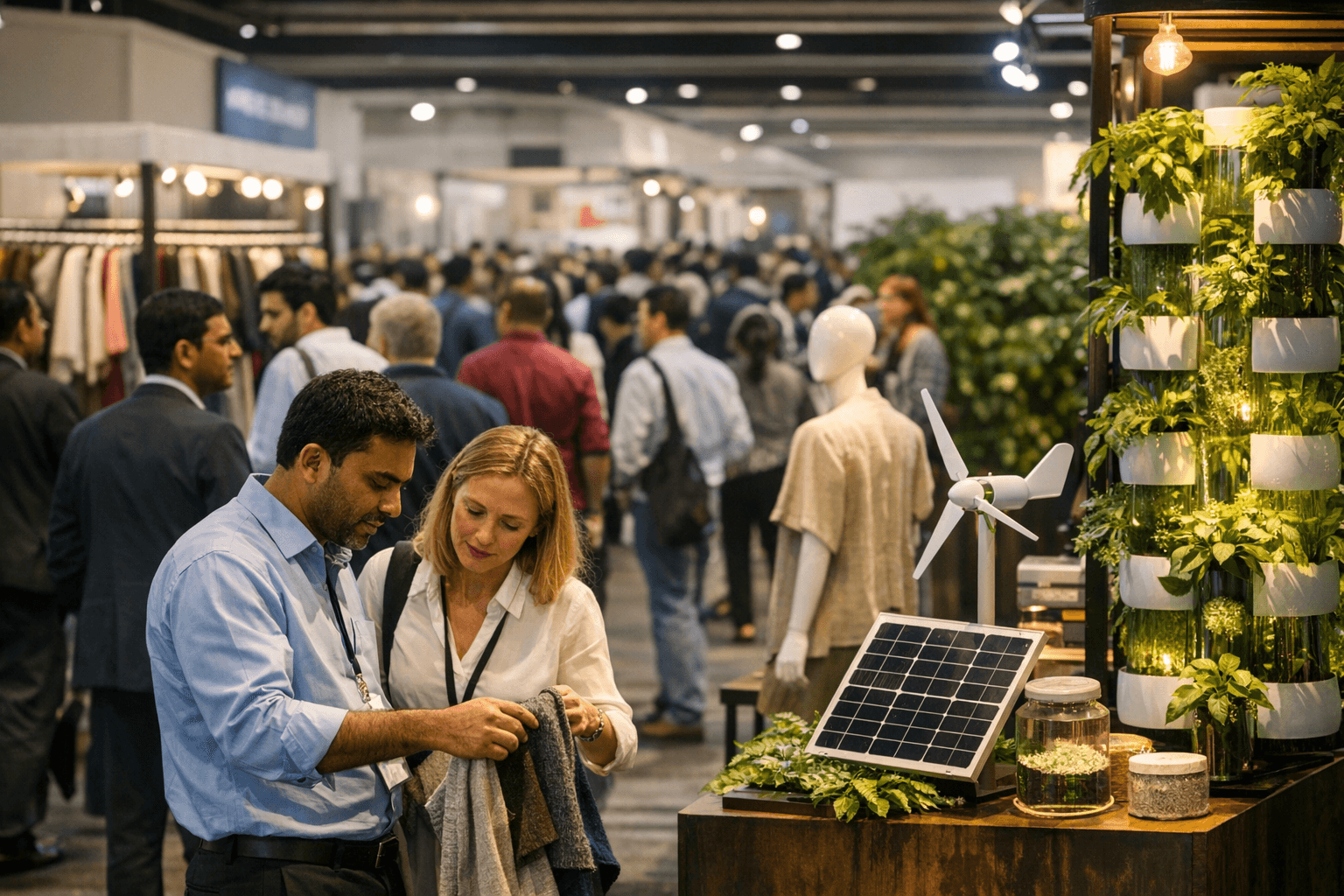
Sustainability infrastructure was the second major signal from the floor. Fifteen dedicated exhibitors occupied the show's Sustainability Pavilion, showcasing eco-conscious innovations across textiles, accessories, certifications, and responsible production processes. These were not concept displays: suppliers brought verifiable certifications, process documentation, and concrete data. One exhibitor disclosed saving approximately four lakh litres of water daily through adapted eco-friendly processes, a figure that resonates directly with the kind of supply-chain disclosure European brands now need to provide. It is precisely the sort of measurable, communicable metric that survives a compliance review.
The third signal came from the ECO-STITCH Sustainability Conclave, a full-day, by-invitation event held April 3 and co-organized by CMAI and SU.RE (Sustainable Resolution). Backed by the Global Alliance for Textile Sustainability Council, the Brands and Sourcing Leaders Association, and the United Nations Industrial Development Organization, the conclave drew more than 150 attendees: brand owners, international buying houses, manufacturers, exporters, policymakers, and start-ups. The explicit goal was building a supply-chain ecosystem where sustainability is foundational to manufacturing decisions, not a bolt-on compliance exercise.
What brands should note is where those conversations are heading. The conclave's backing by UNIDO and a globally recognized sustainability council points toward traceability frameworks that will eventually align with the third-party verification EU legislation is trending toward. Suppliers who participated in these sessions are, in practical terms, getting ahead of restricted-substance list updates and recycled-content claim standards before they become non-negotiable import conditions.
The fourth signal was the visibility of AI and digital tools on the show floor. FAB Show 2026 explicitly positioned technology as the mechanism for achieving both manufacturing efficiency and compliance reporting. AI solution providers exhibited alongside fabric and trim suppliers, and the show's broader narrative around digitizing India's garment supply chain tracks with what brand compliance teams actually need: automated record-keeping, material traceability from fiber to finished product, and supplier audit support at scale. Naveen Sainani, Chairman of the FAB Show and CMAI's Honorary General Secretary, was direct about the intent: "This year we are reiterating a stronger push on sustainability by introducing leading service providers and focused technology-driven initiatives around sustainability, including AI participation to support the industry's shift towards innovation and smart manufacturing."
The presence of Raymond Lifestyle, Aditya Birla Fashion and Retail, and Zola Fashions among the show's guests of honour at inauguration confirms that the event draws genuine decision-making authority, not just procurement researchers on fact-finding missions.
The fifth signal was the show's deliberate integration of emerging design talent as a pipeline for sustainable material adoption. CMAI partnered with the National Institute of Fashion Technology, JD Institute of Fashion Technology, Symbiosis Institute of Design, SOFT Pune, and the International School of Design for a Grand Sustainable Fashion Show featuring 12 curated sequences blending AI-driven design, Indian crafts, and sustainable fabrics. It is the kind of forward-looking integration that signals eco-conscious material innovation is no longer concentrated at the premium end of the market; it is moving through the entire supply chain, including mid-market apparel manufacturing.
For brands conducting their next sourcing review, the practical translation is this: Indian suppliers are investing in the vocabulary and infrastructure of compliance faster than many Western brands have updated their supplier questionnaires. The 12 percent surge in pre-registrations and the breadth of representation from 27 buying countries suggest that India's position as a credible sourcing destination is holding, even as the criteria for what makes a credible partner become considerably more demanding. The tags on what shoppers find on shelves this season will, in many cases, trace back to sourcing decisions made on this floor.
This article was produced by Prism’s automated news system from verified source data, official records, and press releases, then run through automated quality and moderation checks before publishing. The system is built and supervised by the people who set the standards it runs under. Read our full AI policy.
Did this article answer your question?


