Europe Needs €11 Billion to Scale Textile Recycling by 2035
Less than 1% of Europe's worn clothes gets recycled back into new fiber. BCG and ReHubs say closing that gap costs up to €11 billion, and nobody has agreed who pays.

The fashion industry has been printing "recycled content" on hangtags for years. The numbers behind those labels tell a different story. A new analysis from Boston Consulting Group and textile recycling initiative ReHubs, presented in Brussels on March 23, establishes the first harmonized fact base on textile waste across Europe and puts a precise price on the problem: between €8 billion and €11 billion in capital investment, plus €5 to €6.5 billion in recurring annual operating costs, to get textile-to-textile recycling to meaningful scale by 2035.
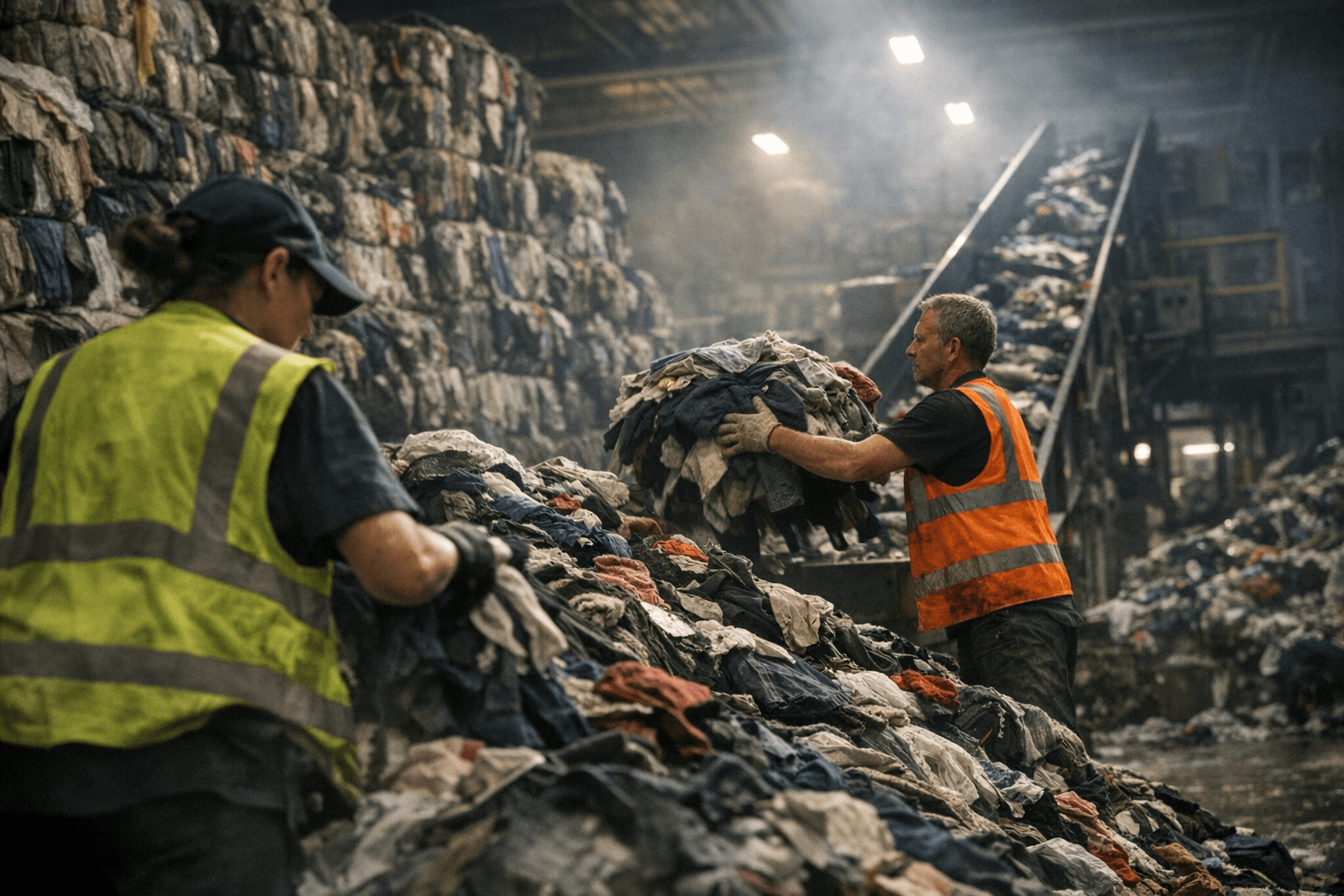
The report, titled "Advancing Textile Circularity," found that Europe generates roughly 15.2 million tonnes of textile waste annually, a figure BCG projects will rise to 18.1 million tonnes by 2035, driven by structural consumption growth running at about 4% per year since 2020 and amplified by fast fashion's persistent output volumes. Of the 13.3 million tonnes currently coming from post-consumer sources, only around 1.5 million tonnes is collected and sorted well enough to enter any recycling pipeline at all. That is roughly one tonne in nine. Less than 1% of that total ultimately gets recycled into new textile fiber.
The bottleneck is not the technology. BCG and ReHubs identified three compounding structural problems: collection coverage is too thin and fragmented, sorting infrastructure is chronically underfunded, and the feedstock reaching recyclers is frequently too mixed in fiber composition and too inconsistent in quality to support textile-to-textile processes at industrial scale. Europe's collection rate sits at 33% today and its sorting rate at 36%. Reaching the report's target of 2.7 million tonnes of textile-to-textile recycling per year by 2035, which represents 15% of materials in the European market, requires pushing those figures to 50% and 63% respectively. Neither is achievable through market forces alone.
Nicolas Manuelli, Managing Director and Partner at BCG, was direct about the economics: "This report shows that scaling textile-to-textile recycling in Europe is achievable, but it requires the right economic conditions. Textile-to-textile recycled fibers are a new product category with higher processing costs, meaning they will not scale without enabling mechanisms."
That word, "mechanisms," carries significant weight here. What the analysis describes is a cost structure that makes T2T recycled fiber currently noncompetitive against virgin materials. Collecting, sorting, preprocessing, and recycling a garment back into usable fiber costs substantially more per tonne than producing virgin polyester or conventionally farmed cotton. BCG notes that under baseline assumptions, profitability remains unattractive for several links in the value chain simultaneously. Without an external intervention to close that gap, private investors will not build the infrastructure at the required scale, because the returns do not pencil out within normal investment horizons.
The report identifies three primary levers. Extended producer responsibility schemes would require brands and retailers to financially contribute to end-of-life collection and sorting, shifting costs off public waste systems and onto the parties that profit from putting new products into the market. Under the EU's revised Waste Framework Directive, EPR fees are already being eco-modulated, meaning a brand pays a significantly higher levy for a garment made from difficult-to-recycle blended materials than for a mono-material construction. Harmonized collection standards across EU member states would build the coordinated volume needed to justify the cross-border recycling hubs that the analysis argues are necessary for feedstock concentration. And demand-side commitments from major brands, specifically credible recycled-content purchasing agreements, would give recycling operators the offtake certainty required to finance plant construction.
None of these levers is yet functioning at the necessary scale. Mandatory separate textile collection across the EU came into effect in 2025 and set a baseline, but EPR rollout remains uneven across member states. Export restrictions on unsorted textile waste and bans on the destruction of unsold textiles are tightening the system's traditional escape valves, which will increase feedstock pressure on European processors. But the legislative timeline varies, and the data infrastructure to support it remains immature. Evan Wiener, board adviser at ReHubs, put the data problem plainly: "We need a unified stance as an industry for one version of the truth." Without standardized definitions and reporting requirements, the report argues, policymakers and businesses will continue operating with inconsistent numbers and misaligned solutions.
Robert van de Kerkhof, CEO of ReHubs, framed the structural opportunity: "Europe has the opportunity to build a truly circular textile ecosystem, but it will require systemic change across the entire value chain. Textile-to-textile recycling is technically possible today, but scaling it requires coordinated action from industry, policymakers, and investors." He added that consistent measurement frameworks could steer both regulation and investment, noting: "What gets measured gets done."
The feedstock quality problem is the least visible bottleneck and arguably the most consequential for what "recycled content" will actually mean to shoppers over the next three to five years. Only around 7% of all textile waste is currently available as usable feedstock for textile-to-textile recycling. The rest is either too contaminated, too blended in fiber composition, or simply never collected in the first place. Advanced sorting technologies including near-infrared spectroscopy, artificial intelligence, and robotics can improve fiber identification and separation significantly, but they require concentrated volumes and sustained capital to operate efficiently. Without consistent, high-quality feedstock flowing through upgraded sorting facilities, recyclers cannot maintain the fiber purity that apparel brands require to support premium positioning.
This has direct consequences for labeling transparency. A garment sold today as containing recycled fiber is overwhelmingly likely to contain mechanically recycled content made from fibers shortened through shredding and degraded in quality, or chemically recycled content derived from post-industrial rather than post-consumer waste. True textile-to-textile recycled fiber, made from a worn garment back into a commercially usable yarn, remains a marginal fraction of what reaches retail. The BCG analysis suggests that fraction will stay marginal through 2027 or 2028 even under an optimistic investment and policy scenario, because the collection and sorting infrastructure simply does not yet exist to feed the volume required.
The question of who ultimately carries the €11 billion is politically unresolved. Brands built on cheap, high-volume output face the largest EPR liability under any robust scheme. Retailers operating on thin margins have limited capacity to absorb sorting and collection levies without passing them to consumers. And public co-investment in industrial recycling infrastructure competes with other infrastructure priorities at the European Commission level. The Netherlands has moved most aggressively, mandating that by 2030, 75% of textiles introduced to the Dutch market must be prepared for reuse or recycling, and that at least 33% of fibers from discarded textiles must be incorporated into new textile-to-textile recycled products. That kind of national legislative floor is precisely what the BCG and ReHubs analysis says must become the continental standard.
The 2.7 million tonne tipping point is the number that runs through the entire report, because it is the threshold at which economies of scale unlock unit cost reductions across the full system. Below it, textile-to-textile recycling stays expensive and structurally marginal. Above it, the cost structure begins approaching competitiveness with virgin materials. Reaching that threshold requires synchronized investment in collection, sorting, and recycling capacity simultaneously, the kind of coordinated capital deployment that markets rarely produce without either regulatory mandate or public co-investment anchoring the risk.
The brands that move first on EPR compliance and commit credibly to recycled content purchasing targets are not just making a sustainability play. They are positioning to shape the regulatory floor before it is set for them. The ones that wait will find themselves paying for infrastructure they had no hand in designing.
This article was produced by Prism’s automated news system from verified source data, official records, and press releases, then run through automated quality and moderation checks before publishing. The system is built and supervised by the people who set the standards it runs under. Read our full AI policy.
Did this article answer your question?


