Study Presented at ACS Spring Meeting Finds Unsafe Lead Levels in Kids’ Fast‑Fashion Shirts
Every one of 11 children's fast-fashion shirts tested exceeded the federal 100 ppm lead limit, and a toddler briefly chewing the fabric could surpass the FDA's daily ingestion threshold.

The threat isn't hypothetical. Preliminary research presented at the American Chemical Society's Spring 2026 meeting in Atlanta found that all 11 children's shirts purchased from four fast-fashion and discount retailers exceeded the U.S. Consumer Product Safety Commission's 100 parts-per-million threshold for lead in children's products, every single item, regardless of brand or country of origin.
Kamila Deavers, a chemistry professor at Marian University in Indianapolis, led the project after her own young daughter briefly showed elevated blood lead levels traced to toy coatings, before today's stricter regulations were in place. That experience built the lab she now runs with undergraduate researchers. At ACS, her team, including chemists Cristina Avello and Priscila Espinoza, presented what is likely the most direct indictment yet of fast fashion's chemical controls for children's wear.
The team tested 11 shirts that spanned the rainbow, including red, pink, orange, yellow, gray, and blue, from four retailers, including fast-fashion and discount companies. Initial screening used X-ray fluorescence spectroscopy, followed by quantitative analysis with inductively coupled plasma methods; clothing samples were digested using acid according to EPA 3050b, and bioaccessibility was assessed using EPA 1340 methodology. The result was unambiguous. "We saw that the shirts we tested were all over the allowed limit for lead of 100 ppm," Espinoza said.
Color is the most reliable predictor of contamination severity. The source appears to be tied to dyeing processes. Lead-based compounds, including lead(II) acetate, can be used to fix pigments and maintain color vibrancy, particularly in brighter shades like red and yellow, which showed higher concentrations in testing. Muted shades such as gray and blue registered comparatively lower total lead, though none came in below the federal limit. The economics are blunt: lead(II) acetate is cheap, and in low-margin fast fashion, cheaper mordants win.
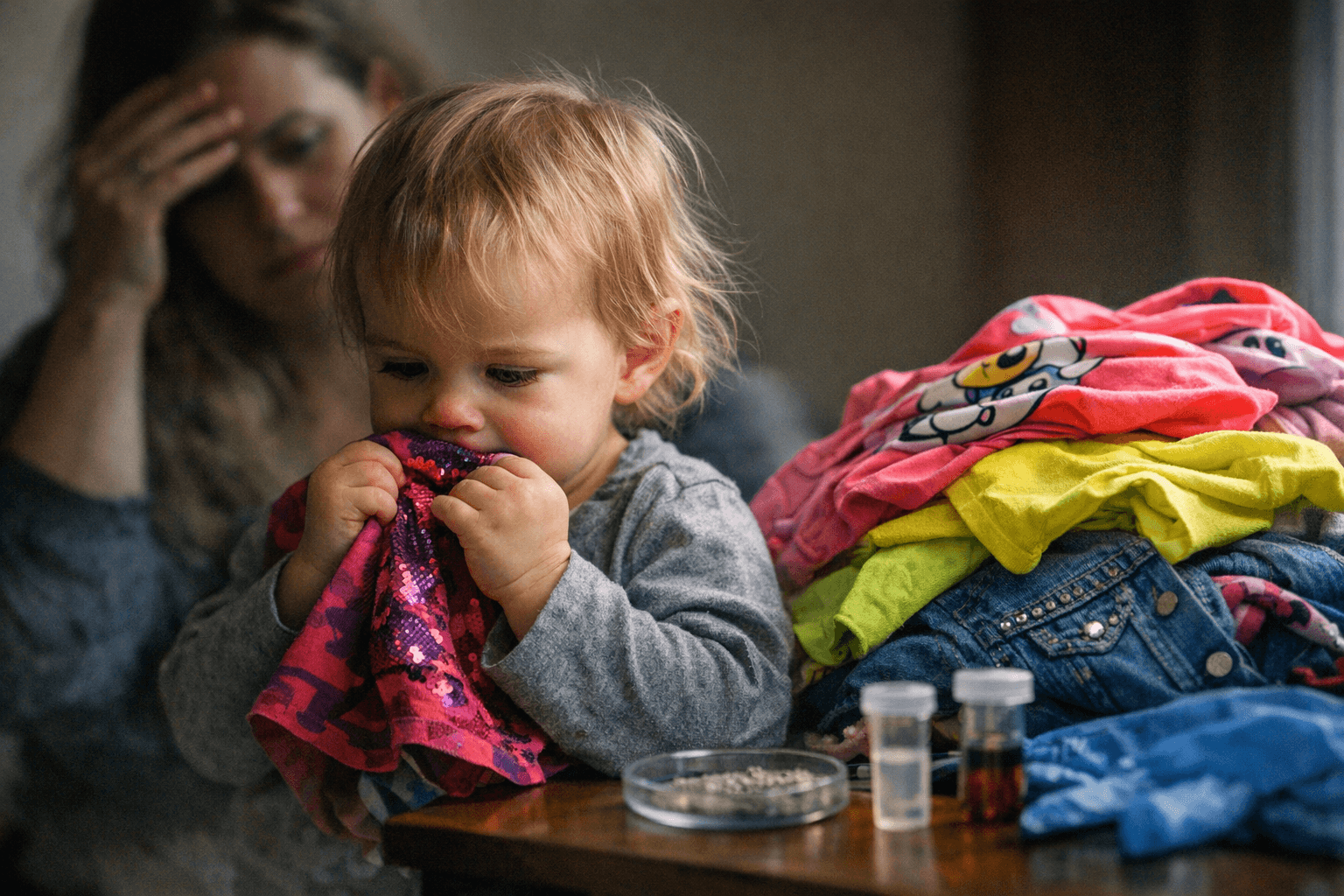
The exposure scenario that should alarm parents is not prolonged skin contact; it is chewing. Bioaccessibility simulations suggest that even brief mouthing of contaminated fabric, a common behavior among young children, could expose them to unsafe amounts of lead, a substance known to harm brain development and behavior. Children under six years old are considered most at risk, according to the EPA.
The regulatory picture is murkier than the science suggests it should be. The Consumer Product Safety Improvement Act requires children's products be tested by a CPSC-accredited third-party laboratory, and importers must hold a Children's Product Certificate before goods reach market. But the researchers flag the structural problem directly in their abstract: regulations on lead levels in clothing are hard to enforce due to the high volume of imported goods. The CPSC cannot inspect every container. In practice, compliance rests almost entirely on importer self-reporting.
For brands and retailers, this highlights a familiar weak spot: limited visibility into upstream suppliers. Textile dyeing often happens several tiers removed from the final manufacturer. A brand can certify its finished garment without independently testing the dyed fabric from which it was cut. Fast fashion's low cost means manufacturers are unlikely to adopt pricier dyeing technology unless consumers and policymakers force change, Deavers says.
The strongest protections currently available to shoppers operate at the fiber and fabric level, not at the finished garment. OEKO-TEX, GOTS, and BSCI certifications indicate that materials and production processes meet rigorous safety and environmental standards. OEKO-TEX Standard 100 specifically requires that every component of a textile be tested for harmful substances, heavy metals included. GOTS applies comparable criteria with additional organic fiber requirements. Neither is mandated under U.S. law, but both provide upstream chemical scrutiny that CPSC's post-market enforcement framework does not guarantee. When buying for young children, look for these certifications explicitly on the label or the brand's product page. Their absence on a brightly colored shirt from a discount retailer warrants real caution.
If suspect garments are already in your child's drawer, remove them from a toddler's regular wear until independent testing data exists for those specific items. Washing does not reliably remove lead bound into textile dye structure. When in doubt, retire the piece entirely.
Avello acknowledged the systemic constraint: it is not feasible to test every garment in circulation. What is feasible, and what these results make harder to ignore, is holding retailers accountable for publishing third-party test reports on their children's lines, disclosing their supplier auditing practices upstream through the dye tier, and establishing clear, public recall protocols when contamination is confirmed. Brands that cannot or will not provide that documentation are answering the question themselves.
The data are preliminary, as the researchers stated in Atlanta. Peer-reviewed publication and broader regulatory testing will follow. But all 11 samples exceeded the 100-parts-per-million lead limit set by the CPSC, and brightly colored fabrics, particularly red and yellow, tended toward higher lead concentrations than muted colors. Eleven shirts tested, eleven failures, zero exceptions: that is not a statistical edge case. That is a supply chain decision, dressed in a price tag.
This article was produced by Prism’s automated news system from verified source data, official records, and press releases, then run through automated quality and moderation checks before publishing. The system is built and supervised by the people who set the standards it runs under. Read our full AI policy.
Did this article answer your question?


