Grace Ling’s Met Gala Look Took a Week, Built by a Team
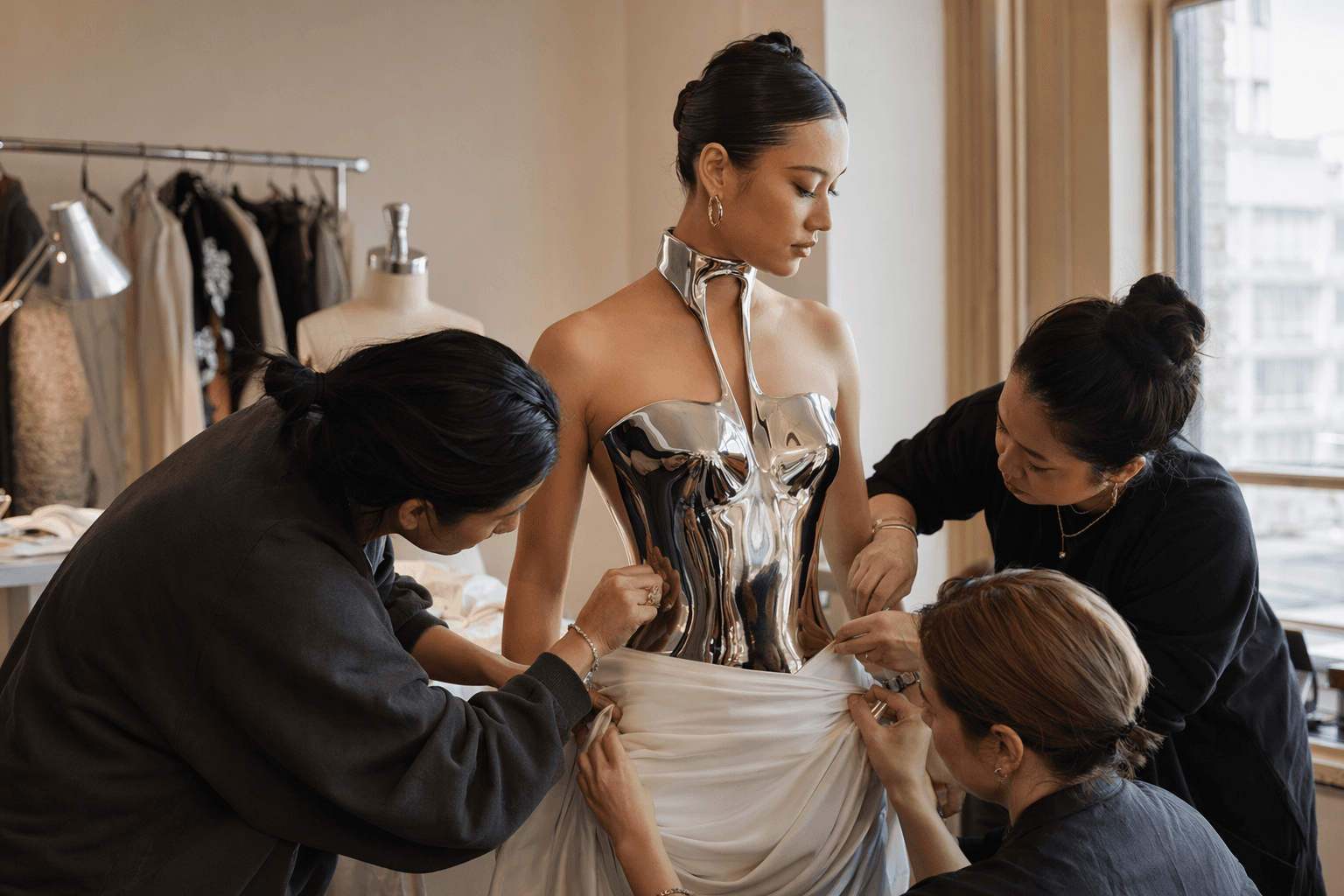
Grace Ling’s Met Gala look was a week-long sprint, built by a small team around a 3D-printed chrome bodice. The real story is the machinery behind an independent designer’s big-night debut.
The real Met story starts before the carpet
Grace Ling’s Met Gala moment was never just about the finished look. It was about the compressed, high-pressure machinery behind it: one week, a team, and a designer whose name had to hold its own on fashion’s biggest night without the safety net of a mega-brand.
That is what makes this story worth watching. The Met Gala rewards spectacle, but Ling’s appearance also exposed the hidden engine of independent fashion, where the glamour is built through fittings, fabrication, and impossible time frames. Her look became a quiet argument for how emerging designers actually survive at the top of the industry: with technical fluency, a lean staff, and the ability to turn an idea into a red-carpet object at speed.
Why Grace Ling is built for this stage
Ling is not a newcomer improvising her way into the spotlight. Born in Singapore and based in New York, she studied fashion design at Parsons School of Design in New York City and Central Saint Martins in London, then worked at Thom Browne and The Row before launching her eponymous label in 2020. That path matters, because it explains why her work feels polished even when it is experimental.
Her brand is known for folding CAD, CGI, and 3D printing into traditional craft, with zero-waste design part of the label’s identity. That mix of digital precision and hands-on making is exactly the kind of skill set the Met likes to reward, especially in a year when the Costume Institute’s exhibition, Costume Art, is focused on the relationship between clothing, the body, and art. Ling’s clothes do not just sit on the body. They seem engineered around it.
There is also a clear career arc here. Ling was named to Forbes’ 2022 30 Under 30 Asia list, then later won the CFDA/Genesis House AAPI Design + Innovation Grant. She has spoken about how meaningful that support was because she had been working solo, handling sales and press herself, and even sewing her first collection by hand. That kind of origin story is not just inspiring. It is practical context for understanding how hard it is to scale one designer’s vision into a Met-level production.
A week is not a lot of time
In Fashionista’s video, Ling said the entire look was built in just one week with her team’s help. That detail is the heart of the story. A week sounds generous until you remember what has to happen inside it: design decisions, prototyping, fabrication, finishing, fittings, and the final adjustments that turn an ambitious concept into something a person can actually wear.
The centerpiece was a 3D-printed bodice made from aero-aluminum plated in chrome. That combination tells you everything about Ling’s approach. It is futuristic, but not flimsy. The chrome surface gives it the cool, reflective sharpness that reads immediately on a red carpet, while the aero-aluminum base suggests structure and lightness, which matters when the garment has to survive a night of movement, cameras, and stairs.
What makes the look especially compelling is how it translates the language of innovation into something visually legible. This is not tech for tech’s sake. It is tech used in service of silhouette, sheen, and impact. The bodice had to read as sculpture from a distance and as craftsmanship up close, which is exactly the balancing act independent designers are asked to perform when they compete with the production muscle of luxury houses.
The Met Gala is a funding engine, not just a photo opportunity
The 2026 Met Gala took place on Monday, May 4, 2026, and it marked the opening of the Costume Institute’s spring exhibition. The Met says the Costume Institute Benefit is its primary source of funding for annual exhibitions, publications, acquisitions, and operations, which gives the night a sharper purpose than the usual celebrity gloss implies.
This matters for designers like Ling because the Gala is not only a spectacle built around celebrity dressing. It is also a stage where the institution’s idea of fashion history gets rewritten in real time. Costume Art opened on May 10, 2026 and runs through January 10, 2027, and the exhibition’s focus on the dressed body places clothing in conversation with art rather than treating it as a separate category. That framing suits Ling perfectly. Her work already lives in that borderland between garment and object.
The Met’s exhibition also inaugurates the museum’s nearly 12,000-square-foot Condé M. Nast Galleries, which adds another layer of institutional scale to the evening. Against that backdrop, an independent designer’s presence feels especially pointed. Ling is not just dressing a celebrity. She is proving that a smaller label can still contribute meaningfully to the culture-defining image of the night.
The collaboration that makes the look feel complete
Ling’s Met appearance also carried a second, quieter collaboration story. She wore custom Charles & Keith heels, and she described the moment as full-circle for a label that had supported her work from the beginning. That kind of relationship is exactly what makes independent fashion feel alive. It is not only about capital or prestige. It is about the network of brands and people willing to grow alongside a designer before the obvious accolades arrive.
The shoes matter because they complete the picture of how modern fashion operates at the edges of the luxury system. A sculptural bodice can command attention, but a thoughtful accessory partnership gives the look depth and continuity. It shows that Ling’s world is not built in isolation. It is built through alliances, loyalty, and timing, which are often the real currencies of fashion.
What to take from Ling’s Met moment
The lesson from Grace Ling’s Met Gala look is not that every designer needs a 3D printer or a chrome finish. It is that the strongest fashion moments today often come from a designer’s ability to merge vision with infrastructure, even when that infrastructure is minimal. The work has to be fast, the team has to be nimble, and the result has to look inevitable.
That is why Ling’s Met appearance resonated beyond the carpet. It showed an independent designer operating under the kind of pressure usually reserved for a major house, and doing it with a language of her own: engineered, precise, and unmistakably modern. In a season full of polished spectacle, the most interesting thing was not the shine. It was the system that made the shine possible.
This article was produced by Prism’s automated news system from verified source data, official records, and press releases, then run through automated quality and moderation checks before publishing. The system is built and supervised by the people who set the standards it runs under. Read our full AI policy.
Did this article answer your question?


