Prada Home turns Japanese ceramics into Milan retail experience
Prada Home is making ceramics feel collectible and ceremonial, turning its Milan debut into a cultural stage for taste, ritual and retail.
The new retail script
Prada Home is not treating Via Montenapoleone 6 as another glossy address to sell through. It is turning the new Milan space into an exhibition, opening Chawan Cabinet by Theaster Gates on April 16, 2026, just ahead of Milan Design Week 2026 and Prada Frames In Sight, the brand’s own design symposium running April 19 to 21. That timing matters: in a week crowded with launches, Prada is choosing cultural framing over a simple store opening, and placing the project in the same building as its menswear store only sharpens the point.
What Prada is selling here is not just homeware, but a point of view. WWD describes the project as a design-led move centered on Japanese ceramics, while Architectural Digest framed Chawan Cabinet as a meeting of West Side Chicago and traditional Japanese tea culture. Together, those readings make the brand’s intent plain: luxury retail is shifting from inventory to interpretation, from shelves to staged meaning, with the store behaving more like a cultural exhibition space than a transaction point.
A cabinet built around touch
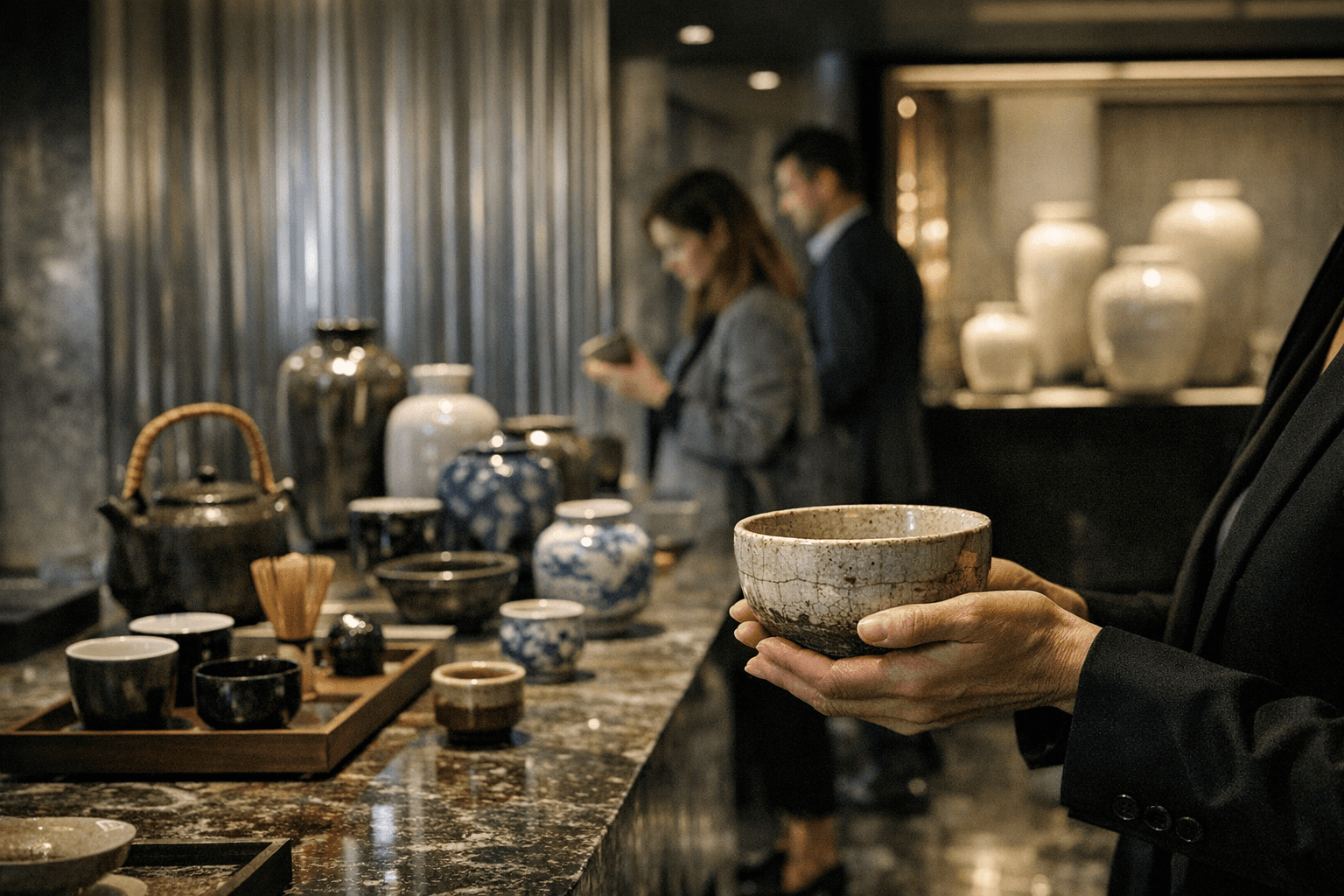
The heart of Chawan Cabinet is tactile, not ornamental. Prada’s own language centers the project on editioned ceramic vessels and ceremonial forms, objects meant to be held, handled and honored through time rather than merely looked at. That distinction is the most interesting thing about the show: ceramics here are not treated as fragile decor, but as intimate tools of ritual, carrying the memory of touch, the trace of fire and the subtle irregularities that make each piece singular.
The collection’s vocabulary is rooted in Japanese tea culture, especially the chawan, the tea bowl designed to sit in both hands. Prada extends that language through other forms too, including yunomi cups, sake vessels and flower vases, so the exhibition reads less like a product drop than a domestic score written in glaze, clay and careful use. The pieces are presented as instruments for living with intention and beauty, a far more persuasive luxury proposition than a flat display of objects on plinths.
The five makers at the center
Prada identifies five ceramic artists as the central figures in the presentation: Shion Tabata, Taira Kuroki, Yuichi Hirano, Koichi Ohara and Theaster Gates. That roster is crucial to the show’s credibility, because it gives the exhibition real depth across generations and methods rather than relying on a single star name. Prada specifically notes that Yuichi Hirano is one of the earliest presenters of contemporary Japanese throwing methods, which gives the project a lineage as well as a contemporary edge.
The individual practices deepen the installation’s texture. Prada describes Taira Kuroki as a refined functional maker working from a family atelier outside Kyoto, where electric firing can produce the kind of clean, green-toned surfaces that recall Oribe glaze without becoming nostalgic. Koichi Ohara moves in a more experimental direction, using crushed gravel, asphalt, glass and stones from around his studio to build a ceramic language that feels almost geological. Those differences matter because they keep Chawan Cabinet from flattening into a single aesthetic, and instead make it feel like a conversation between techniques, regions and generations.
Why Prada keeps returning to Gates
This is not Prada’s first time using Theaster Gates to turn a space into a cultural argument. Prada and Fondazione Prada previously presented his China Cabinet project at Prada Rong Zhai in Shanghai, on view from March 11 to May 7, 2021. That venue, a restored 1918 residence in central Shanghai reopened by Prada in October 2017, already signaled how seriously the house takes architecture, preservation and the domestic sphere as platforms for brand storytelling. Chawan Cabinet feels like the Milan chapter of that same strategy, only tighter, more intimate and more retail-aware.
White Cube’s account of the Milan presentation underscores just how far Gates’ ceramics now travel. The show includes his editioned works, large-scale ceramic sculptures and Tokoname clay tiles that have already appeared in installations at the Mori Art Museum in Tokyo, the Albuquerque Foundation in Sintra and the 2026 Shanghai Biennial. That institutional range turns the project into more than a boutique installation. It becomes evidence that collectible craft now moves comfortably between museum, foundation and luxury retail, carrying cultural capital at every stop.
Gates himself put the emotional logic bluntly: he said the project gives him the chance to shift his artistic center and return to “the hand, the table, friendship and simple human kindness,” adding, “Pots are about people. I want to focus on that.” That is exactly why this Prada project lands. It refuses the coldness of prestige display and instead treats domestic objects as social ones, charged with use, memory and relationship.
What this signals for home-luxury branding
Prada Home is showing the next phase of luxury home branding in real time. The formula is no longer just a new boutique and a polished assortment. It is immersive art-and-design storytelling, a space where ceramics, ritual and brand mythology are braided together so the object feels less like merchandise and more like a collectible lifestyle signal. Prada has effectively built a retail environment that teaches taste while it sells it, and that is the sharpest luxury move in Milan this season.
This article was produced by Prism’s automated news system from verified source data, official records, and press releases, then run through automated quality and moderation checks before publishing. The system is built and supervised by the people who set the standards it runs under. Read our full AI policy.
Did this article answer your question?


