Renasens Raises €10 Million to Scale Waterless Textile Recycling Technology
A Swedish startup cracked polycotton recycling using CO₂ — no water, no toxic chemicals — and just raised €10M to prove it works at scale.
Over 12 million tons of textile waste are generated annually in Europe, yet less than 1% is recycled into new fiber. Existing technologies handle clean, single-fiber waste but fail on the blended and treated materials that dominate post-consumer textiles. Renasens, a Stockholm-based deep-tech startup founded in 2022, closed a €10 million (roughly $11.5 million) seed round this week that could change the math.
Led by Extantia, with participation from Course Corrected VC and continued backing from Norrsken Launcher, the funding is said to be the largest hardware seed round in Europe this year. The new capital will be used to establish a pilot plant in Borås, Sweden, and begin feeding recovered fibers directly back into European manufacturing.
Renasens was founded in September 2022 by Dr. Jade Abir Bouledjouidja, a chemical engineer whose breakthrough came from an unexpected place: during her PhD research into drug delivery using supercritical fluids, she realized the same principles could solve textile recycling's toughest barrier. She moved from France to Sweden to develop the idea and validate the technology at KTH Royal Institute of Technology. She rented a lab at KTH in January 2025 and by February had filed her second patent and reached technology readiness level 4 (a nine-level measurement system for assessing technology maturity). She received her first investment of €1.1 million that month from Norrsken Launcher and hired a team working between Stockholm and the pilot facility in Borås. In October 2025, Renasens won the H&M Global Change Award and launched a seed funding round, seeking €10 million.
The platform uses modified supercritical CO₂, a state in which carbon dioxide exhibits properties of both a liquid and a gas, to decolor and separate blended textiles. The process enables the recovery of intact fibers without depolymerization, toxic chemicals, or water use. The process has three steps within a modular unit: the first two are chemical (removing the dyes and cleaning the textile), the third mechanical (separating the fibers). It is the combination of these processes that contributes to patentability, according to Dr. Bouledjouidja. The two chemical phases result in a 3-5% loss of fiber strength and length, while the electrostatic mechanical separation step has a 98% separation rate for polycotton blends, a composition previously deemed "impossible to solve for" in post-consumer waste.
Unlike many recycling technologies that remain confined to controlled environments, Renasens designed its system for industrial deployment from the outset. Its modular setup allows integration into existing factories, avoiding the need for massive, centralized plants. The company is already supplying recovered cotton and polyester fibers to manufacturers in Portugal and Italy, proving early commercial viability.
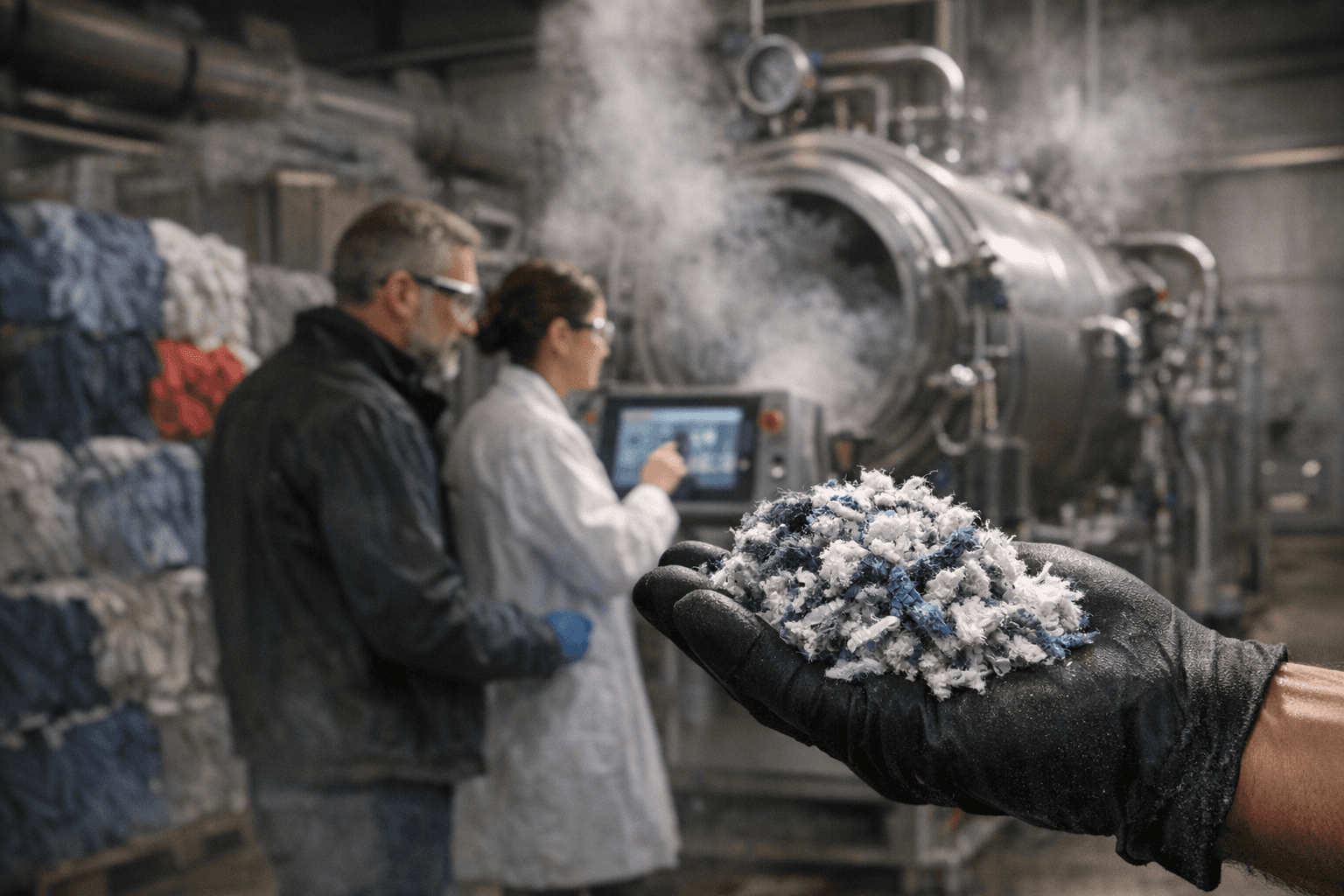
"Post-consumer textile waste has been written off as unsolvable for many years, not just technically, but structurally," said Dr. Bouledjouidja. "We have cracked the material science behind this, our pilot plant is now scaling, and we are building the infrastructure and partnerships to make recycled fiber economically viable at industrial scale in Europe for the first time."
Extantia Principal Carlota Ochoa Neven Du Mont framed the investment in systemic terms: "Renasens is a piece of strategic European infrastructure. As the EU tightens its grip on textile waste regulation, the brands and manufacturers that need compliant, high-quality, and locally sourced fiber have no viable options. Renasens changes that and what's more, they do this at a green discount."
The company's development comes as EU regulations tighten, with mandatory textile collection systems introduced in 2025, and extended producer responsibility schemes expected by 2027, increasing demand for scalable recycling solutions. The seed funding has already allowed procurement of machinery due to arrive at the pilot plant between August and December this year, with the next milestone being production of 200kg of fibers per hour across different modules. Dr. Bouledjouidja has stated the longer-term goal is to license the technology to manufacturers across Portugal, Spain, and France once it is validated at industrial scale — a model that would spread Renasens' waterless process across the continent without requiring the company to own and operate every plant itself.
Know something we missed? Have a correction or additional information?
Submit a Tip