Secondhand Apparel Market Poised to Reach $393 Billion by 2030
Secondhand apparel grew 13% globally in 2025 while new clothing sales went nearly flat. That gap is only widening.
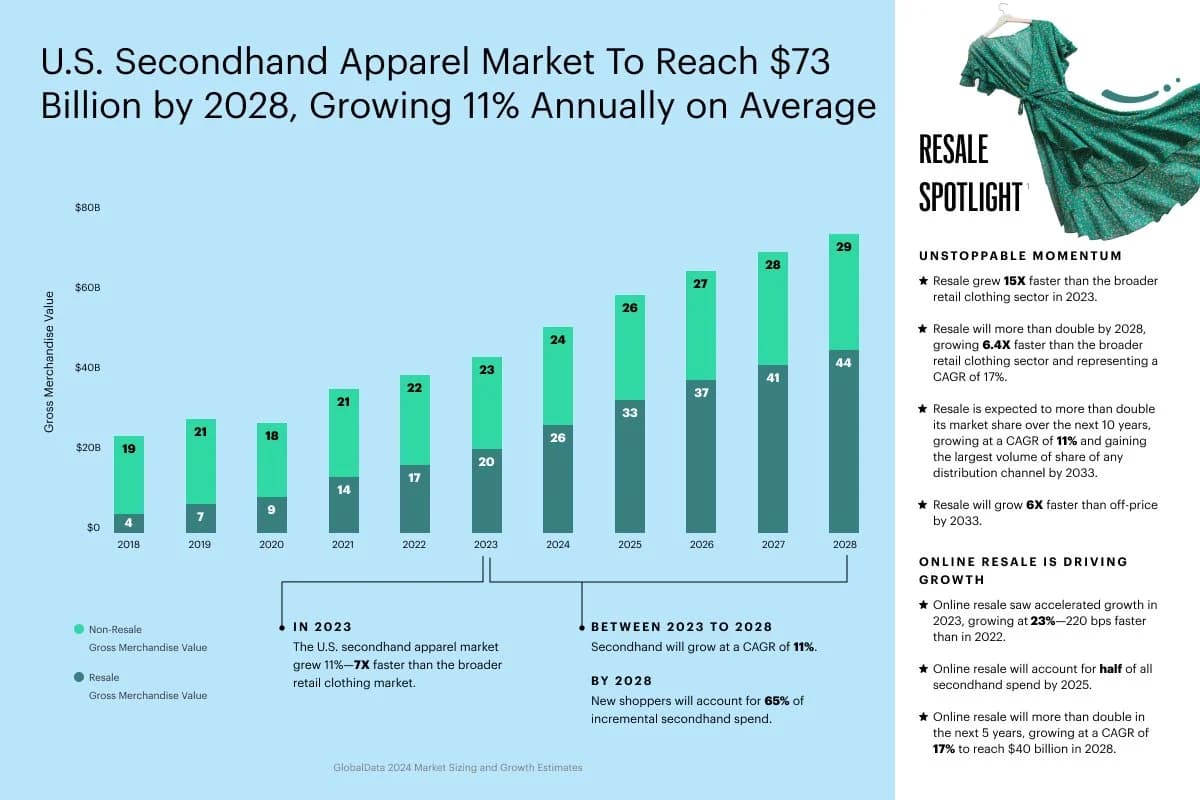
The conversation around fashion resale has shifted, decisively and structurally. ThredUp's 14th annual Resale Report, released April 2 and conducted by analytics firm GlobalData, projects that the global secondhand apparel market will reach $393 billion by 2030, representing roughly 10% of total global apparel spend. The most clarifying number in the report isn't the headline projection; it's the gap it reveals. In 2025, the global secondhand market grew 13% while new apparel sales went nearly flat. That's not a niche outperforming its category. That's a category realignment.
Between 2025 and 2030, the global secondhand market is expected to expand at a compound annual growth rate of about 9%, putting it on track to grow two times faster than the overall apparel market. In the U.S., the pace is even more striking. The U.S. secondhand apparel market grew 19% in 2025, its strongest annual growth since 2021, outpacing the broader retail clothing market by 3.6 times. The global secondhand market is projected to reach $393 billion by 2030, with U.S. resale set to hit $78.8 billion. Online resale alone, currently at $29.7 billion, is projected to nearly double to $48.3 billion by 2030, with U.S. online resale already tracking at $31 billion in 2026.
"Resale is no longer just growing, it's taking direct market share," said James Reinhart, ThredUp's co-founder and CEO. "The next phase of this market will be defined by who can best unlock supply and use AI to connect that inventory with the next generation of shoppers."

Gen Z and millennials are expected to drive more than 70% of market growth through 2030. ThredUp's survey found that 52% of Gen Z and millennials say they attempt to sell more than half of their wardrobes, treating their closets less like a collection and more like an inventory that turns. "We call them resale natives," Reinhart said. "They grew up shopping secondhand." Meanwhile, a majority of all consumers, 59%, shopped secondhand apparel in 2025, up seven points in just three years.
Discovery is moving off resale's own platforms, with nearly half of all activity now happening across social feeds, creators, and outside digital channels. For brands and platforms alike, that has a practical implication: if a piece isn't surfacing through creator content or a social scroll, it's invisible to the fastest-growing segment of the market.
AI is the other structural force reshaping the category. Among the 3,268 U.S. adults GlobalData surveyed in January and February, 81% of those who already use AI in their resale shopping said it improved their experience; 69% said they'd willingly use AI to monitor platforms for hard-to-find items; 59% said they'd use it to negotiate prices; and 39% said it would bolster their trust in the authenticity of products on peer-to-peer resale platforms.

That last figure matters most for the intentional buyer. Authentication remains the sharpest fault line in resale, separating platforms and brands that have built real circular infrastructure from those simply riding the moment's tailwind. Patagonia's Worn Wear program, launched more than a decade ago, is among those that turn a profit on their own, built on durability, repair, and a branded secondary market that reinforces rather than cannibalizes the original product. Big retailers and even luxury brands have launched resale programs, but the meaningful distinction is between companies that have embedded take-back and authenticated resale into their actual business model and those that have borrowed the language without building the plumbing.
The global secondhand market is no longer just a high-growth story; it's entering a more competitive, structurally complex phase. At a projected 9% annual growth rate sustained over five years while new apparel flatlines, Reinhart's suggestion that the market's trajectory may still be underestimated is not a small claim. It's the entire thesis.
This article was produced by Prism’s automated news system from verified source data, official records, and press releases, then run through automated quality and moderation checks before publishing. The system is built and supervised by the people who set the standards it runs under. Read our full AI policy.
Did this article answer your question?


