Seven Ways to Spot Real Sustainability Claims in Fashion Shopping
Most "eco" fashion labels are legally unenforceable words; here's exactly how to tell the difference between a real commitment and a marketing phrase.
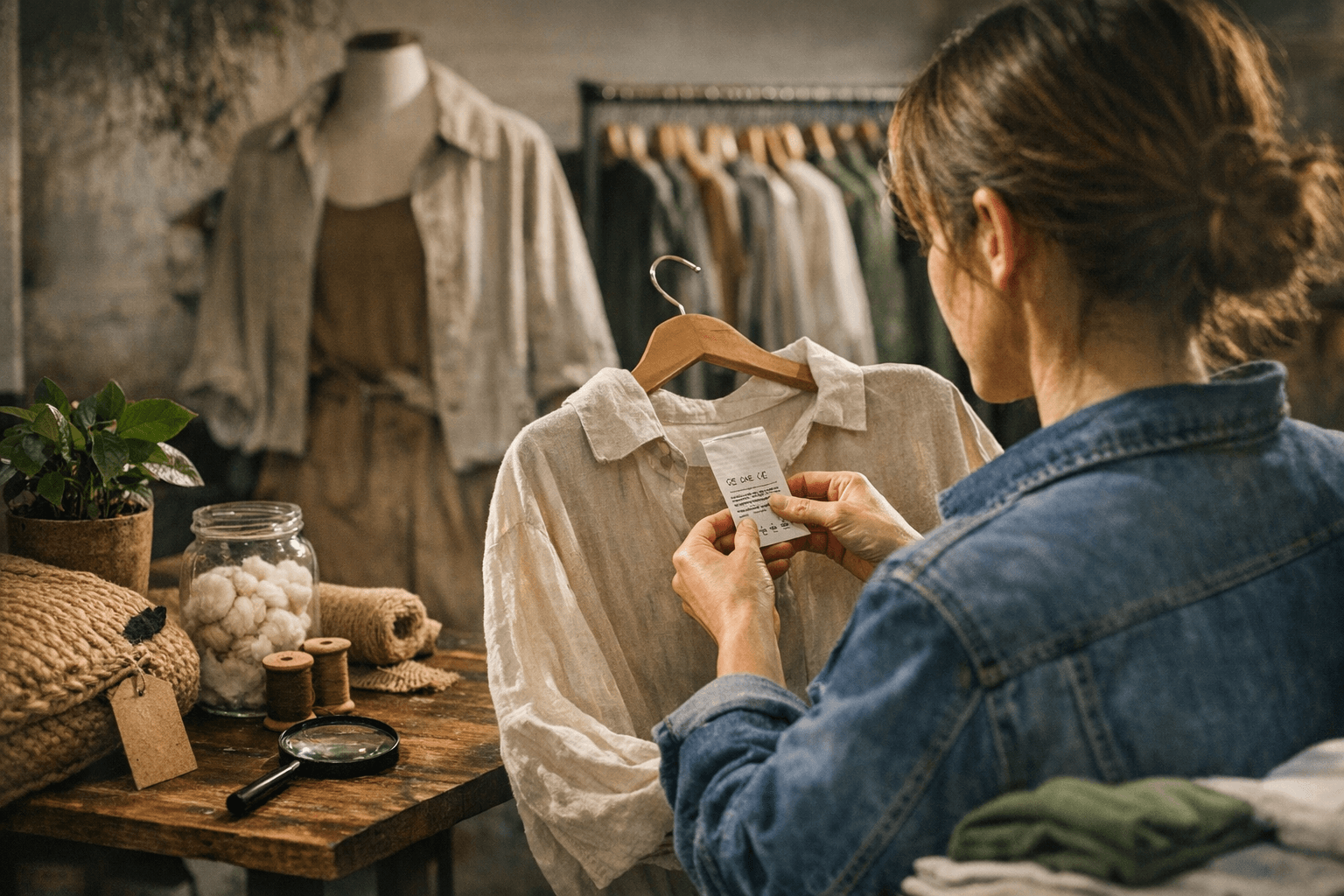
The conversation around sustainable fashion has shifted decisively, and so has the standard of proof. Brands can no longer rely on vague environmental language to win over savvy shoppers, and regulators are catching up fast. The UK's Competition and Markets Authority launched a formal investigation into ASOS, Boohoo, and George at Asda in 2023, secured undertakings from all three in 2024, and followed up by sending warning letters to 17 additional well-known fashion brands in September of that year. The CMA's new enforcement powers under the Digital Markets, Competition and Consumers Act allow it to impose fines of up to 10% of global turnover for greenwashing. Knowing how to read a label, a certification badge, or a brand's sustainability page is no longer just a niche concern; it's a practical consumer skill.
Look for Certifications You Can Actually Verify
Not all eco-labels are created equal, and the most important word in sustainability certification is "verifiable." The three heavyweights in textile certification are GOTS (Global Organic Textile Standard), which covers organic fibers alongside environmental and fair-labor criteria throughout the supply chain; OEKO-TEX, which certifies chemical safety in finished products; and GRS (Global Recycled Standard), which verifies recycled content and includes standards for traceability and ethical factory practices. Each serves a distinct function, and knowing that distinction matters: OEKO-TEX only covers chemical safety, not labor practices or farming methods. GRS only verifies recycled content, not the conditions under which garments are assembled. Legitimate GOTS and GRS labels will feature a license number or a named certifying body, such as Soil Association or Control Union. If a brand claims GRS compliance, you can request the Transaction Certificate directly; if they cannot produce one, the claim is not a certification, it is a marketing assertion. Cross-referencing a license number against the certification body's public database takes under two minutes and instantly distinguishes a live certificate from an expired or fraudulent one.
Demand Product-Level Data, Not Brand-Level Promises
Sustainability at the brand level is meaningless if it cannot be traced to the specific garment in your hand. Ask for fiber content breakdowns, not just "made with recycled materials," which could mean as little as a few percent of one component. Ask about end-of-life recommendations: does the brand offer a take-back scheme, a repair service, or a published guide for responsible disposal? Ask about repairability; a jacket with proprietary zippers and sealed seams is designed to become waste. Global fiber production hit a record 132 million tonnes in recent years, and the majority of that still ends up in landfill or incineration. A brand genuinely invested in circularity will have specific answers to specific questions. One that deflects to corporate mission statements almost certainly does not.
Prefer Brands That Publish Supplier Lists
Supply chain transparency is one of the clearest dividing lines between brands performing sustainability and brands practicing it. Publishing a full or partial supplier list requires real organizational discipline and carries reputational risk if conditions are poor; that accountability is precisely the point. GANNI, the Danish brand, publishes detailed supplier lists alongside its progress against climate targets and the methodologies behind those claims, not just buried in annual reports but in its active marketing communications. Patagonia and Eileen Fisher have embedded supply chain transparency goals into every department's KPIs rather than siloing them in a sustainability team. Looking ahead, the EU's Digital Product Passport regulation has identified apparel and textiles as a top-priority product group, with a delegated act planned for 2027. When DPP becomes mandatory for the EU market, each garment will carry a digital record tracking its lifecycle impact. Brands building toward DPP-equivalent disclosure now are ahead of the curve; brands with nothing to show are not.
Treat Vague Language as a Red Flag, Not a Feature
"Eco," "green," "conscious," "natural," "responsible": these words have no standardized legal definition in most markets and no enforceable threshold. The US Federal Trade Commission's Green Guides have long flagged environmentally vague terms as potentially deceptive under Section 5 of the FTC Act, yet the FTC recorded zero enforcement actions against green claims in recent years. The UK's CMA published specific guidance for fashion brands in September 2024, explicitly warning that unsubstantiated environmental claims violate consumer protection law. When a brand's sustainability section is dense with these words and thin on numbers, treat it as a signal rather than a selling point. The test is simple: can you replace the claim with a measurable figure? "Made sustainably" fails. "Made with 72% certified recycled nylon, independently verified by Bluesign" does not.
Check Whether Auditors Cover Social as Well as Environmental Risk
Third-party assurance is only as useful as its scope. Many brands commission audits that cover environmental metrics, such as carbon emissions or water use, while leaving labor conditions unexamined or verified only at Tier 1 suppliers closest to the brand. A garment's fiber is grown, spun, woven, dyed, cut, and sewn across multiple tiers, and the worst labor conditions tend to appear furthest from a brand's direct line of sight. When evaluating an audit or assurance statement, check whether it covers social risk (wages, working hours, forced labor protocols) alongside environmental risk, and whether it extends to Tier 2 and Tier 3 suppliers. The ASA issued more than 10 rulings against advertisements containing misleading green claims in 2025 alone, many of which involved claims presented as comprehensively audited that turned out to cover only a narrow slice of the supply chain.
Cross-Check Claims Against Regulatory and Press Investigations
A brand's own sustainability page is, by definition, curated. Regulatory rulings and investigative journalism are not. The CMA's publicly accessible record of enforcement actions and the ASA's rulings database are free to search and routinely reveal the gap between what brands say publicly and what regulators have found. Beyond official channels, press investigations from outlets covering fashion accountability have broken stories on brands with certified collections that turned out to represent a fraction of total output, or "progress" targets quietly rolled back from one annual report to the next. Before taking a brand's sustainability credentials at face value, a ten-minute search of its name alongside terms like "greenwashing," "ruling," or "CMA" will surface whether it has faced scrutiny and, critically, how it responded.
Demand Timelines With Measurable KPIs
The final and most rigorous test of a real sustainability commitment is whether it comes attached to specific numbers and a specific year. A brand announcing it will "transition to responsible materials" by an unspecified future date has made no commitment at all. By contrast, a Fashion Revolution analysis found that H&M, Patagonia, ASICS, and Marks & Spencer are among the only four major brands keeping emissions-reduction targets aligned with UN goals: a verified 55% reduction by 2030 against a 2018 baseline. H&M separately reported that in 2024, 36% of electricity sourced across its Tier 1 to Tier 3 supply chain came from renewable sources. These are figures that can be tracked, challenged, and verified year on year. Living-wage programs with audited remediation plans, recycled content targets expressed as a percentage by a named year, renewable energy commitments tied to specific supply chain tiers: these are the architecture of genuine accountability. Anything less is ambition on paper.
The fashion industry is not short of sustainability language; it is short of sustainability evidence. The seven checks above are not cynicism toward brands doing real work; they are the minimum standard for telling that work apart from the noise. As regulatory pressure tightens across the UK, EU, and eventually the US, brands with verifiable systems already in place will have a clear advantage. The ones leaning hardest on adjectives should be watched most closely.
This article was produced by Prism’s automated news system from verified source data, official records, and press releases, then run through automated quality and moderation checks before publishing. The system is built and supervised by the people who set the standards it runs under. Read our full AI policy.
Did this article answer your question?


