Shanghai Fashion Week FW26 Proves the City Is a Global Creative Hub
Maison Margiela staged its first-ever show outside Paris to close Shanghai Fashion Week FW26, as Chinese designers raised the stakes on material specificity.

When Maison Margiela sent its invitations for Shanghai Fashion Week, each envelope contained a can of white paint. The gesture was pure Margiela logic: a brand code dating to 1988, deployed in a city the house had never shown in before. On April 1, Glenn Martens made his directorial debut outside Paris at a working shipyard on the city's outskirts, where cargo containers stacked with the Temu logo formed the unlikely backdrop for a collection that included a beeswax-treated Edwardian gown and FW26's most talked-about runway moment. It was a closing act that Shanghai, running its fall 2026 edition under the theme "Ascending Through Design," had clearly earned.
The week, which ran March 25 to April 1 across seven of Shanghai's districts, confirmed what buyers and press have been circling for several seasons: this is no longer a regional showcase. It is a genuinely competitive creative platform. But as the city cements that status, a quieter question is gaining urgency along the front rows: which designers are backing their aesthetic claims with material transparency, and which are hiding behind mood-board language?
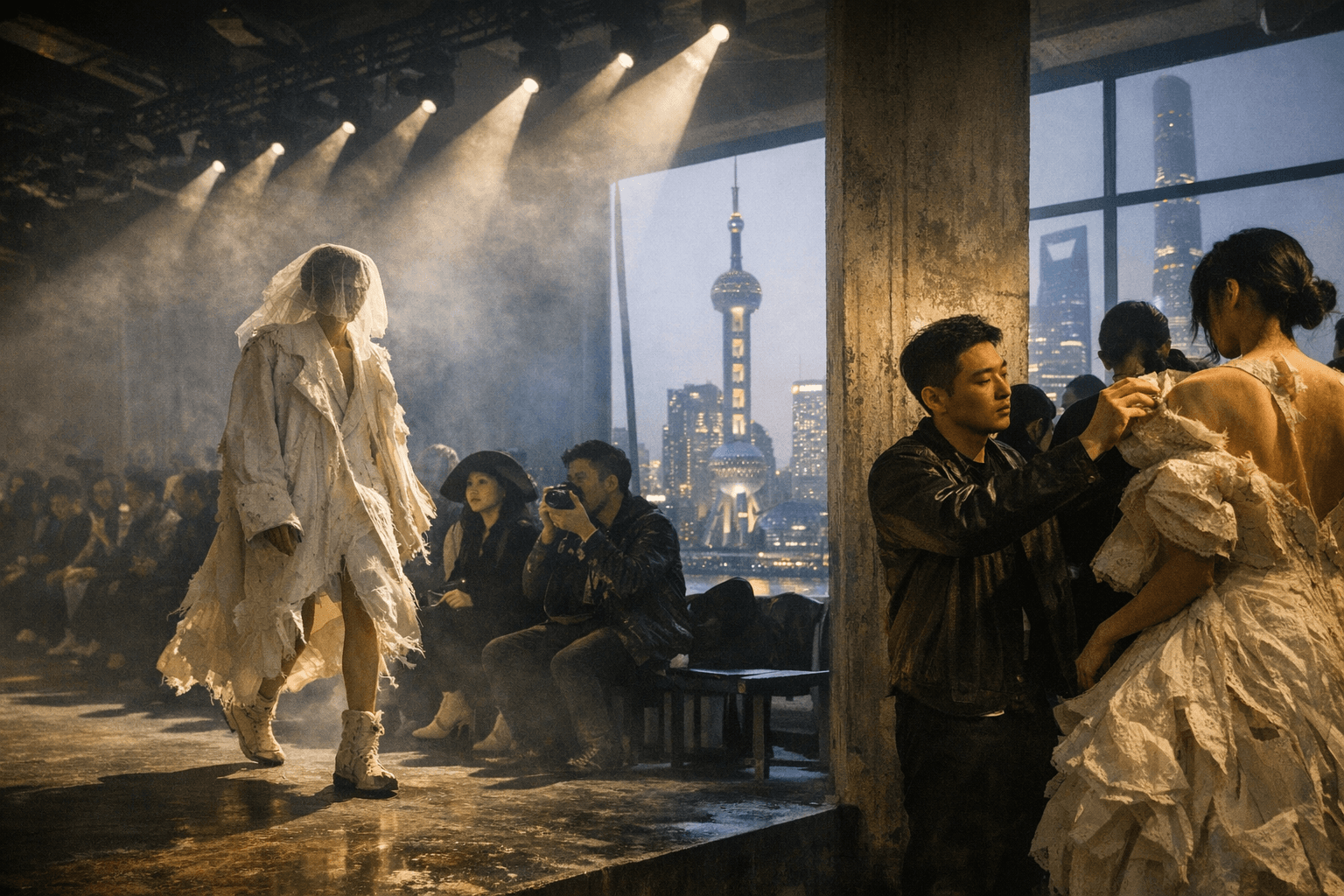
Samuel Gui Yang offered one of the cleaner answers. His FW26 collection moved the "New Chinese style" narrative forward with a declared mix of handmade paper, silk, and linen, materials that carry provenance rather than just poetry. It is the kind of specificity that is beginning to matter to international stockists, who are increasingly distinguishing between designers who name their fibers and those who simply name their feelings.
Maison Margiela's Artisanal line, now on display in Shanghai through April 6 as part of the "Artisanal: Our Creative Laboratory" exhibition, takes the argument further. The line is built on the meticulous reworking of found materials, and the 58 couture looks on show span from the house's inaugural Artisanal piece, the Autumn/Winter 1989 porcelain plate waistcoat, to pieces fresh off the FW26 runway. Upcycling, deconstruction, and raw material transformation are not marketing copy here; they are literally the exhibition's organizing sections.
Susan Fang took a different route to credibility. Her FW26 collection leaned into precision 3D printing alongside hand-stitched beads, and she extended the work commercially through a "Peach Blossom" series with Melissa, featuring sculptural petals and gradient transparency, and an "Infinity in Bloom" collection with CASETiFY. Fang has been candid about the business logic: collaborations fund experimentation while expanding reach to global buyers without a marketing budget to match the ambition.
Feng Chen Wang's 10th anniversary show, titled "Two as One," was the week's most emotionally loaded presentation. Models walked in pairs in mirrored looks, a visual nod to the genderless DNA that has defined the label since Wang's time at the Royal College of Art, and the show officially launched the brand's first complete womenswear line. Wang also staged an additional runway presentation at the Apple Store in Jing'an and was named Visionary of the Year at the inaugural New Wave Fashion Awards in Shanghai.
The group WWD has termed "the Shanghai Four," comprising Shushu/Tong, Oude Waag, Samuel Gui Yang, and Mark Gong, remained the major draw for international attention, with the majority adapting their product mix and price points to current market realities. Several collections showed unmistakable Matthieu Blazy-at-Chanel influence: crisp shirts, dropped-waist skirts, transparent bags. The references were sharp enough to suggest these designers are not just watching Paris; they are responding to it in real time.
What Shanghai FW26 revealed is that the city's creative momentum is no longer the story. The more pressing narrative now belongs to the designers who can pair that momentum with material honesty. That is where the next round of serious retailer conversations will begin.
This article was produced by Prism’s automated news system from verified source data, official records, and press releases, then run through automated quality and moderation checks before publishing. The system is built and supervised by the people who set the standards it runs under. Read our full AI policy.
Did this article answer your question?


