U.S. Hemp Fiber Finds a Scalable Path Through Vietnam's Textile Network
Montana's IND HEMP inked a deal to send U.S.-grown hemp fiber through Vietnam's spinning and weaving network, giving brands a traceable alternative to Chinese supply chains.

The agreement was quiet by industry-event standards: a memorandum of understanding signed among three partners, announced at the tail end of the Functional Fabric Fair in Portland. But the implications for brands hunting credible natural-fiber supply chains are anything but small.
Montana-based IND HEMP formalized the partnership with Summit International Trading and Vietnam's Thien Phuoc Ramie Group, creating what amounts to the first structured U.S.-to-Vietnam pipeline for decorticated hemp fiber. The timing was deliberate. Vietnam recently revised its import policies to permit hemp fiber, and the Functional Fabric Fair, which ran April 7 through 9 in Portland, gave the trio a platform to show the resulting yarns and fabrics to an audience already primed to care about supply-chain provenance.
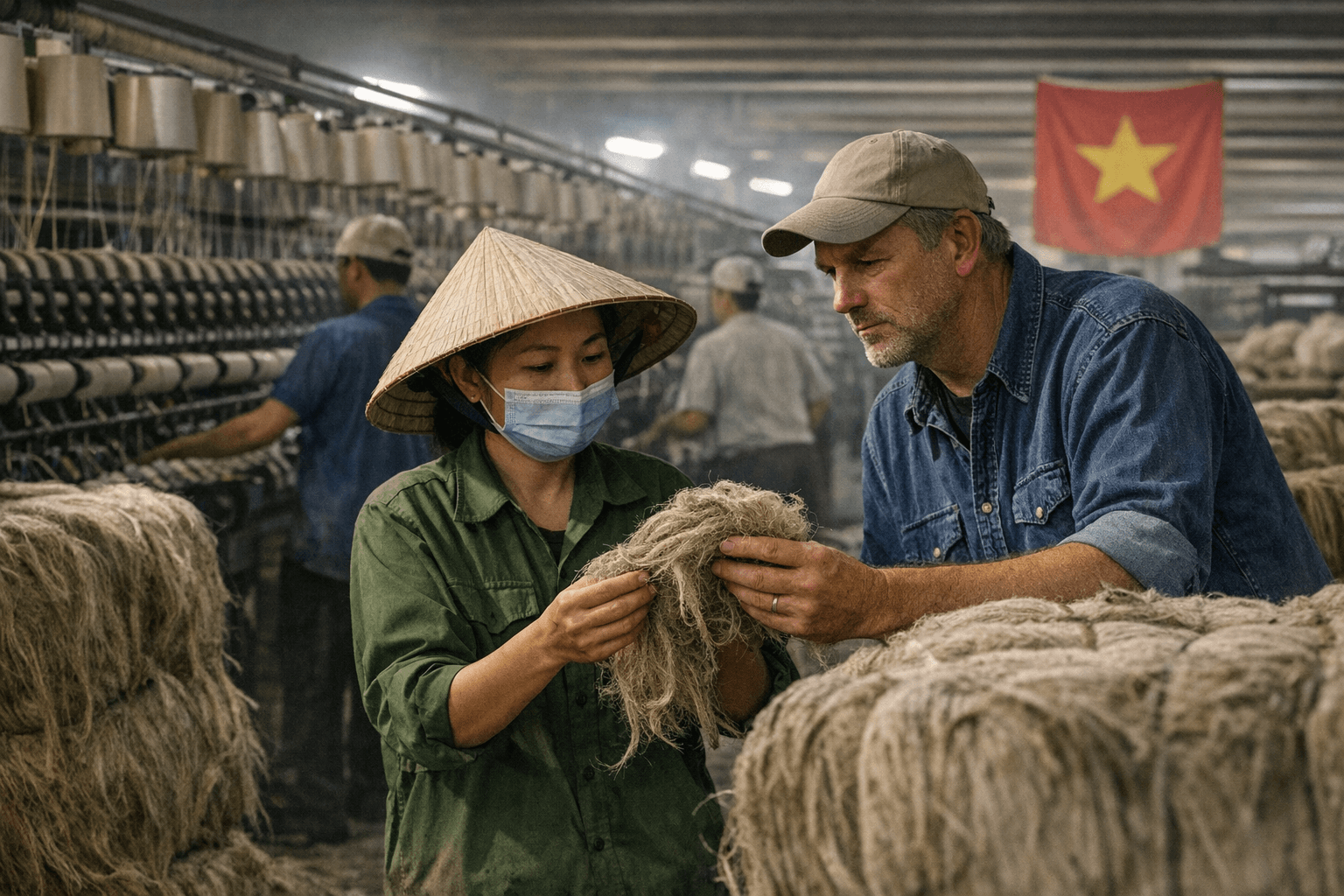
The structure of the deal breaks cleanly along each partner's strengths. IND HEMP provides the processed fiber, grown and decorticated in the United States. Summit International Trading manages logistics and coordinates the cross-Pacific movement. Thien Phuoc Ramie Group handles the technically demanding downstream work: degumming, spinning, and textile production. What the three companies have built, in effect, is a vertically legible chain from American farm to finished fabric, with Vietnam's deep manufacturing infrastructure doing the heavy lifting in between.
That infrastructure is no small asset. Vietnam became the largest textile exporter to the United States in 2025, a position built on decades of investment in spinning capacity, weaving operations, and garment manufacturing. Routing hemp fiber through that network means brands don't have to choose between scale and story. They can have the production volume Vietnam's mills can deliver and the traceability that sustainability-conscious consumers and procurement teams increasingly demand.
The tariff calculus matters here, too. Vietnam carries significantly lower tariff exposure than China for U.S. importers, which makes the economics of a hemp supply chain through Hanoi or Ho Chi Minh City more attractive than one routed through Chinese processors, even before factoring in the reputational and transparency benefits. For brands that have made public commitments around supply-chain accountability, those benefits are no longer soft metrics; they are due-diligence requirements.
Hemp fiber has long circled the edges of the sustainable-textiles conversation without ever quite landing a scalable manufacturing solution. The plant requires no pesticides, consumes relatively little water, and produces a fiber that can be spun into everything from crisp, linen-like suiting fabric to softer jersey blends, depending on how it's processed. The missing piece has consistently been infrastructure: reliable sourcing, consistent processing, and a manufacturing partner capable of producing at the volumes fashion brands actually need.
The IND HEMP-Summit-Thien Phuoc agreement doesn't solve every gap in that chain, but it closes the most critical one. American-grown hemp now has a documented, operational route to some of the world's most capable textile mills. For any brand currently writing sustainability commitments around natural fibers, that route just became worth a serious look.
This article was produced by Prism’s automated news system from verified source data, official records, and press releases, then run through automated quality and moderation checks before publishing. The system is built and supervised by the people who set the standards it runs under. Read our full AI policy.
Did this article answer your question?


