Beyond the Party: The Rise of Quiet Luxury on the Island of the Winds
Mykonos is quietly reinventing itself for travelers who prefer a private villa and a ferry to Delos over a table at a beach club.
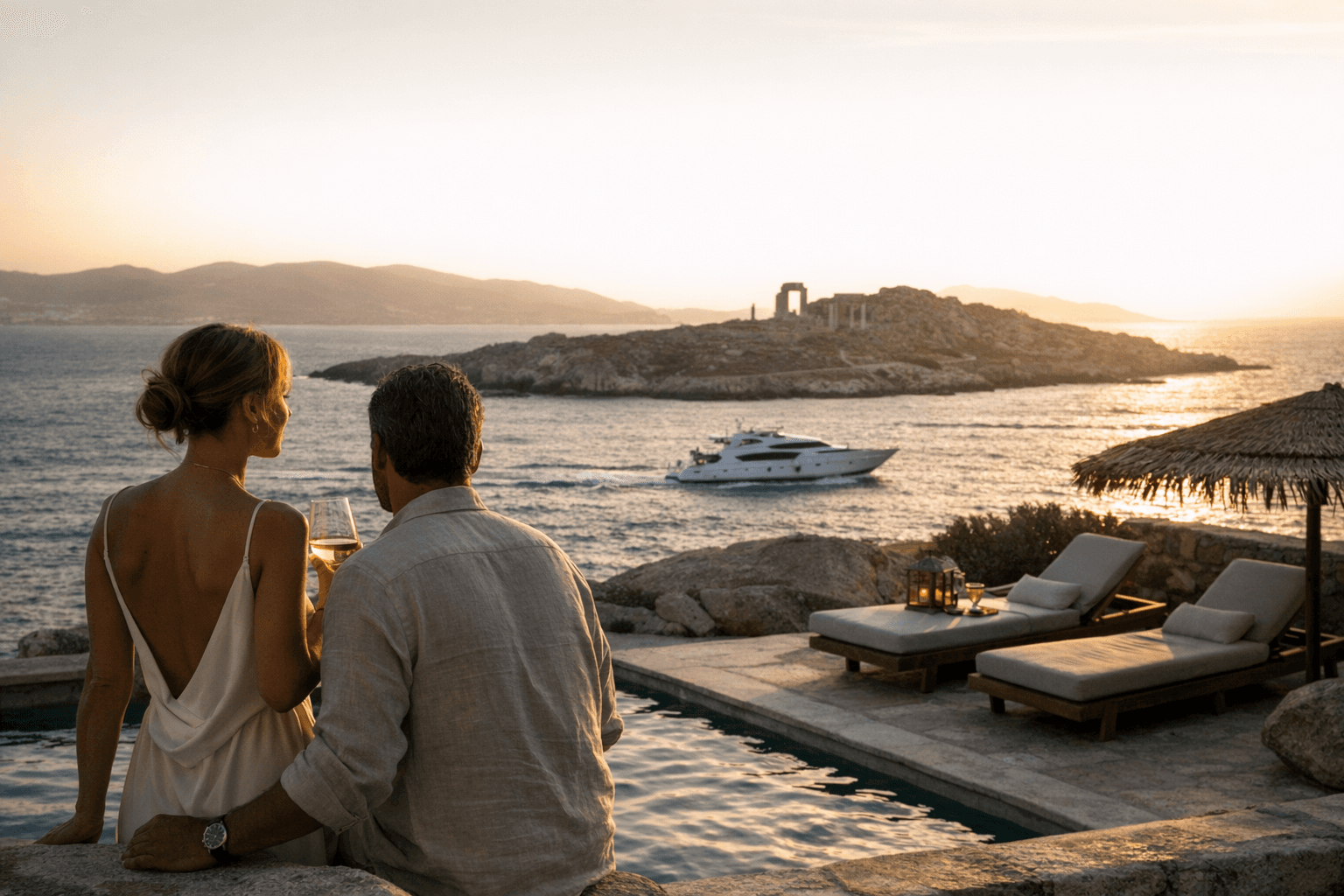
Mykonos has always known how to make an entrance. For decades, its reputation arrived ahead of it: the thumping beach clubs, the celebrity sightings, the magnum bottles lifted above the crowd at sunset. But something is shifting beneath the whitewashed surface of the Aegean's most famous island. A quieter, more deliberate kind of traveler has started arriving, and they are changing what Mykonos looks like from the inside out.
This is not a story about austerity. High-net-worth visitors are spending just as freely here as they ever did. The difference is what they are spending on: privacy over performance, craftsmanship over spectacle, experiences with depth rather than volume. It is, in the language of the moment, quiet luxury travel, and Mykonos, the so-called Island of the Winds, is becoming one of its most compelling destinations.
What Quiet Luxury Travel Actually Means
Strip away the buzzword and the concept is straightforward: deliberate spending. Where the old Mykonos playbook called for visibility, the new one calls for discretion. Boutique hotels rather than sprawling resort complexes. Bespoke dining arranged around a single long table on a terrace, not a reservation at the loudest table in the room. Off-peak arrivals timed to the light and the quiet rather than to the social calendar.
This mirrors, almost precisely, the logic of the quiet luxury wardrobe that has reshaped fashion over the past several years: calm neutrals, exceptional craft, and pieces built to outlast their season. The same consumer who reaches for undyed linen and heritage leather is now booking a Cycladic stone villa rather than a hotel suite with a branded infinity pool. The aesthetic and the travel behavior are expressions of the same underlying value system.
Where to Stay: Villas and Boutique Hotels
The accommodation choice is the first and most telling signal of which Mykonos you have come for. Private villas have become the preferred base for this new wave of visitors, offering the kind of absolute seclusion that no hotel, however well-staffed, can replicate. Waking to an unobstructed view of the Aegean from a terrace that belongs only to you, preparing a meal in a kitchen stocked by someone who knows the island's producers, moving through your days without a lobby or a check-in desk: this is the proposition, and demand from villa operators and hosts has grown measurably.
For those who prefer staffed hospitality, boutique properties built in the Cycladic idiom offer the closest alternative. Kalesma Mykonos sits on a hill above Ornos Bay, its 46 rooms and suites arranged like sugar-cube volumes along a winding path through prickly pears and palms. The palette is earthy and subdued, the sea views panoramic. Cavo Tagoo, positioned on the rocks above Mykonos Town, has long attracted guests who value privacy above the social scene, with ocean-facing villas, plunge pools, and a spa that earns its keep. Neither property is cheap, but neither is competing on price. They are competing on the quality of the silence.
Beyond the Chora: Ano Mera and the Inland Island
The Mykonos that most visitors experience is essentially the coastline: the beaches, the port, the labyrinthine lanes of Chora with their boutiques and bar terraces. Move inland, and you find Ano Mera, the island's only proper village, and the one that has remained largely unchanged by the tourism economy that transformed everything around it.
Ano Mera sits at the center of the island, a short drive from the noise and the crowds, and it operates at a completely different register. The focal point is the Panagia Tourliani monastery, its ornately decorated interior a reminder that Mykonos had a long life before the DJs arrived. Local tavernas serve food cooked from ingredients grown nearby. The streets are genuinely quiet. For a traveler whose entire approach to the island is built around resisting the obvious, Ano Mera is not a detour. It is the point.
Delos: The Sacred Island Next Door
Twenty minutes by ferry from the port of Mykonos lies one of the most significant archaeological sites in the Aegean. Delos is tiny, just five kilometers long and barely more than one kilometer wide, and it has been uninhabited since the seventh century BC. What remains is a UNESCO World Heritage Site, inscribed in 1990, and a remarkably intact record of a city that was once one of the most important trading centers in the ancient Mediterranean.
Delos was settled as early as 3000 BC. By its peak, it had grown into a thriving commercial hub built around a sanctuary dedicated to Apollo and Artemis, a site of pan-Hellenic religious significance that drew pilgrims, merchants, and diplomats from across the Greek world. The integrity of what survives, temples, colonnades, the famous Terrace of the Lions, is extraordinary precisely because no one has lived there to disrupt it. Restoration has been approached with archaeological restraint rather than spectacle.
A day trip to Delos is, in practical terms, one of the most concentrated cultural experiences available anywhere in the Cyclades. It is also, by the standards of what visitors typically spend in Mykonos, almost absurdly affordable. The contrast is part of its appeal to the quiet luxury traveler: an entire ancient world, available for the price of a ferry ticket.
Timing: The Case for Shoulder Season
Peak season on Mykonos runs through July and August, and it delivers everything the island's party reputation promises: full hotels, packed beaches, premium prices at every point of the food and accommodation chain, and the Meltemi, the strong, dry wind that blows from the north and northeast across the Aegean each summer. The Meltemi can gust above 40 knots and sustain for three to five consecutive days, a detail that surprises many first-time visitors who arrive in high summer expecting only warmth and still water.
The shoulder seasons, May through June and September through October, change the calculation entirely. Prices ease, the beaches return to a manageable scale, and the island's natural character reasserts itself. The light in May is clear and sharp, the water already warm enough to swim. By late September, the summer visitors have largely departed, the sea retains its heat, and the countryside begins to turn. Villa operators and luxury travel specialists consistently point to early June and mid-to-late September as the two windows that offer the best balance of weather, access, and the specific quality of calm that the quiet luxury traveler is actually seeking.
A New Register for a Familiar Island
The fashion industry's old money aesthetic found its footing by insisting on a different relationship with visibility: less logo, more construction; less trend, more longevity. The traveler it has cultivated is now asking the same questions of a destination that it asks of a coat. Not "will this be seen?" but "will this hold up?" Not "is this the place to be?" but "is this the right place for me?"
Mykonos, it turns out, has always had the raw material to answer both versions of that question. The party island is still there for those who want it. But for those who arrive in May with a villa booking and a ferry ticket to Delos already in hand, the Island of the Winds is offering something it rarely advertised before: the particular luxury of being left alone.
Know something we missed? Have a correction or additional information?
Submit a Tip