Creative Director Changes Drive Measurable Shifts in Luxury Resale Markets
When a luxury house changes creative directors, the resale market moves fast. Here's how those announcements translate into real price and demand shifts.
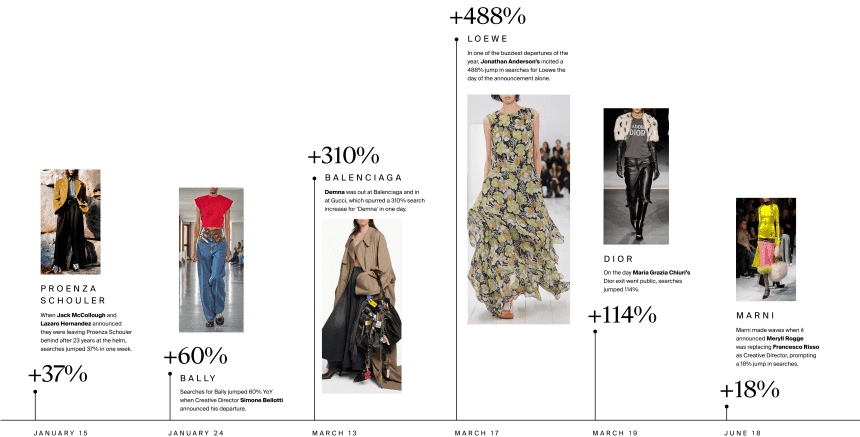
There is a particular kind of energy that ripples through the fashion industry the moment a major creative director appointment is announced. Editors refresh their feeds, stylists recalibrate their mood boards, and somewhere in the background, a quieter but equally urgent recalibration begins: the luxury resale market starts to move.
The relationship between creative leadership and resale value is not new, but it has become increasingly measurable. Recent analysis combining platform data with expert commentary confirms what savvy resale buyers have long suspected: the moment a house announces a creative director hire, exit, or debut collection, search volumes spike, demand shifts, and prices adjust, often within hours. These are not gradual, organic movements. They are responsive, data-driven fluctuations tied directly to the perception of a brand's creative future.
Why Creative Direction Moves the Resale Needle
To understand why a single announcement can reshape a secondary market, you have to understand what luxury consumers are actually buying. At this price point, a bag or coat is never purely functional. It is a coded object, and its meaning is inseparable from the vision behind it. When that vision changes, so does the object's cultural weight.
A creative director represents a house's aesthetic identity, its references, its relationship to culture. When that identity is in flux, buyers on the resale market respond in two distinct directions. Some move to secure pieces from the outgoing director's tenure before prices climb, betting on the scarcity and nostalgia that tend to follow a creative departure. Others watch and wait, curious whether the incoming director will elevate or destabilize the house's desirability. Both responses generate measurable market activity.
The Anatomy of a Resale Surge
The short-term effects of a creative director announcement are perhaps the most dramatic. Search volume on major resale platforms tends to spike immediately following news of a hire or departure, as consumers type in the house's name alongside the director's to understand what they own, what it might be worth, and what is about to become rare.
This search behavior translates quickly into pricing pressure. Sellers who understand the moment adjust their listings upward. Buyers who are paying attention compete for pieces that suddenly feel more finite. The mid-term picture is more nuanced: it depends heavily on whether the incoming director's debut is received as a continuation of the house's DNA or a rupture from it. A debut collection that reads as a confident evolution tends to sustain or increase resale values across the board. A debut that alienates the existing customer base can depress prices for current-era pieces while accelerating demand for archive.
The Exit Effect
Departures carry their own particular gravity. When a beloved creative director leaves, their body of work at a house immediately acquires the status of a closed archive. Pieces that were simply "current season" the week before become potential collectibles the week after. This is the exit effect, and it plays out with surprising consistency across houses of different sizes and price points.
The dynamic is especially pronounced when the departing director has a strong personal aesthetic that defined the house for a significant period. Buyers understand, correctly, that what comes next will be different. The question is whether different means more or less desirable, and while that answer is still unknown, the safer bet, emotionally and financially, often feels like owning a piece of what was.

The Debut as Market Signal
If the announcement is the spark, the debut collection is the sustained flame or the cold water. A new creative director's first collection functions as a market signal of unusual clarity. It tells resale buyers whether the house's existing archive will be celebrated, subverted, or set aside entirely, and the secondary market prices that information almost immediately.
A debut that generates strong critical and commercial response tends to create a halo effect across a house's resale catalog. Buyers who missed the collection retail will turn to the secondary market; sellers will raise prices accordingly. A debut that lands with confusion or skepticism tends to produce the opposite: a retreat toward older, more legible eras of the house's history, with archive pieces from a previous director's golden period absorbing the demand that might otherwise have gone to current season.
What This Means for How You Shop and Sell
For anyone engaging with the luxury resale market, whether as a buyer building a considered wardrobe or a seller managing a collection's value, the practical implications are significant.
- Announcements are market events. The moment a major creative director change is confirmed, the window for pre-surge purchasing or strategic listing opens immediately.
- Debut collections set a trajectory. The reception of a first collection is worth watching closely, not just as fashion news but as a pricing indicator for the months that follow.
- Archive values are not static. They respond to present-day creative leadership, rising when current seasons disappoint and sometimes cooling when a new director successfully redefines what the house means.
- Research the tenure. Pieces from a director's most critically praised period tend to hold value with greater resilience than transition-era work.
The Broader Picture
What the data ultimately confirms is that luxury fashion and the secondary market for it are no longer separate ecosystems. They are deeply entangled, with cultural signals from the primary market translating into financial movement on resale platforms with increasing speed and precision. Creative direction is brand identity, and brand identity is price.
For the fashion-aware consumer who shops intentionally, this is useful intelligence. The old assumption that resale value was determined primarily by condition, provenance, and rarity has not disappeared, but it has been joined by something more volatile and more interesting: the ongoing story of who is making a house's creative decisions and what that means for everything the house has ever made. In that sense, every appointment announcement is not just fashion news. It is a market event with a price tag attached.
Know something we missed? Have a correction or additional information?
Submit a Tip