How to Choose One Cashmere Sweater That Lasts a Lifetime
Not all cashmere is created equal — the difference between a sweater that pills in a season and one you'll wear for decades comes down to 13.5 microns, two ply, and knowing exactly which brands won't cut corners.

There is a version of this purchase that ends in disappointment: the sweater that feels impossibly soft in the store, pills by February, and bags at the elbows before spring. Then there is the other version, the one that costs more up front, gets softer every year, and becomes the piece you reach for first. The difference is not about brand name recognition. It is about fiber science, construction standards, and knowing how to read a label before you hand over your card.
The fiber is everything: understanding microns and grade
Cashmere comes exclusively from the soft undercoat of Capra hircus goats, raised on the high-altitude plateaus of Mongolia, Inner Mongolia, and parts of Kashmir and Nepal. Unlike sheep's wool, cashmere fibers grow only once a year during winter and are combed, not sheared, by hand in spring. Each goat yields just 150 to 200 grams of usable underdown annually. That scarcity is not a marketing story; it is the structural reason why real cashmere commands real money.
The single most important number on any cashmere tag is the micron count: the diameter of each fiber. Premium cashmere at 14 to 15.5 microns feels almost impossibly soft, like touching a cloud. Standard cashmere at 17 to 19 microns feels nice but noticeably less luxurious. For investment-grade knitwear, Grade A is the target. Grade A is the most expensive of all cashmere because it is the thinnest, longest, and most durable. The diameter sits at 14 microns, with a fiber length of around 36mm. Its value lies in fiber strength despite thinness: the garment is more durable and consequently has more longevity.
Then there is Loro Piana's baby cashmere, which sits at an entirely different level. This ultra-fine fiber is obtained solely from the douvet of cashmere goat kids. Cashmere comes from adult Capra Hircus goats, while baby cashmere can only be gathered when the kids are less than a year old. The result is just 30 grams of exceptionally fine, soft fiber, measuring only 13.5 microns in diameter. Baby cashmere was the brainchild of Pier Luigi Loro Piana. While visiting Chinese goat herders, he came across the fiber from Capra Hircus goat kids and immediately recognized how fine it was, describing it as "like touching baby hair." It took him ten years to convince a select number of herders to separate the fiber from the kids from that of the adults, given the tiny quantities involved.
Loro Piana is the largest global manufacturer of cashmere, focusing exclusively on high-end products. Their cashmere averages 14.5 microns from adult goats and 13 to 13.5 microns from baby cashmere. Their fibers are sourced exclusively from China and Mongolia and woven in Italian mills. The Pablo Sweater and Varallo Crewneck in baby cashmere currently sit at $2,190, with the Treccia Sweater at $2,560. These are not impulse purchases; they are decade-long commitments priced accordingly.
Why Brunello Cucinelli belongs in the same conversation
If Loro Piana owns the top of the fiber hierarchy, Brunello Cucinelli commands the craftsmanship argument with equal authority. Cashmere launched Brunello Cucinelli's career in 1978 and continues to be at the heart and soul of his label's timeless collections. From raw materials selection, only the softest cashmere is sourced directly from nomadic goatherds in Mongolia, processed through the highest level of Italian manual skill.
Cardigans and sweaters are central to the brand's offering, with designs crafted by artisans in the medieval hamlet of Solomeo, Italy. Brunello Cucinelli is a luxury brand that caters to those who understand that true luxury is not about having the most famous brand or following fleeting trends, but about owning pieces that offer longevity. The founding designer himself said as much: in an interview with Fashionista, Cucinelli explained he didn't want to make anything that would go to waste: "If you come to my home, on the ground floor, I keep all the different garments that I've been wearing since I was 16, 17. I prefer to repair, to preserve." He also shared that everything produced in the brand's factory must be "extremely top-notch quality."
Underpinned by 'Made in Italy' excellence, Brunello Cucinelli knitwear spotlights the brand's artisanal craftsmanship techniques and cashmere-dyeing heritage. Silhouettes span turtleneck, V-neck, and crewneck styles, with sweaters woven with subtle embellishments, including sequins and metallic thread. Cable-knit cardigans sit alongside zip-up styles in a palette of neutral hues. Entry-level Brunello Cucinelli cashmere sweaters begin around $1,200 to $1,500 at retail, with more elaborate pieces reaching well beyond $3,000, positioning the brand as the more accessible of the two without any compromise in fiber sourcing.
Construction signals that separate keepers from casualties
The fiber grade means nothing if the construction is weak. High quality cashmere will always be 2-ply, made with two pieces of cashmere yarn so that you cannot see through the wool, with even, closely-spaced, flat stitching on the seams. As a rule, only purchase items that are 2-ply cashmere or higher. One-ply cashmere is not as durable and has a greater likelihood of developing holes.
Gauge matters, too. The greater the gauge, the more cashmere yarn was used to make the item and the tighter the knit will be. A 12-gauge sweater has 12 rows or stitches per 1 inch of cashmere; the fabric will feel dense to the touch. For a sweater meant to last decades, a higher gauge is an asset, not just a tactile preference.
Any brand that stipulates the ply count, the micron width, staple length, or the country of origin is sharing more than the average retailer. That transparency is itself a quality signal. If a brand cannot tell you what grade fiber is in the sweater you are about to spend four figures on, walk away.
The tests you run before you buy
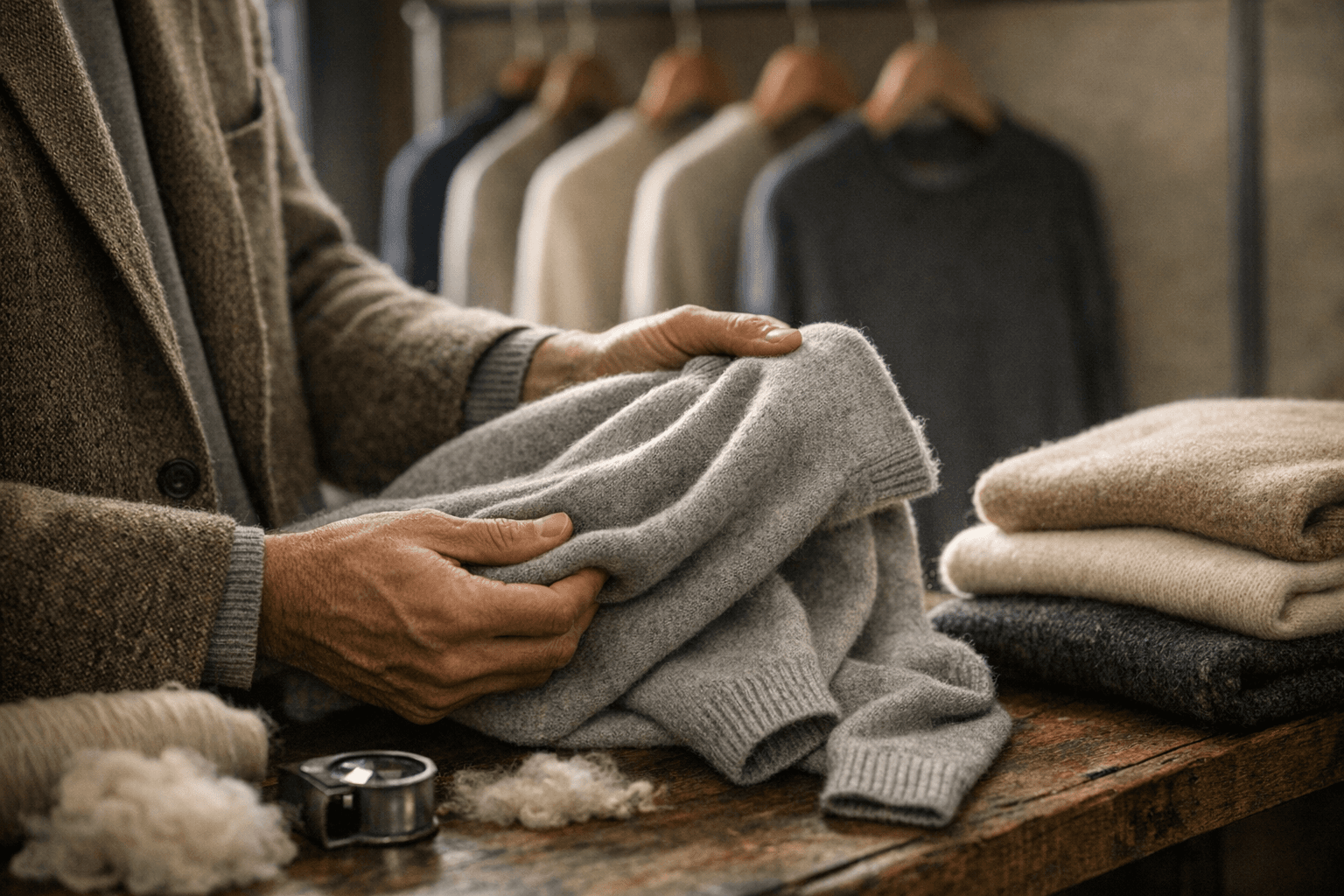
Three quick physical checks will tell you more than most tags.
- The stretch test: Gently stretch the item, then let go. Watch how quickly it springs back to its original shape. High quality cashmere will return to normal; lower grades will either stay stretched out or take far longer to revert.
- The light test: Hold the sweater up to light. If you can see through it easily, that indicates low GSM (grams per square meter). True luxury cashmere has weight and substance.
- The touch test: Genuine cashmere should feel instantly soft but not slippery or greasy. If it feels unnaturally slick, it has likely been treated with silicone or synthetic softeners that degrade fiber integrity over time.
Also check the pill behavior immediately. If any fibers come loose and ball up in your hand when you run a hand along the surface, the cashmere was likely made from shorter hair. High quality cashmere sweaters are made of long, thin strands. All cashmere will shed fibers over time, but if the fibers pill right off the shelf, the cashmere is low quality.
What to avoid, categorically
Red flags to watch for: "cashmere blend" labels, which usually mean very little actual cashmere mixed with cheaper fibers; no fiber specifications; "cashmere-like" or "cashmere feel" language, which signals it is not actual cashmere; a scratchy texture, since real cashmere should never feel scratchy; and no country of origin, since reputable producers specify where their cashmere is from.
Before buying any cashmere, be wary of anything that is not 100% cashmere. Many companies produce "cashmere blends," mixing cashmere fibers with cheaper, lower quality wools or even nylon. These blends lack all of the unique qualities that cashmere is known for. The UK's Competition and Markets Authority flagged this exact problem at scale: in 2023, it tested 42 "cashmere" garments sold by major retailers and found that 62% failed fiber-content labeling requirements. At the price points where investment cashmere lives, that deception is unacceptable.
Care: the final multiplier on your investment
High quality cashmere gets softer with age without pilling, but only if you treat it correctly. Loro Piana's own care guidance is precise: never wear the product two days in a row, so the fibers can regain their natural structure; check the label for washing and ironing instructions; use a professional cleaning service for pieces with delicate details; fold carefully and store with cedar balls or moth repellent in a dry place away from heat and light sources. Brunello Cucinelli follows the same logic at Solomeo: hand wash only, dry flat, never tumble dry, iron at the lowest possible temperature.
The old-money approach to a cashmere sweater has never been about wearing the most expensive thing in the room. It is about wearing something so well-made that people cannot tell when you bought it, because the answer could just as easily be last season or fifteen years ago.
Know something we missed? Have a correction or additional information?
Submit a Tip