Luxury's Quiet Brain Drain, As Top Talent Exits Stagnant Fashion Houses
Cultural erosion is accelerating luxury's quiet brain drain, as the gap between external aspiration and internal reality becomes a growing strategic liability for major houses.
Cultural erosion is accelerating luxury's quiet brain drain, and the gap between external aspiration and internal reality has become a growing strategic liability. That's the signal worth sitting with. Not another round of creative director musical chairs, not a slick campaign refresh, but something quieter and more corrosive: the senior talent, the institutional memory, the people who actually know how a house thinks, are walking out the door.
Jing Daily's analysis by Carlota Rodben, published March 13, 2026, names this moment plainly. The luxury sector, the piece argues, has fallen into a pattern of cultural erosion, operational sameness, and strategic conservatism that is pushing its most valuable human assets elsewhere. This isn't a headline about a single departure. It's a structural problem that has been building for years.
The Quiet Exit Nobody's Announcing
The departures that define this era aren't always the ones that make the front page. While the industry spent the better part of 2025 obsessing over creative director shuffles, a parallel, less publicized exodus was underway at the senior commercial and operational level. There has been a "knock-on effect across many departments in each brand, including design, marketing and communications" triggered by the churn at the top. When a creative director goes, they rarely go alone. The teams they built, the execs who aligned their strategies to that vision, the department heads who spoke their language: those people follow, or they disengage.
The gap between senior executives and frontline employees matters. When leadership priorities drift too far from operational reality, systems don't just underperform; they begin to fracture. That fracture is exactly what Jing Daily's analysis is documenting. It's not dramatic. It's the slow leak of institutional capability that looks fine from the outside until, suddenly, it isn't.
What "Operational Sameness" Actually Costs
The phrase "operational sameness" sounds abstract until you look at what it produces. Since roughly 2014, fashion has perfected one trend above all others: the erosion of originality. What followed was predictable: soft sales, louder logos, and a culture increasingly addicted to status symbols over design intelligence or craftsmanship. Add cheap labor, accelerated production cycles, and creative directors swapped at algorithmic speed, and the industry locked itself into a loop of overconsumption: overpriced, overbranded, under-imagined.
For senior talent with options, that environment is suffocating. Luxury must be "design-led" again. Creativity has always been the engine of luxury's cultural relevance; its lead has produced red-carpet and catwalk moments that are talked about decades after the runway ended. But not all brands have protected or prioritized it equally. The talent that built careers on protecting and prioritizing that creativity isn't staying to watch it be deprioritized by spreadsheet logic.
At the heart of today's uncertainty lie organizational cultures that were built for a more predictable era. Most luxury companies still resemble one of four archetypes: chaotic, straitjacket, perfectionist, or fear-driven. Each can perform when growth is linear and markets are stable; none is resilient in a world defined by volatility, divergent client expectations, and technological acceleration. Talented people, especially those with a decade or more of luxury experience, can smell that stagnation before the quarterly results confirm it.
Strategic Conservatism and the Talent Calculus
Here's the uncomfortable math: luxury clients are leaving and the bottom half of the industry is contracting. So why do brands remain trapped in a failing strategy? The answer, increasingly, is that the people who might have forced the conversation internally have already left.
Luxury fashion is now entering a period of strategic reassessment. After years of price increases that often outpaced improvements in creativity or craftsmanship, many aspirational customers have begun to disengage. Several major luxury houses have responded by appointing new creative directors and attempting to reinvigorate their brand narratives. But swapping creative directors is a visible fix for a problem that runs much deeper. The commercial strategists, the brand architects, the executives who understand how to translate creative vision into market performance, those roles don't get press releases when they turn over.
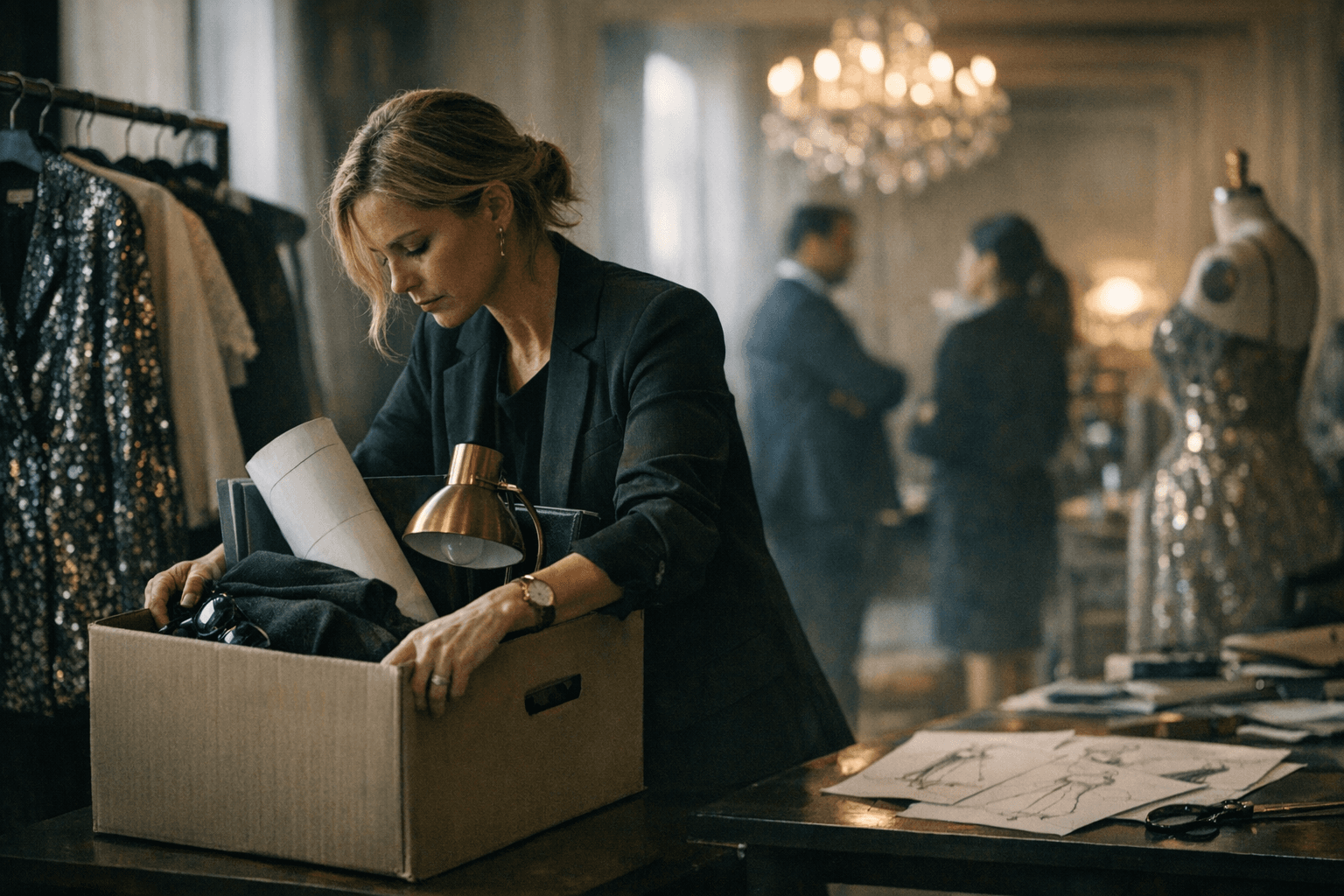
Recruiters say boards are now gravitating toward leaders who blend operational discipline, digital fluency, broad experience and high emotional intelligence: executives who can run the business, shape culture and still see around corners. The problem is that the houses experiencing the most acute brain drain are the ones least likely to offer that kind of environment. Strategic conservatism repels exactly the candidates it most needs.
The Creative Director Carousel Obscures the Real Story
The head-spinning game of creative director musical chairs that played out across 2025 was one for the history books. An ongoing series of designers exiting and joining major fashion houses dominated industry headlines all year long, culminating in a September fashion month season full of new designers' debuts, from Matthieu Blazy at Chanel to Louise Trotter at Bottega Veneta.
The names are genuinely staggering. Dior, Chanel, Gucci, Balenciaga, Celine, Loewe, Givenchy, Maison Margiela, Fendi, Tom Ford, Jil Sander, Bottega Veneta, Mugler, Jean Paul Gaultier, Dries Van Noten and Lanvin were among European brands that made a designer switcheroo over the past year or so, marking a great generational change in luxury. And yet the many HR changes taking place raised a lot of questions about who our era-defining designers are. Is it possible for modern-day fashion brands, many of which now turn over close to €20bn per year, to still nurture the next Coco Chanel and take creative risks?
The industry fixated on those headlining exits. Meanwhile, the quieter departures, the commercial directors, the culture carriers below the masthead, kept accumulating without the same scrutiny.
Where the Talent Is Going
The irony is that the talent exiting stagnant houses isn't disappearing from luxury altogether. It's flowing toward the places that have preserved what the conglomerates are losing. In one of the most symbolic moments of 2025, Hermès briefly overtook LVMH to become the world's most valuable luxury group, a shift driven not by hype, but by discipline. While LVMH battled softness in aspirational luxury, Hermès surged ahead thanks to its unwavering scarcity model, impeccable craftsmanship, and a customer base untouched by wider economic turbulence.
Hermès didn't accidentally become the benchmark. It maintained an internal culture that made it worth staying in. Hermès, a standout performer, has a commitment to creativity that has set it apart. Craftsmanship, product excellence, and a seamless brand experience have all contributed to it being one of the only luxury fashion houses seeing positive brand-value growth.
The lesson for houses bleeding talent isn't to announce another creative director appointment or reissue archive pieces. The decisive factor is culture. Luxury companies must shift from rigid to adaptive, from hierarchical to empowered, from perfectionist to experimental. This means environments where cross-functional teams can iterate quickly, where psychological safety enables creativity, and where progress is valued over perfection. Experimentation, not replication, is the currency of future readiness.
The brands that understand this will stop the leak. The ones that don't will keep wondering why their new creative director's first collection didn't move the needle, not realizing that the team capable of executing the vision left six months before the show.
Know something we missed? Have a correction or additional information?
Submit a Tip