Rolex & Tiffany New Arrivals: Pre‑Owned Luxury — March 22, 2026
Gray & Sons' March 22 pre-owned drop spans three price points: a $9,250 Rolex Datejust 31mm, a $5,200 unused Ernst Benz Chronolunar, and a $295 Tiffany money clip.
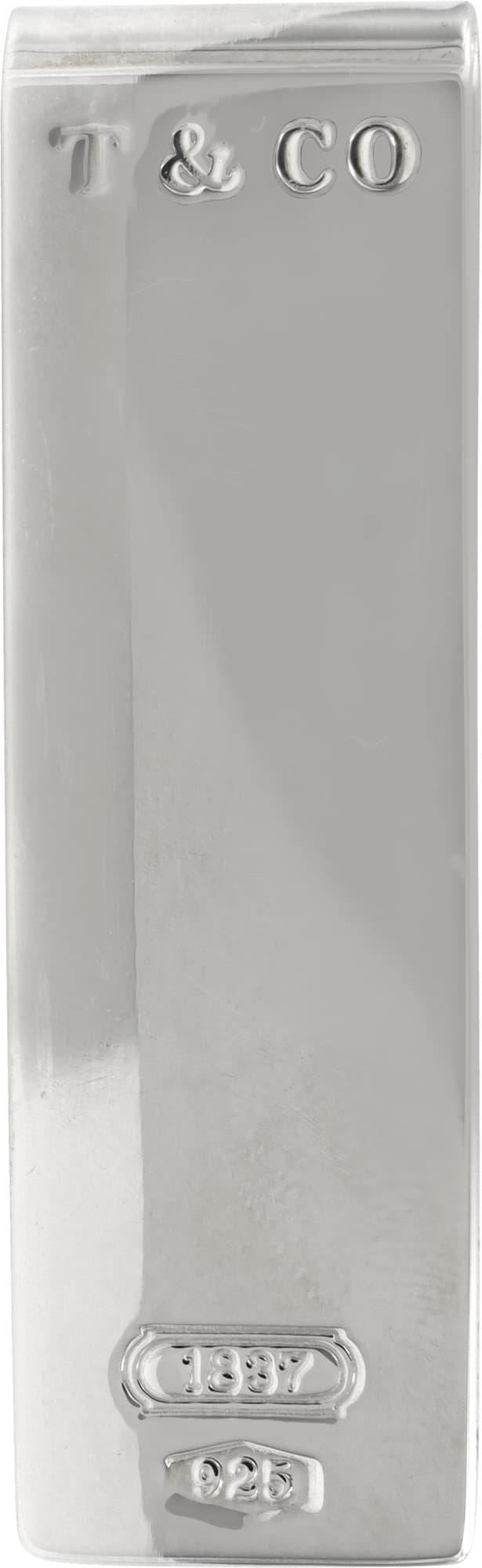
Pre-owned luxury has its own particular grammar, and Gray & Sons, the Miami-area dealer with more than four decades in the certified secondary market, speaks it fluently. The dealership's March 22 inventory update reads less like a sale page and more like a well-edited wardrobe edit: a mid-size Rolex with the proportions that old-money dressing has always preferred, an unissued chronograph with serious movement credentials, and a sterling silver Tiffany accessory that answers the question of what to do with your cash once you've arrived. Three items, three price points, one coherent point of view.
The Rolex Datejust 31mm: The Right Size for the Right Reasons
The 31mm Datejust occupies a particular sweet spot in the Rolex catalogue. It is not a "ladies'" watch in the diminutive sense the term once implied, nor is it the 36mm that has become the default recommendation of every watch account with an opinion. It sits between those poles with remarkable composure, suiting wrists that find the 36mm just slightly too declarative and the 28mm too retiring. For the old-money wardrobe, that restraint is precisely the point.
Gray & Sons has the piece listed at $9,250, which holds up well against the broader secondary market. On Chrono24, pre-owned Datejust 31 examples range from roughly $5,895 for base steel configurations to $12,250 for two-tone pieces with diamond dials. A Gray & Sons acquisition carries the dealer's 24-month warranty and its "Like New for Life" guarantee, backed by Swiss-trained watchmakers on staff since 1980 — context that shifts the value calculus considerably when you're spending in the high four figures.
The Datejust's appeal as an heirloom vehicle is not incidental. Rolex introduced the model in 1945 as the first mechanical wristwatch to automatically change the date at midnight. Eighty-plus years of uninterrupted production means every Datejust on the secondary market carries a lineage, and the 31mm in particular has been a fixture on the wrists of women who treat watches the way old money treats real estate: something acquired carefully, worn consistently, and eventually passed on.
The Ernst Benz Chronolunar: Underrated by Design
At approximately $5,200, the unused Ernst Benz Chronolunar is the discovery piece in this inventory drop, and possibly the one that rewards the most research. Ernst Benz is not a household name in the way that Rolex is, but among people who know movements, the brand has a credible following. The Chronolunar runs on the Valjoux 7751, an automatic movement that also powers chronographs from Omega, Glycine, and various high-end independents. It delivers day, date, and lunar-cycle complications alongside the chronograph function, which makes it technically ambitious without being the kind of niche esoterica that becomes impossible to service.
Retail pricing for the Chronolunar Officer variant, when new, has been documented between $6,500 and $7,450. The Gray & Sons listing, described as unused, lands at roughly $5,200, which represents meaningful savings against new retail while sidestepping the depreciation hit of the typical pre-owned market, where used Chronolunar examples on Chrono24 trade between $3,258 and $3,995. "Unused" in the certified pre-owned context is a specific condition designation: the watch has not been worn but has passed through the secondary market, and at a dealer with in-house watchmakers, that status is verifiable.
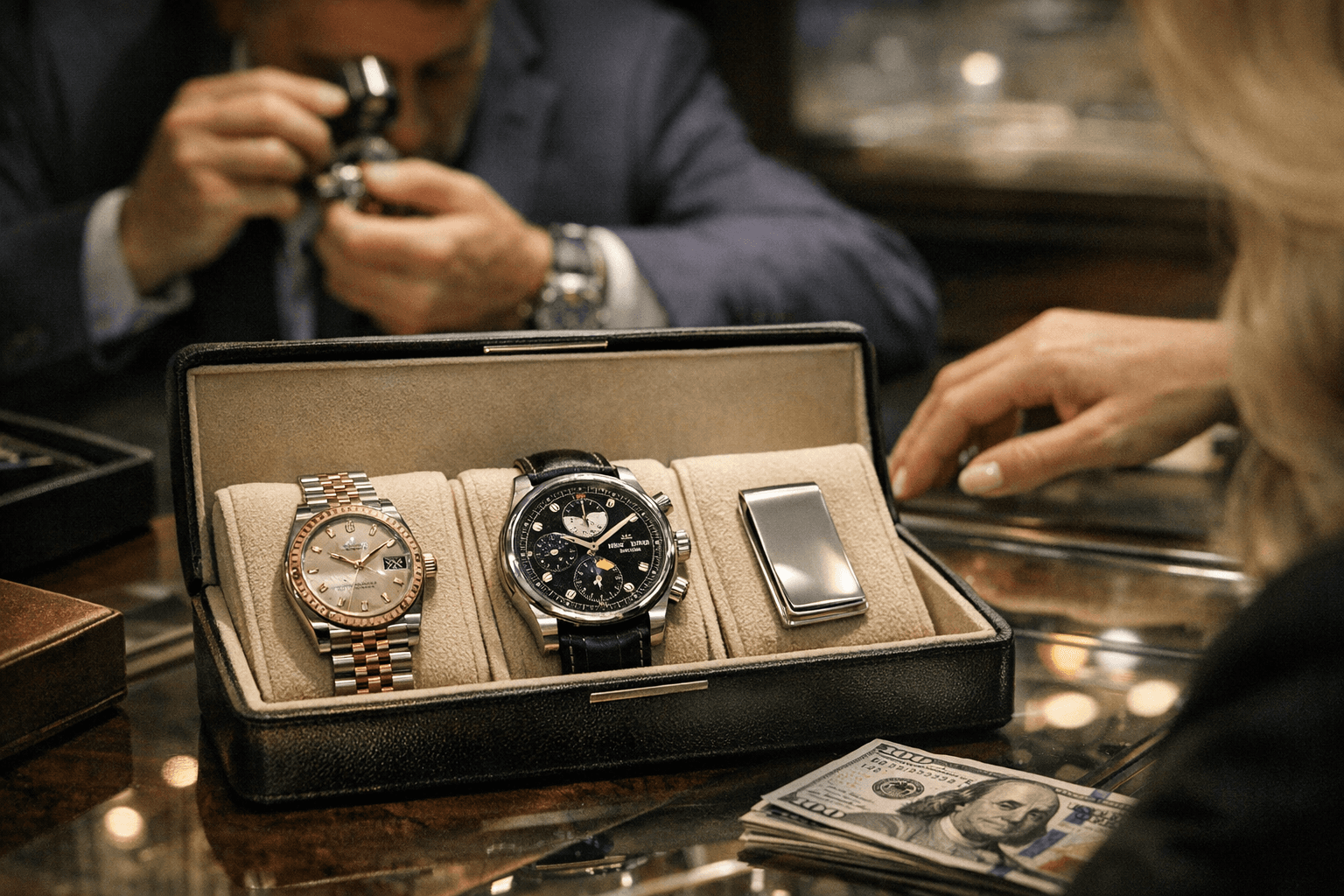
Aesthetically, the Chronolunar reads as a serious dress-sport watch. Its officer-style case and layered dial complications suggest a man who wears a watch to tell more than the time, without needing it to announce itself at volume. That positioning fits the quiet-luxury register precisely.
The Tiffany 1837 Money Clip: Small Object, Strong Signal
At $295, the sterling silver Tiffany 1837 money clip is the most accessible item in the drop, and also the one most likely to be underestimated. The 1837 line takes its name from the year Charles Lewis Tiffany founded the house in New York, and the collection has always operated as Tiffany's most stripped-back expression: no gemstones, no color, just the weight and finish of sterling silver doing the work.
A money clip is, on its surface, a simple object. It is also a studied one. Carrying a money clip instead of a wallet is a deliberate choice that signals a certain attitude toward both money and bulk. The old-money wardrobe has always had an interest in accessories that function impeccably while looking as though they require no effort, and a Tiffany 1837 clip in sterling fits that brief exactly. Retail comparators for the 1837 money clip range from roughly $185 to $275 depending on the specific configuration, placing the Gray & Sons ask at $295 at a slight premium to some retail prices. That premium buys provenance verification and dealer accountability, which matters for signed silver pieces where condition and hallmark integrity are everything.
Building the Heirloom Wardrobe Across Price Points
What makes this particular inventory snapshot useful is its range. The Datejust at $9,250 and the Chronolunar at $5,200 represent genuine watch investments; both are pieces that can be worn daily, serviced indefinitely, and resold without catastrophic loss. The Tiffany money clip at $295 is what the industry calls an entry piece, but it is not a lesser one. Signed sterling silver from a house with Tiffany's heritage holds its character over decades in a way that fashion accessories simply cannot.
Gray & Sons has operated in this market since 1980, long enough to have established the kind of institutional knowledge that makes condition notes trustworthy rather than promotional. Their inventory rotates weekly, which means the March 22 listing is a time-specific snapshot of what was authenticated and available at that moment. For anyone assembling a quiet-luxury wardrobe with an eye on resale, that rotation cadence is worth monitoring. The best pre-owned pieces tend not to linger.
This article was produced by Prism’s automated news system from verified source data, official records, and press releases, then run through automated quality and moderation checks before publishing. The system is built and supervised by the people who set the standards it runs under. Read our full AI policy.
Did this article answer your question?