The Trench Coat, a Timeless Old Money Staple Worth Every Penny
One coat, 40 years of wear: the trench coat's 270-stitch collar and military-class origins make it the only outerwear investment that genuinely earns its price tag.
A coat with a 40-year lifespan. A collar that takes a specialist tailor an entire year to master. Two hundred and seventy individual stitches just to achieve the fluid curve that allows the collar to sit perfectly against the neck. The trench coat is fashion's most persuasive cost-per-wear argument, and it didn't arrive that way by accident.
Where It Began: Gabardine, Basingstoke, and the British War Office
Thomas Burberry established his label in 1856 in Basingstoke, Hampshire, England, but the invention that changed outerwear forever came more than two decades later. In 1879, Burberry developed gabardine: a tightly woven twill whose natural water-resistance comes not from chemical treatment but from the tight twist of its fibres. He patented it in 1888. Before gabardine, the dominant waterproofing solution was rubberised cotton, the material behind the Mackintosh coat. That technology worked, but it was heavy, suffocating, and entirely non-breathable. Gabardine solved both problems at once, producing a fabric that could repel rain without trapping the person wearing it.
By 1901, Burberry had submitted a design for a British Army officer's raincoat to the War Office, laying the groundwork for what would become the silhouette we reach for instinctively today. The origin story is genuinely contested: Aquascutum, the other great British outerwear house, also claims co-invention of the trench coat design. But Burberry's gabardine patent remains the more widely cited foundation.
The Military Details That Became Fashion Codes
During the First World War, the coat's design was refined into a silhouette that has barely changed since. Epaulettes were added to display a military officer's rank. The D-rings on the belt, now styled purely as hardware detail, were originally functional: designed to allow officers to attach map cases, swords, and other field equipment. A persistent myth holds that the rings were meant to carry hand grenades. They were not.
The class dimension was embedded from the beginning. The trench coat was an optional item of dress available only to British Army officers and Warrant Officers Class I, obtained by private purchase. No other ranks were permitted to wear it. That single restriction encoded a social signal into the coat's fabric, one that still resonates more than a century later when we reach for it as a marker of taste and restraint.
The Craft Behind the Collar
Ask any tailor what separates a genuine quality trench coat from an imitation and the answer is almost always the collar. At Burberry, it takes a specialist tailor a full year to learn how to stitch it correctly. Up to 270 stitches are required to create the fluid curve that allows the collar to lie perfectly against the neck. No other part of the coat demands that level of accumulated, irreplaceable skill.
That construction investment pays off across decades. A quality cotton gabardine trench coat, properly maintained, can withstand up to 40 years of regular use. At even a modest purchase price of $800, that works out to $20 per year of wear. At higher price points, the cost-per-wear logic only sharpens. This is not a coat you replace; it is a coat you inherit or pass on.
Quiet Luxury, Old Money, and the Trench's Moment
The trench coat didn't need a trend revival to validate itself, but the past few years delivered one anyway. The broader quiet-luxury movement gained mainstream momentum in March 2023, when Gwyneth Paltrow's understated, neutral-palette courtroom wardrobe during her ski-accident trial in Park City, Utah went viral. Suddenly, restraint was the loudest signal in the room.
HBO's Succession sharpened the aesthetic into something aspirational and specific. Kendall Roy became a widely cited masterclass in old-money dressing, with pieces like his Loro Piana cashmere baseball caps, retailing at $525 each, becoming emblems of a new status code: the kind that signals wealth by refusing to announce it. TikTok creators then democratised the look, teaching followers how to achieve the old-money aesthetic through secondhand shopping and lower-priced alternatives, broadening its reach well beyond the traditional luxury consumer.
By April 2024, CNBC was reporting that quiet luxury was alive and well, now increasingly rebranded as "old money style." The commercial impact has been tangible across the industry. Ermenegildo Zegna Group reported double-digit growth across its stores, according to Business of Fashion, while Hermès, Loro Piana, Brioni, and Delvaux all saw their market values rise by billions on the back of renewed appetite for understated, timeless pieces. The trend has demonstrated enough staying power into 2025 to suggest it has moved from cultural moment to enduring movement.
The trench coat sits at the centre of this shift precisely because it predates it. The coat was never chasing the trend; the trend simply caught up to the coat.
A Market Growing on Both Sides of the Price Spectrum
The global trench coat market was valued at approximately USD 1.4 to 2.5 billion in 2024, with estimates varying by research firm. Forecasts project the market will reach between USD 2.5 billion and USD 4.1 billion by 2033, growing at a compound annual rate of roughly 7.2 to 7.5 percent. Europe holds the largest regional market share, driven by the coat's historical roots in the United Kingdom and the continent's rainy climate. North America is the second-largest market. Asia Pacific is the fastest-growing region, fuelled by rising disposable incomes, e-commerce expansion, and growing demand for quality Western-style outerwear among a new generation of fashion-conscious consumers.
How to Wear It
The trench coat's styling versatility is inseparable from its investment case. A few principles hold regardless of price point:
- Belted vs. open: Cinched and belted creates structure and reads more formal, working particularly well over tailoring. Worn open with a loose, relaxed knot, it softens the silhouette and layers effortlessly over knitwear.
- Length: A mid-thigh to knee-length cut is the most versatile option. It works over tailored trousers and denim without disrupting proportions. Full-length versions lean more dramatic and are best kept otherwise restrained.
- Fabric for climate: Cotton gabardine handles three seasons with ease and is the classic choice for the old-money read. For colder climates, a wool-blend trench provides genuine insulation without sacrificing the clean, angular silhouette.
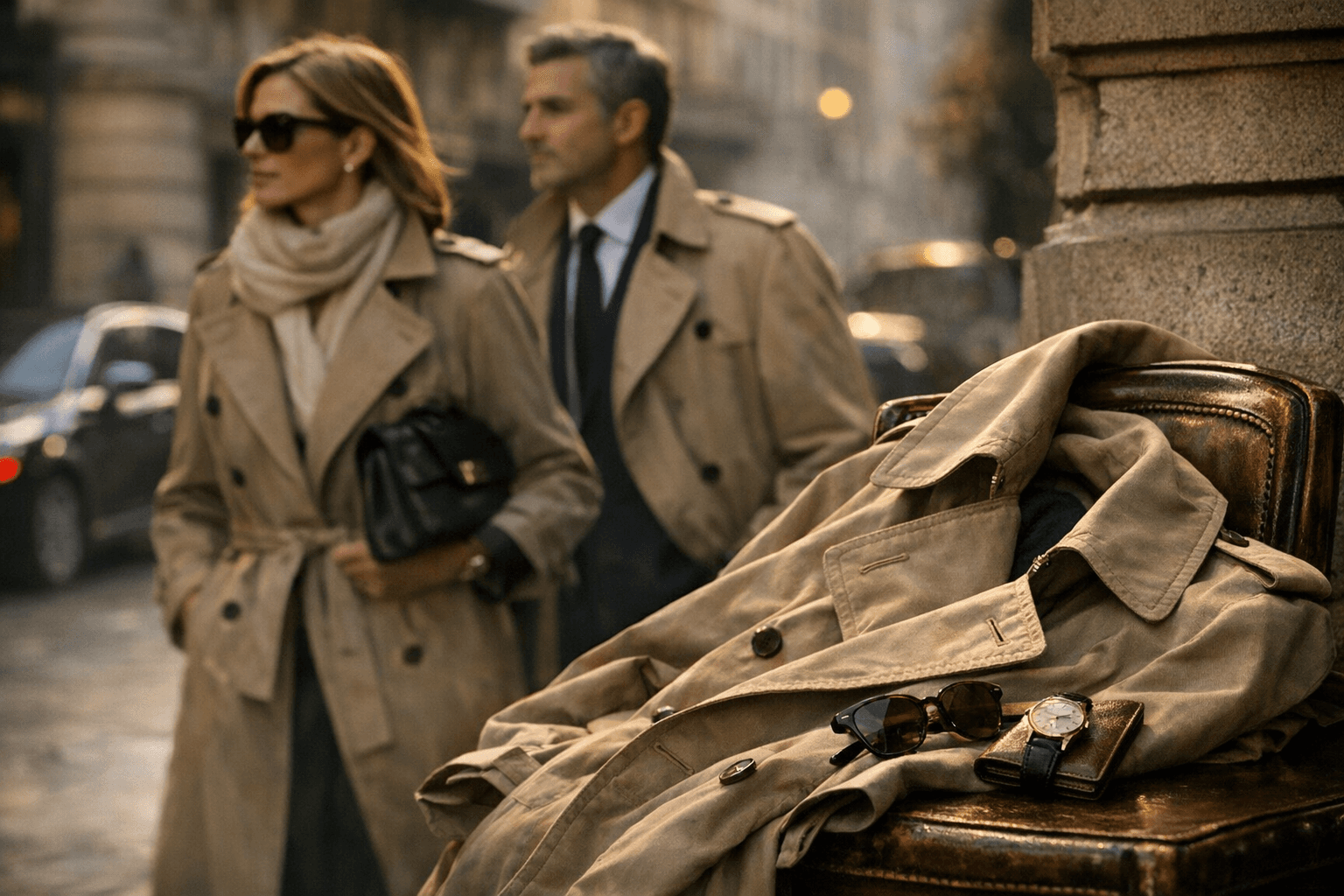
- Minimal hardware: The quiet-luxury signal depends on restraint. Look for storm flaps, classic D-ring belts, and a clean neutral palette. Camel, khaki, and cream are the canonical colours; black reads slightly more contemporary but loses some of the coat's heritage weight.
- Layering: The trench's generous cut was designed to be worn over a military uniform. Use it accordingly: over a chunky roll-neck, a structured blazer, or a full suit. It was engineered for volume underneath, and it shows.
The coat Thomas Burberry designed for officers buying their own kit in 1901 was never intended as a fashion statement. That it has since become fashion's most enduring one is the best possible argument for investing in one now, and wearing it for the next four decades.
This article was produced by Prism’s automated news system from verified source data, official records, and press releases, then run through automated quality and moderation checks before publishing. The system is built and supervised by the people who set the standards it runs under. Read our full AI policy.
Did this article answer your question?