Vestiaire Collective Scales Luxury Resale From Paris Startup to Global Marketplace
With GMV approaching €1 billion and its first annual profit targeted for 2026, Vestiaire Collective is converting 17 years of growth into a scalable business.

Vestiaire Collective is sitting at just under €1 billion in gross merchandise value, posted positive EBITDA during the year-end shopping season for the first time, and is now targeting its first full-year profit in 2026. For a company that launched out of a Paris apartment in 2009 with 3,000 pre-owned pieces pulled from friends' wardrobes, that milestone is not a footnote. It is the entire point.
From "Vestiaire de Copines" to a 70-Country Marketplace
The origin story has the kind of clarity that most startups lack. Co-founder Fanny Moizant observed something specific during the 2009 recession: cash-strapped fashion insiders were offloading their Hermès and Chanel pieces on personal blogs, but there was no trusted intermediary to guarantee authenticity or assign fair pricing. She launched the platform with five co-founders including Sophie Hersan, Sébastien Fabre, and Alexandre Cognard, under the name "Vestiaire de Copines," meaning roughly "friends' wardrobe." The first inventory, over 3,000 pieces, came from reaching out to people they already knew.
By 2012, the company had rebranded to Vestiaire Collective and opened in the UK. The U.S. followed in 2014. That geographic sequence mattered: the company built its authentication infrastructure and community model in European markets before taking on the larger, more competitive American market. Today it operates across more than 70 countries with offices in Paris, London, New York, Milan, Berlin, and Hong Kong.
Nine Funding Rounds and a $667 Million Capital Stack
Vestiaire's funding history is a record of consistently attracting the right backers at each growth stage. A Series A in June 2010 raised approximately $1.9 million. A Series B in 2011 added $9.8 million. The Series C in 2013, at $20 million, brought in Condé Nast, a shareholder whose editorial authority aligned precisely with the platform's curatorial ambitions. A $37 million Series D in 2015 funded geographic expansion, and a 2017 Series E led by Vitruvian Partners raised $62 million, pushing cumulative funding past €116 million.
The defining round came in 2021: €178 million, backed by Kering, the French luxury conglomerate behind Gucci, Balenciaga, and Saint Laurent, alongside Tiger Global Management. Kering took a stake of close to 5 percent and joined the board. The signal was unambiguous. A major luxury group was not treating resale as a threat to its primary market; it was betting on the infrastructure that carries its products into second lives. SoftBank, Generation Investment Management (co-founded by former U.S. Vice President Al Gore), BPI France, and Condé Nast all hold positions between 5 and 10 percent. Eurazeo remains the largest shareholder at roughly 25 percent.
In February 2024, Vestiaire ran an equity crowdfunding campaign on Crowdcube, raising approximately €3.5 million, more than three times its initial target. The company's valuation at that point stood at €1.1 billion. Total funding across nine rounds has reached $667 million from 21 investors.
The Operating Model: Commission, Curation, and Authentication
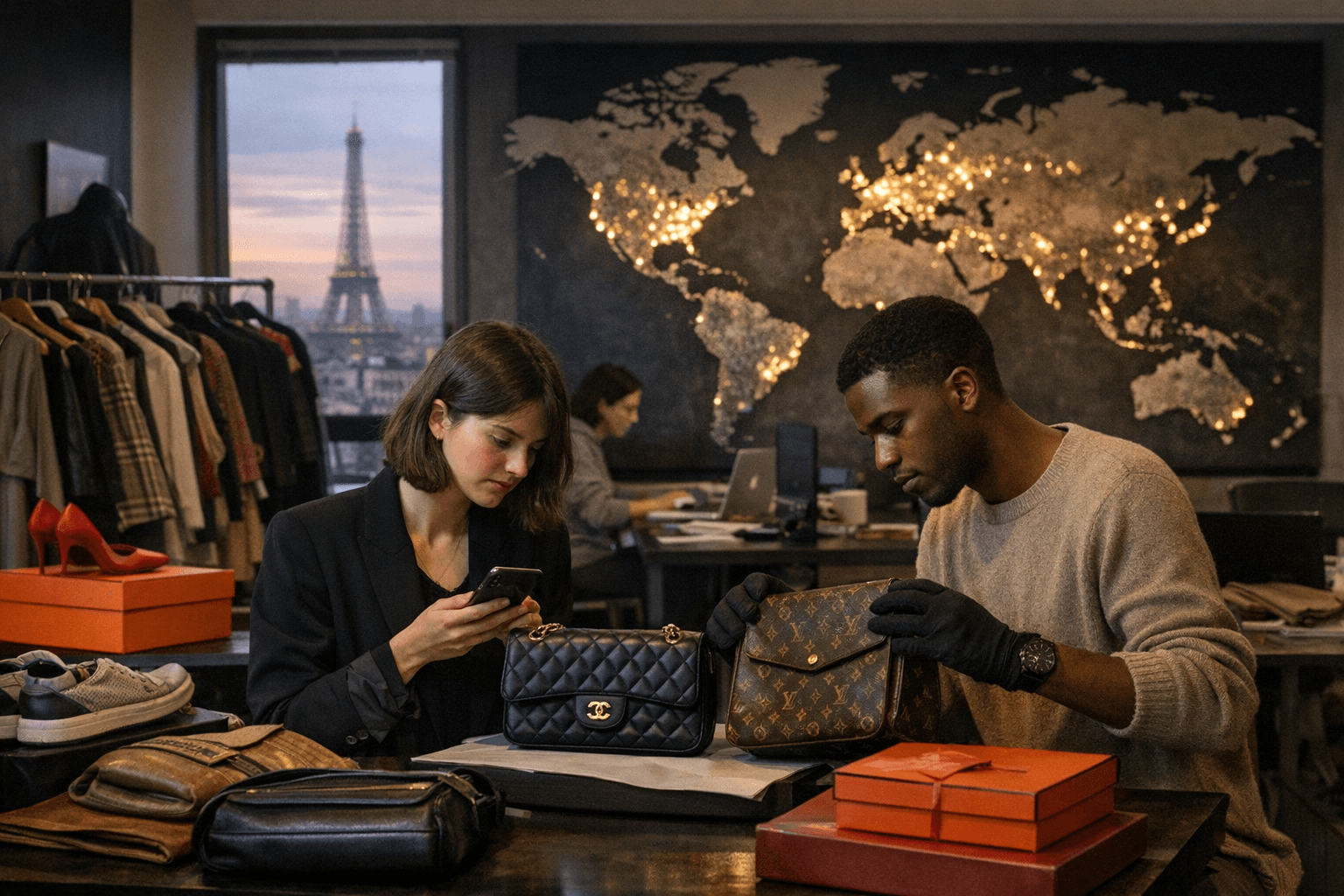
The platform runs on a commission-based consumer-to-consumer model. Sellers upload photographs; listings are digitally verified through AI technology and reviewed by curation teams before going live. Buyers can then choose either direct shipping or routing their item through one of Vestiaire's four international authentication centers. That physical verification process runs across four stages: profile monitoring, digital verification, physical verification, and quality control. The reported counterfeit error rate sits under one in a thousand. When the platform does encounter high-quality fakes during authentication, it returns those items to the relevant brands for training purposes, a detail that captures how deeply operational the brand relationships have become.
Authentication is not just a trust mechanism; it is a core revenue lever. The commission model is reinforced by B2C services, VIP consignment, and an increasingly prominent Resale-as-a-Service offering that helps luxury brands run their own resale programs. Average order value exceeded $1,200 in 2025. A buy-now-pay-later integration through Affirm and Klarna, covering high-value items in transit and storage, has been shown to lift conversion by approximately 18 percent. Gross margin holds above 50 percent.
Brand Partnerships and the Circular Luxury Logic
Vestiaire counts 15 public luxury brand partnerships, with numerous additional confidential collaborations focused on authentication protocols and staff training. The Kering-owned Alexander McQueen program was the first of its kind: McQueen sales representatives contact clients to gauge interest in reselling pieces, issue store credit for those who proceed, and curated items appear in a dedicated brand-approved section carrying an authenticity tag. When asked about other Kering brands following suit, Kering's chief client officer told WWD: "They have no obligation...but given the importance of the trend, I think what we're seeing with Alexander McQueen is a good signal of what is going to happen ahead."
The logic runs deeper than brand goodwill. When buyers know a piece retains resale value, they invest more confidently in primary market purchases, which in turn stabilizes pricing for new goods. Luxury resale, in this framing, is not a threat to the firsthand market; it is its backstop. Mytheresa extended its resale partnership with Vestiaire in October 2025. Chloé's Digital ID program offers instant resale capability through the platform, giving customers a seamless exit from any Chloé purchase. As the company's then-CEO Maximilian Bittner described the positioning: "We see ourselves as a differentiated player and also the only truly global player."
A Leadership Change and a Precise Profit Target
In October 2025, Vestiaire's board elevated Bernard Osta from chief financial officer to CEO, replacing Maximilian Bittner, who had held the role for seven years. Osta joined the company in May 2021 as chief strategy officer, bringing 15 years of investment banking experience from Lazard and Goldman Sachs in New York and Paris. His approach: disciplined execution over reinvention, with deeper penetration of underpenetrated markets as the primary growth vector. The U.S. is the central target. Despite being present in the American market since 2014, Vestiaire treats North America as still largely unfinished business. Under Osta, the company has made new senior hires in technology and product specifically to accelerate that execution. The broader goal, stated explicitly before and after his appointment, is to explore an IPO once annual profitability is confirmed.
The transition was not without friction. Co-founder Fanny Moizant, who had helped build Vestiaire from that original Paris apartment into a platform operating on six continents, said publicly in January 2026 that her departure was not her own choice.
The Market Itself Is the Wind at Their Back
The global resale market is projected to reach $360 billion by 2030, growing at a rate that outpaces firsthand fashion. Vestiaire's revenue of €200 million against GMV of just under €1 billion, with a gross margin above 50 percent, reflects a business that has built real structural advantage in a market expanding faster than most of the categories surrounding it.
The company has raised $667 million, assembled a shareholder structure that reads like a who's who of luxury and tech capital, and operates authentication infrastructure across four international centers with a workforce of over 600 employees. With Bernard Osta framing 2026 as the year growth converts to profit, and a potential IPO waiting on the other side of that milestone, Vestiaire is no longer a startup in any meaningful sense. It has become the infrastructure layer through which old-money wardrobes circulate globally, and the economics are finally maturing to match the vision that was there from the very first 3,000 pieces.
Know something we missed? Have a correction or additional information?
Submit a Tip