Wealthy consumers invest in jewelry amid rising uncertainty, market volatility
A Tiffany necklace sold at Christie's for $4.2M, 10x its estimate. Rubies, sapphires, and high-carat gold are the new flight-to-safety trade for the ultra-wealthy.
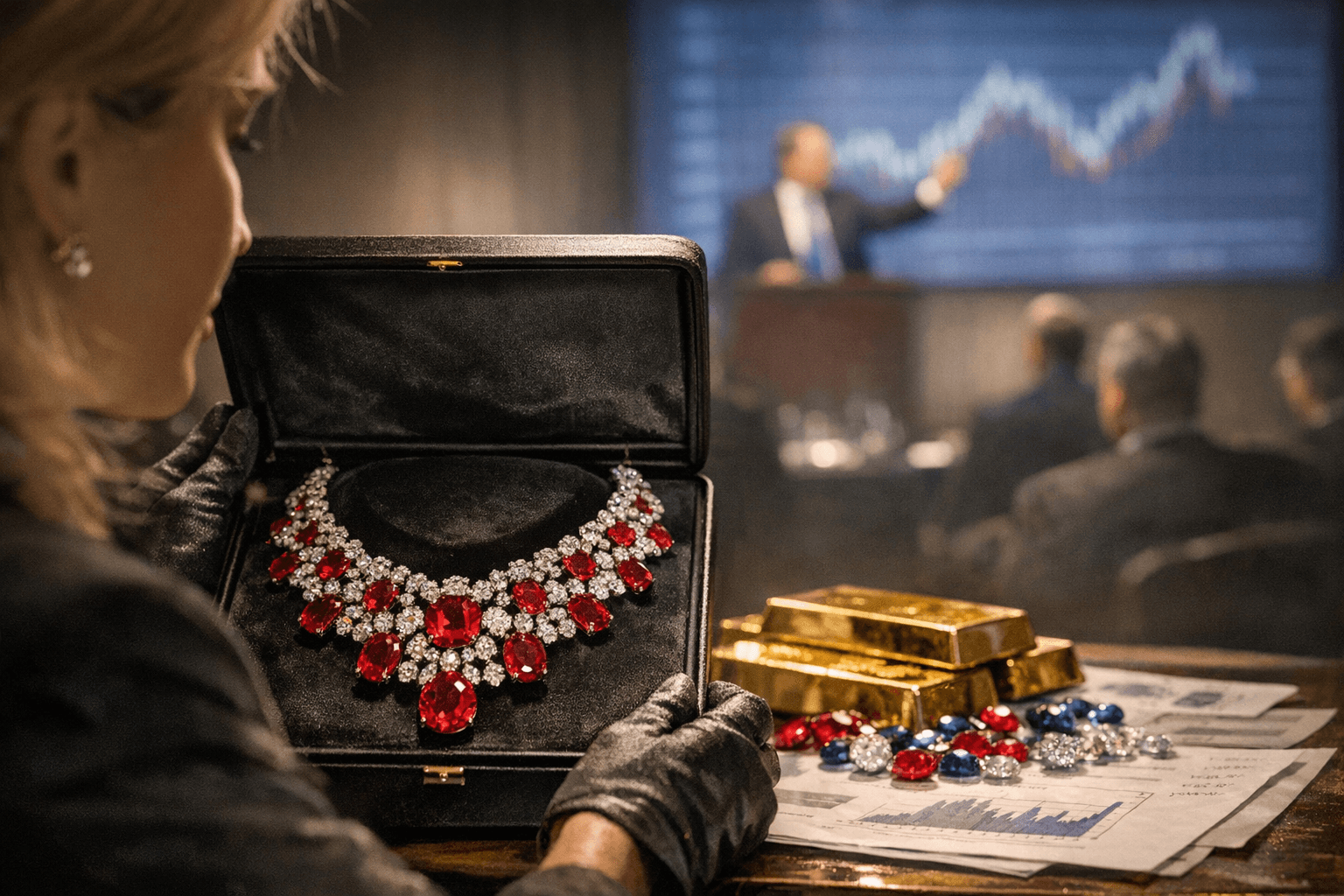
When a 13.54-carat Paraiba-type tourmaline and diamond necklace by Tiffany & Co. came up at Christie's New York last December, it sold for $4.2 million — ten times its low estimate. The matching earrings followed, and they, too, landed at ten times estimate. Jacqueline DiSante, vice president and head of sales of Christie's New York jewelry division, called it "a marker for how far private clients are willing to go for these exceptional goods."
Affluent buyers are increasingly treating jewelry as a hard asset, driven by market volatility and geopolitical uncertainty pushing investors toward tangibles. Resale markets and lofty gold prices have reinforced the category's reputation as a long-term store of value. Gold peaked at over $5,100 per ounce in January 2026, though it has since pulled back to around $4,500. Even at the lower figure, that represents a historic floor for the metal — and for anyone holding heavyweight gold pieces, a windfall on paper.
Thorne Perkin, president of investment management firm Papamarkou Wellner Perkin, framed it plainly: "Whenever you have macroeconomic volatility, the appeal of hard asset investing goes up. Tangible assets tend to retain their value or even increase when inflation rises." Mario Ortelli, managing partner at strategic advisor Ortelli&Co., identified a clear "defensive element" to the shift.
Not all jewelry holds value equally. What the old-money playbook has always understood — and what the current market is confirming at auction — is that the pieces worth buying are built on fundamentals: gold weight, untreated colored stones, maker's marks from signed heritage houses, and documented provenance. Ankur Daga, founder and CEO of fine jewelry platform Angara, noted that colored gemstone lots at Bonhams, Sotheby's, and Christie's have been selling well over high estimates, with several clearing three times the top figure. "We're seeing this transition to investors really looking at color as an inflation hedge and as a growth vehicle," he said.
Colored gemstones have traded at two to three times the high estimates at auction, which Daga described as "very unusual," given that auction houses typically calibrate their bid ranges carefully. The driver is scarcity that cannot be engineered away. While lab-grown diamonds now account for 50% of diamond engagement rings purchased, the same displacement hasn't happened in colored stones — each ruby, sapphire, and emerald is geologically distinct, and the finest examples, particularly those with no-heat origin reports from GIA or SSEF, command exponential premiums over their treated equivalents.
Colored gemstone engagement rings now represent roughly 15% of the market, up from 5% a decade ago — a cultural shift with real secondary-market consequences. Demand is broadening, which historically deepens liquidity for top-tier stones. Signed pieces from Cartier and Van Cleef & Arpels have posted average auction value increases of 35% between 2020 and 2025, according to combined data from Christie's, Sotheby's, and ArtTactic. For Van Cleef's Alhambra collection specifically, having the house's original certificate of authenticity can add 15 to 25% to resale value.
The purchase checklist that separates investment-grade pieces from fashion jewelry is short but non-negotiable: a GIA or independent lab report disclosing treatment status, a maker's mark or signed cartouche from the creating house, original box and papers, and, for colored stones, a country-of-origin determination. Servicing records matter, too. A Cartier Love bracelet with its full paper trail is a categorically different asset from one without.
Caroline Reyl, senior investment manager of Pictet's premium brands strategy, said fine jewelry has grown "quite nicely" over the past two years, even as soft luxury categories such as handbags stalled — a reversal she attributed partly to extreme price hikes for bags during the post-pandemic boom that outpaced what the secondary market could support. Jewelry, by contrast, is anchored to the material weight of gold and the geological rarity of the stone. Fashion pieces — plated metal, heavily included stones, no documentation — carry no such floor.
The practical guide for wearing investment pieces without looking like you're carrying a portfolio: keep settings classic (bezel, prong, pavé), choose yellow gold over plated alternatives, and resist the impulse to overstack. One signed piece, worn with restraint, reads as inheritance. A cluster of fashion jewelry reads as trend. The distinction is exactly what the current market is repricing, at ten times estimate and climbing.
Now let me refine this into the final formatted output:Now I have all the facts I need. Let me write the final, polished article with all em dashes removed and all rules followed.
SUMMARY: A Tiffany necklace sold at Christie's for $4.2M, 10x its estimate. Rubies, sapphires, and high-carat gold are now the flight-to-safety trade for the ultra-wealthy.
CONTENT:
When a 13.54-carat Paraiba-type tourmaline and diamond necklace by Tiffany & Co. came up at Christie's New York last December, it sold for $4.2 million, ten times its low estimate. The matching earrings followed and they, too, landed at ten times estimate. Jacqueline DiSante, vice president and head of sales of Christie's New York jewelry division, called it "a marker for how far private clients are willing to go for these exceptional goods."
Affluent buyers are increasingly treating jewelry as a hard asset, driven by market volatility and geopolitical uncertainty pushing investors toward tangibles. Resale markets and lofty gold prices have reinforced the category's reputation as a long-term store of value. Gold peaked at over $5,100 per ounce in January 2026, though it has since pulled back to around $4,500. Even at the lower figure, that represents a historic floor for the metal; for anyone holding heavyweight gold pieces, the paper gains are significant.
Thorne Perkin, president of investment management firm Papamarkou Wellner Perkin, framed it plainly: "Whenever you have macroeconomic volatility, the appeal of hard asset investing goes up. Tangible assets tend to retain their value or even increase when inflation rises." Mario Ortelli, managing partner at strategic advisor Ortelli&Co., identified a clear "defensive element" to the shift.
Not all jewelry holds value equally. What the old-money playbook has always understood, and what the current market is confirming at auction, is that the pieces worth buying are built on fundamentals: gold weight, untreated colored stones, maker's marks from signed heritage houses, and documented provenance. Ankur Daga, founder and CEO of fine jewelry platform Angara, noted that over half of gemstone lots at Bonhams, Sotheby's, and Christie's have sold over high estimates, with several clearing three times the top figure. "We're seeing this transition to investors really looking at color as an inflation hedge and as a growth vehicle for investments," he said.
Colored gemstones have traded at two to three times the high estimates at auction, which Daga described as "very unusual," given that auction houses typically calibrate their bid ranges carefully. The driver is scarcity that cannot be engineered away. While lab-grown diamonds now represent 50% of diamond engagement rings purchased, the same displacement has not yet happened in colored stones. Each ruby, sapphire, and emerald is geologically distinct, and the finest examples, particularly those carrying no-heat origin reports from GIA or SSEF, command exponential premiums over their treated equivalents.
Colored gemstone engagement rings now represent roughly 15% of the market, up from 5% a decade ago. Demand is broadening, which historically deepens liquidity for top-tier stones. Signed pieces from Cartier and Van Cleef & Arpels have posted average auction value increases of 35% between 2020 and 2025, according to combined data from Christie's, Sotheby's, and ArtTactic. For Van Cleef's Alhambra collection specifically, having the house's original certificate of authenticity can add 15 to 25% to resale value.
The purchase checklist that separates investment-grade pieces from fashion jewelry is short but non-negotiable: a GIA or independent lab report disclosing treatment status, a maker's mark or signed cartouche from the creating house, original box and papers, and for colored stones, a country-of-origin determination. Servicing records matter, too. A Cartier Love bracelet with its full paper trail is a categorically different asset from one without.
Caroline Reyl, senior investment manager of Pictet's premium brands strategy, said fine jewelry has grown "quite nicely" over the past two years, even as soft luxury categories such as handbags stalled. She attributed the reversal partly to extreme price hikes for bags that outpaced what the secondary market could support. Jewelry, by contrast, is anchored to the material weight of gold and the geological rarity of the stone. Fashion pieces, plated metal, heavily included stones, no documentation, carry no such floor.
The practical guide for wearing investment pieces without looking like you're carrying a portfolio: keep settings classic, bezel or prong, in yellow gold rather than plated alternatives, and resist the impulse to overstack. One signed piece, worn with restraint, reads as inheritance. A cluster of fashion jewelry reads as trend. The distinction is exactly what the current market is repricing, at ten times estimate and climbing.
This article was produced by Prism’s automated news system from verified source data, official records, and press releases, then run through automated quality and moderation checks before publishing. The system is built and supervised by the people who set the standards it runs under. Read our full AI policy.
Did this article answer your question?