Chemical textile recycling faces reality check as scale-up stalls
Chemical recycling is hitting a feedstock wall: dirty, blended textiles are harder to process than the pitch decks admit, and brands need cleaner design and better collection systems before scale claims hold up.
Textile Exchange’s 2025 materials market tracking shows global fiber production reached 132 million tonnes in 2024 while recycled fibers stayed below 8% of the total. Chemical recycling is not stalling because fashion ran out of ambition. It is stalling because the clothes coming back are messy: contaminated, blended, dyed, and often impossible to sort into a clean, predictable input stream.
The feedstock wall brands keep running into

The industry has been trying to sell circularity with the optimism of a clean white tee. The reality is a bin full of mixed fabrics, metal trims, print inks, elastane, coatings, and whatever else ended up in the donation pile. Textile Exchange’s 2025 materials market tracking shows fiber production is still growing, and the recycled share is still tiny. The 2024 report had already shown global fiber production at an all-time high of 124 million tonnes in 2023, so 2024 extended the same trend.
The European Union is forcing the issue. Under the Waste Framework Directive, member states must have separate collection systems for used textiles from 2025. The European Environment Agency has warned that if sorting and treatment capacity do not keep up, the result can be more exports, more incineration, and more landfilling, not less.
Why chemistry keeps losing to the garment itself
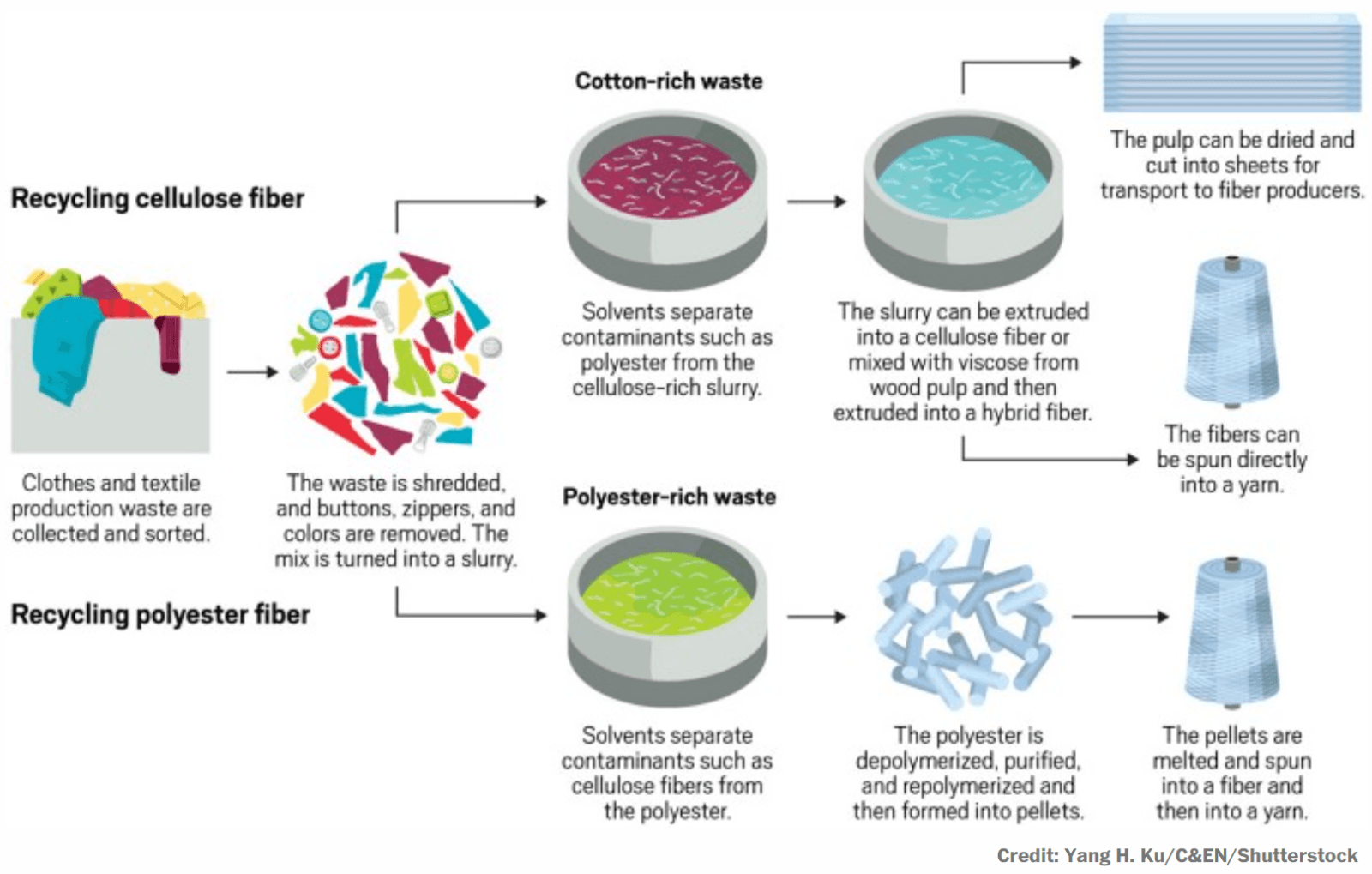
Chemical recycling sounds elegant when you say it fast. In Refashion’s definition, chemical recycling breaks textile waste down into polymers and/or monomers using chemical processes. That is the promise: undo the fabric and start again. But the garment does not politely dissolve into purity. Dyes, additives, contamination, and blended fabrics keep showing up as the recurring blockers in the technical literature, and mechanical recycling has its own hard ceiling because it cannot separate mixed fibers.
Fashion for Good identifies most discarded clothing as post-consumer, and a large share as blended textiles with two or more fiber types. That means the recycler is not just dealing with waste. It is dealing with design decisions made months or years earlier by a brand that wanted stretch, drape, softness, or price control. A cotton-poly jersey, a stretch denim, a coated shell jacket, a logo sweatshirt with mixed trims: all of that is fashionable on the hanger and stubborn in a recycling line.
A 2025 study, *Textile Recycling: Positive Change or Toxic Truth?*, found substantial contamination differences between open-loop and closed-loop recycled fibers.
The lab is moving. Industry scale is another story
A 2024 paper in *Nature* detailed a chemical-processing method that handled mixed fabrics in 15 minutes, the kind of result that gets attention from engineers and sustainability teams hunting for a breakthrough. A 2025 paper in *Nature Communications* examined sequential hydrolysis for polycotton waste textiles, another step for one of the sector’s most annoying fabric families.
But lab success is not the same thing as a feedstock system. Review papers still reach the same unsentimental conclusion: the hard parts are sorting, decontamination, and economics. That is the bit brands often skip when they talk about “next-gen recycling.” You can build a clever process for mixed fibers, but if the incoming bale is a jumble of post-consumer clothing with grease, dirt, elastane, buttons, zips, and unknown finishes, the chemistry spends its time cleaning up someone else’s mess.
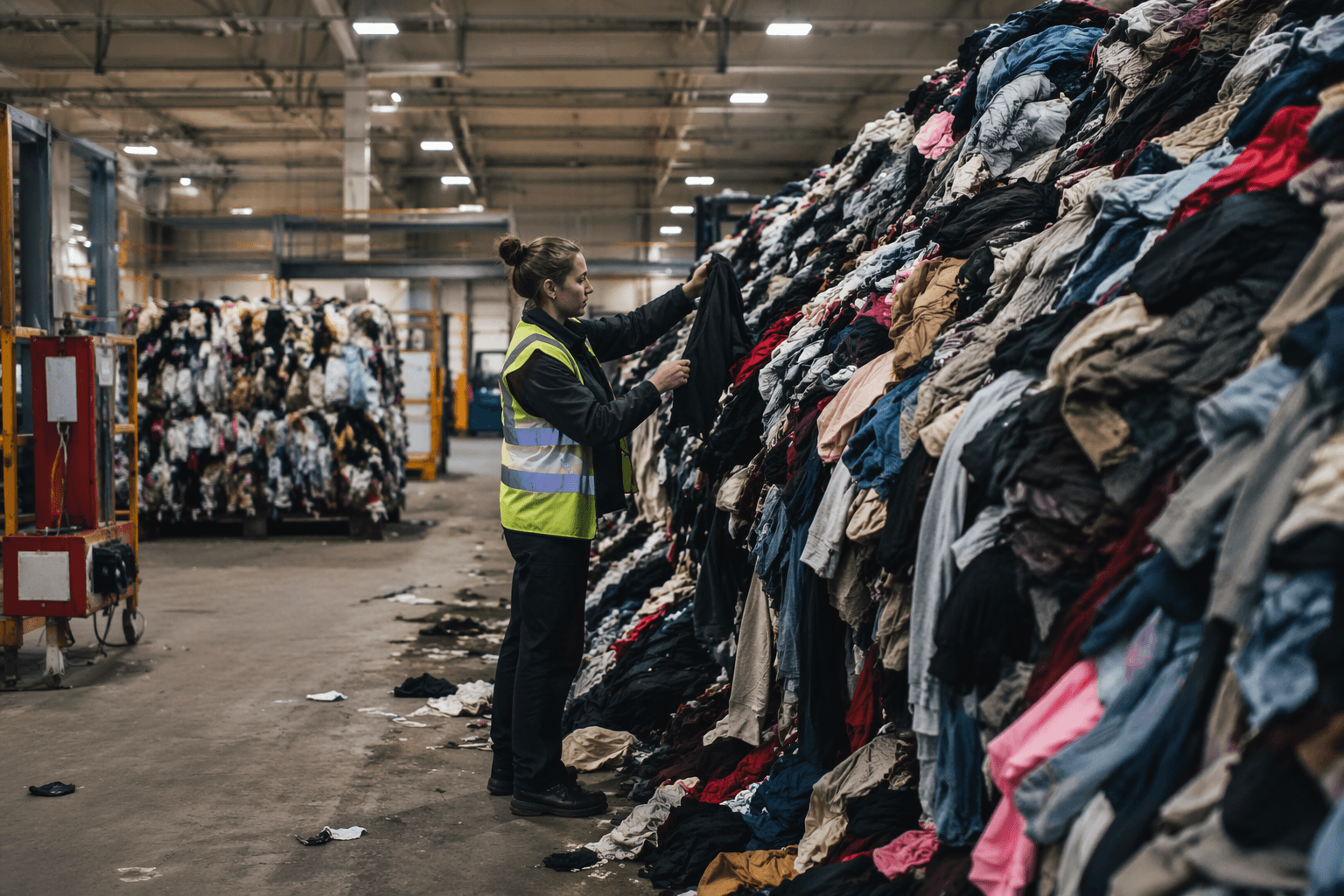
Global textile waste is projected to reach 134 million tonnes annually by 2030. The question is whether the system can feed a process materials that are stable enough, clean enough, and cheap enough to process at industrial scale.
What brands have to change before scale claims feel real
Design for simpler endings
If sourcing and sustainability teams want chemical recycling to move beyond glossy deck language, product design has to get less chaotic. That means fewer blended fabrics, fewer hard-to-remove additives, and fewer decorative extras that make a garment gorgeous in store and miserable at end of life.
The Ellen MacArthur Foundation’s circular-fashion logic only works when the garment is designed to come back as a legible input, not a mystery bundle. A cleaner cotton jersey, a more disciplined mono-material shell, or a less overbuilt knit with fewer embedded finishes is not as flashy as innovation theater, but it is a lot more useful to a recycler.
Build collection systems around clean separation
The EU’s separate-collection requirement is a start, not a finish. If brands want feedstock quality, they need systems that separate used textiles before they become contaminated beyond recovery. That means capture, sorting, and decontamination have to be designed as part of the product strategy, not bolted on after the fact.
Collection programs need to stop acting like feel-good drop boxes. A take-back bin in a flagship store is not enough if the material still gets crushed together with mixed household waste downstream. Brands need to think like industrial operators: what enters the system, how it is sorted, what contamination threshold is acceptable, and which products are actually fit for chemical recycling versus downcycling or disposal.
Make the recycled-fiber claim measurable
“Recycled fiber” is not a magic phrase. Sourcing teams should be asking sharper questions: what was the feedstock, how contaminated was it, was it open-loop or closed-loop, what yield came out, and where did the output actually go?
This article was produced by Prism’s automated news system from verified source data, official records, and press releases, then run through automated quality and moderation checks before publishing. The system is built and supervised by the people who set the standards it runs under. Read our full AI policy.
Did this article answer your question?