Fashion brands bet on bio-based elastane to cut fossil fuels
Bio-based elastane is leaving the lab and moving onto factory lines, with LYCRA, Hyosung and Yulex racing to cut fossil stretch without losing snap-back.
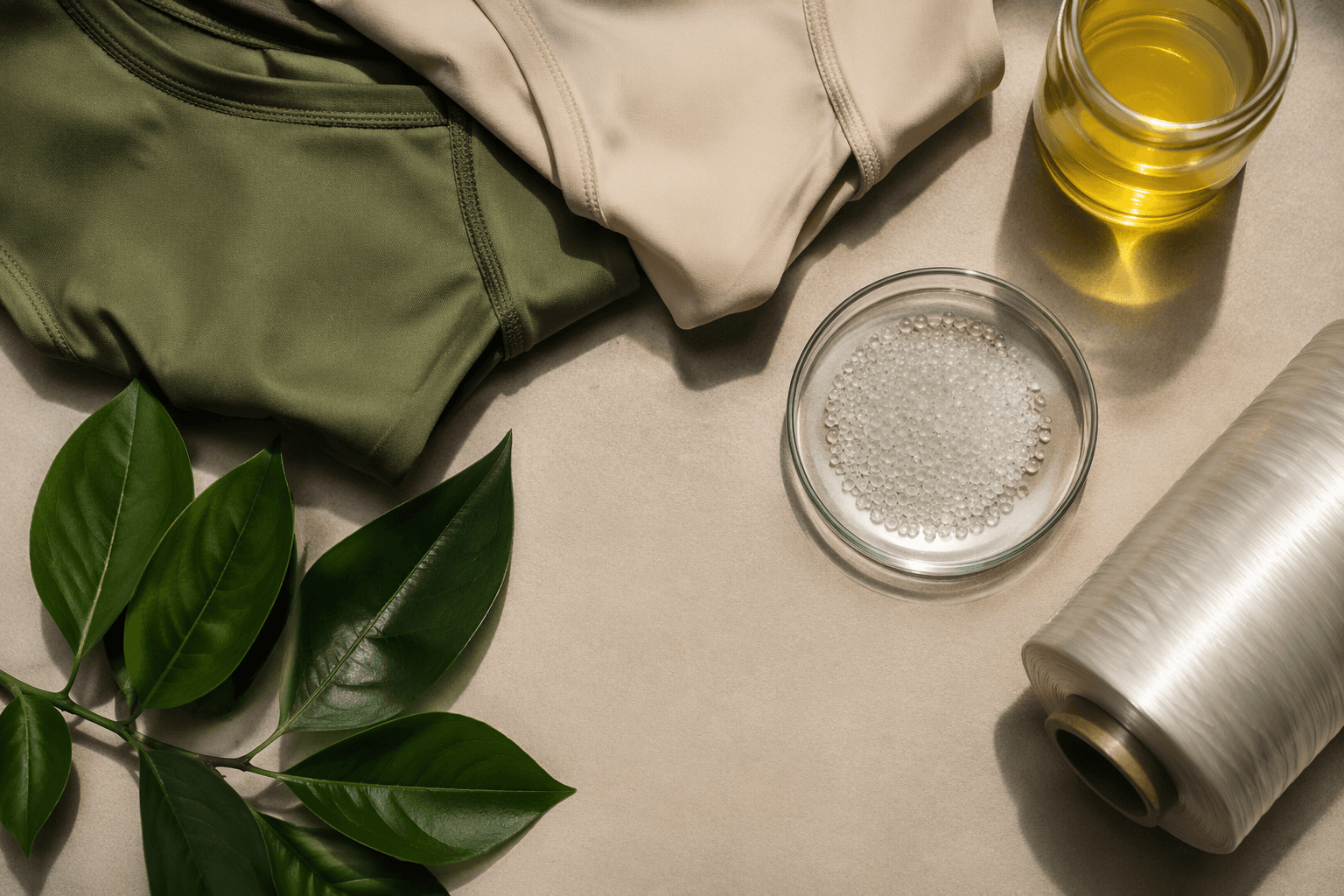
Bio-based elastane is where sustainability gets brutally practical. Elastane is only about 2% of most garments, yet it shows up in more than 80% of clothing, from underwear to outerwear, which is exactly why brands keep circling back to it as the material that makes a “better” wardrobe harder to make truly better. The commercial stakes are obvious: stretch fibers are one of fashion’s hardest fossil-based inputs to replace, and the companies betting on bio-based versions are trying to prove they can cut emissions without wrecking fit, recovery, or mill readiness.
Why elastane is the choke point
Elastane is the tiny ingredient that changes how a garment lives on the body. It makes denim recover, activewear hold shape, and underwear stay close without bagging out, but it also becomes a recycling headache when it is blended with cotton, polyester, or nylon. That blend problem is why a fabric can look responsible on the hanger and still be a pain point once it reaches the end of its life.
The broader industry pressure is not subtle. Cargill says apparel generates 10% of global carbon emissions and could account for 28% by 2050 if the sector keeps stretching in the wrong direction. That is the real backdrop for this material race: stretch is not a side issue, it is one of the places where brands can either keep burning fossil inputs or start rewiring the supply chain.
The LYCRA route: drop-in chemistry, less factory drama
The cleanest commercial pitch in the group belongs to The LYCRA Company. On September 28, 2022, it announced an agreement with Qore to enable what it called the world’s first large-scale commercial production of bio-derived spandex using QIRA. The company says 70% of its bio-derived LYCRA fiber content will come from annually renewable feedstock, and that the fiber could cut carbon footprint by up to 44% versus the equivalent fossil-based product.
That matters because the easiest sustainability win in fashion is the one that does not force mills to rebuild everything from scratch. Jon Veldhouse, CEO of Qore, says QIRA directly replaces conventional BDO and improves sustainability without changing manufacturing processes. In plain terms, that is the kind of thing procurement teams like: same industrial logic, lower fossil content, less disruption. Qore itself is a joint venture between Cargill’s bioindustrial business and HELM, and Cargill says QIRA is produced at its biotechnology campus and corn refining operation in Eddyville, Iowa, which gives this route a very concrete industrial base.
The LYCRA Company also has historical proof points on its side. It says equivalent performance for bio-derived LYCRA was demonstrated in 2014, when the world’s first bio-derived spandex launched under the LYCRA brand, and it later secured a patent for the process used to make renewable elastane from bio-derived BDO. The first renewable LYCRA fiber made with QIRA was slated for production in 2024 at the company’s Tuas, Singapore site, which tells you this is not a concept sketch anymore. This is the most “drop-in” of the three paths, and that is a huge advantage when brands want less fossil fuel without rethinking every knit and weave spec.
Hyosung’s sugarcane bet: scale, energy and a cleaner feedstock story
Hyosung is making a different wager, and it is a smart one. On July 17, 2025, the company said it was transitioning its bio-based spandex feedstock from corn to sugarcane, moving from dent corn toward sugarcane-based bio-BDO. Hyosung, which describes itself as the world’s largest producer of spandex by market share, is not acting like a niche experiment here. It is trying to steer the category.
The company partnered with Geno in 2024 to begin construction at a Vietnam plant that will produce Bio-BDO from sugarcane using Geno’s proprietary technology. The facility is expected to start production in the first half of 2026 and could produce up to 50,000 tons of bio-BDO by the end of 2026. That kind of output is the difference between a good slide deck and a supply chain brands can actually buy into.
Hyosung’s global sustainability director for textiles, Simon Whitmarsh-Knight, makes the sugarcane case with three concrete advantages: higher yield per hectare than corn, more carbon sequestration, and bagasse that can be used as renewable energy. That is the kind of feedstock logic that starts to matter once you are counting grams of carbon and pennies of cost in the same spreadsheet. Sugarcane can improve the economics because it produces more output from the land and leaves behind a useful energy byproduct, which is exactly the sort of industrial efficiency fashion needs more of, not less.
Hyosung also says there is no compromise in durability or performance, and that the new system could deliver faster speed to market, shorter development times, and a more robust supply chain. That is the right language for mills and brands that do not want to lose the clean fit and snap of conventional stretch just because the input is greener.
Yulex goes sideways with natural rubber
Then there is Yulex, which is taking the most interesting technical detour. Instead of working through corn or sugarcane as a chemical intermediate, it launched YULASTIC on March 5, 2025 as a plant-based alternative to elastane made from natural rubber harvested from the Hevea brasiliensis tree. Yulex says the material is a fine natural-rubber filament, and in lab tests it matches synthetic elastane in strength, elongation and durability while outperforming it in elastic recovery.
That is a strong performance claim, and it is aimed straight at the biggest fear brands have about bio-based stretch: that “sustainable” is code for limp, lumpy, or dead after a few wears. Liz Bui, Yulex’s CEO, put the pitch in blunt, retail-friendly terms: “Soft, stretchy, and excellent recovery, no bag, no sag.” That line lands because it speaks the language designers and buyers actually care about.
YULASTIC is set to roll out first in socks and denim, which makes sense. Those categories live or die on recovery and shape retention, and they are close enough to the body that any weakness shows up fast. Yulex says the filaments are locally sourced and purified in Thailand and Vietnam to reduce transportation emissions, and it says several household-name fashion brands are preparing to integrate YULASTIC into collections, even if it does not name them. Its broader track record also reaches beyond apparel, with Yulex saying it replaces neoprene, geoprene and elastane in wetsuits, footwear, bags, and other applications, and citing partners including Patagonia, Billabong and Decathlon.
What has to change before brands can switch
The real test is not whether these materials sound promising. It is whether brands and mills can slot them into real product lines without turning development into a science project. For QIRA and bio-derived LYCRA, the biggest selling point is compatibility, because a direct replacement for conventional BDO lowers the pain of switching. For Hyosung, the promise is industrial scale and a cleaner agricultural feedstock with a stronger energy story. For YULASTIC, the question is whether natural-rubber filament can travel beyond its first categories and hold up in more complex garments.
The switch also has a traceability requirement. Hyosung leans on traceability, transparency, and certification in the sugarcane value chain, and that is not optional anymore. Brands want proof that a bio-based label is backed by real sourcing, not just greener packaging, especially when they are trying to explain why a premium stretch garment costs what it does.
And recyclability still hangs over the whole category. Bio-based feedstock does not automatically fix the fact that elastane blended into other fibers remains hard to recycle. The most useful thing these fibers can do right now is cut fossil dependence at the source, then give designers a material that behaves enough like the old one to keep production moving.
The race is now less about whether bio-based elastane is possible and more about which version can win procurement, performance testing, and scale at the same time. The winner will be the fiber that lets brands keep the clean silhouette, the snug waist, the recovery in the knee and elbow, and the factory workflow, while quietly stripping out a chunk of fossil fuel from the garment before it ever reaches the rack.
This article was produced by Prism’s automated news system from verified source data, official records, and press releases, then run through automated quality and moderation checks before publishing. The system is built and supervised by the people who set the standards it runs under. Read our full AI policy.
Did this article answer your question?