Gandhigram’s Magic of Khadi pop-up blends craft, eco-printing, rural livelihoods
Gandhigram’s khadi pop-up turns hand-spun cloth into a live case study in craft, eco-printing, and rural income. It is as much about livelihoods as it is about looks.
Why this pop-up matters
Gandhigram’s Magic of Khadi lands in Chennai with real range: hand-spun khadi, kalamkari saris, eco-printed fabrics, muslin, and village industry products all under one roof. The appeal is not just the texture of the cloth, though that matters, too. This is a sharp, practical reminder that sustainable fashion can still look alive, layered, and beautifully made while supporting rural work at the same time.
The pop-up runs for two days at C.P. Art Centre on Eldams Road in Alwarpet, and the setup reads less like a tidy retail event and more like a working platform for craft. Gandhigram Trust has long positioned itself as a rural development institution from Dindigul district, and that identity shapes everything here. The point is not to romanticize khadi as a museum object; the point is to show it functioning in the present, in a city market, with an audience that understands design as much as ethics.
What you will actually see
The strongest visual pull in this lineup is the mix of surfaces. Khadi has that unmistakable dry, airy hand, the kind of cloth that sits close to the body without feeling precious, while kalamkari brings in the drawn, story-rich energy of traditional patterning. Then there is muslin, which changes the mood completely: lighter, softer, almost floating, and that contrast is exactly what makes the pop-up feel current rather than nostalgic.
Aditi Jain, the textile designer working with Gandhigram, points to eco-printed fabrics alongside kalamkari and muslin saris designed by the Centre of Excellence for Khadi as this year’s highlights. That mix says a lot about where khadi is going now. It is no longer being sold only as virtue fabric; it is being styled as a material with design intelligence, one that can move from heritage dress into modern wardrobes without losing its roots.
Eco-printing is the most compelling room in the house
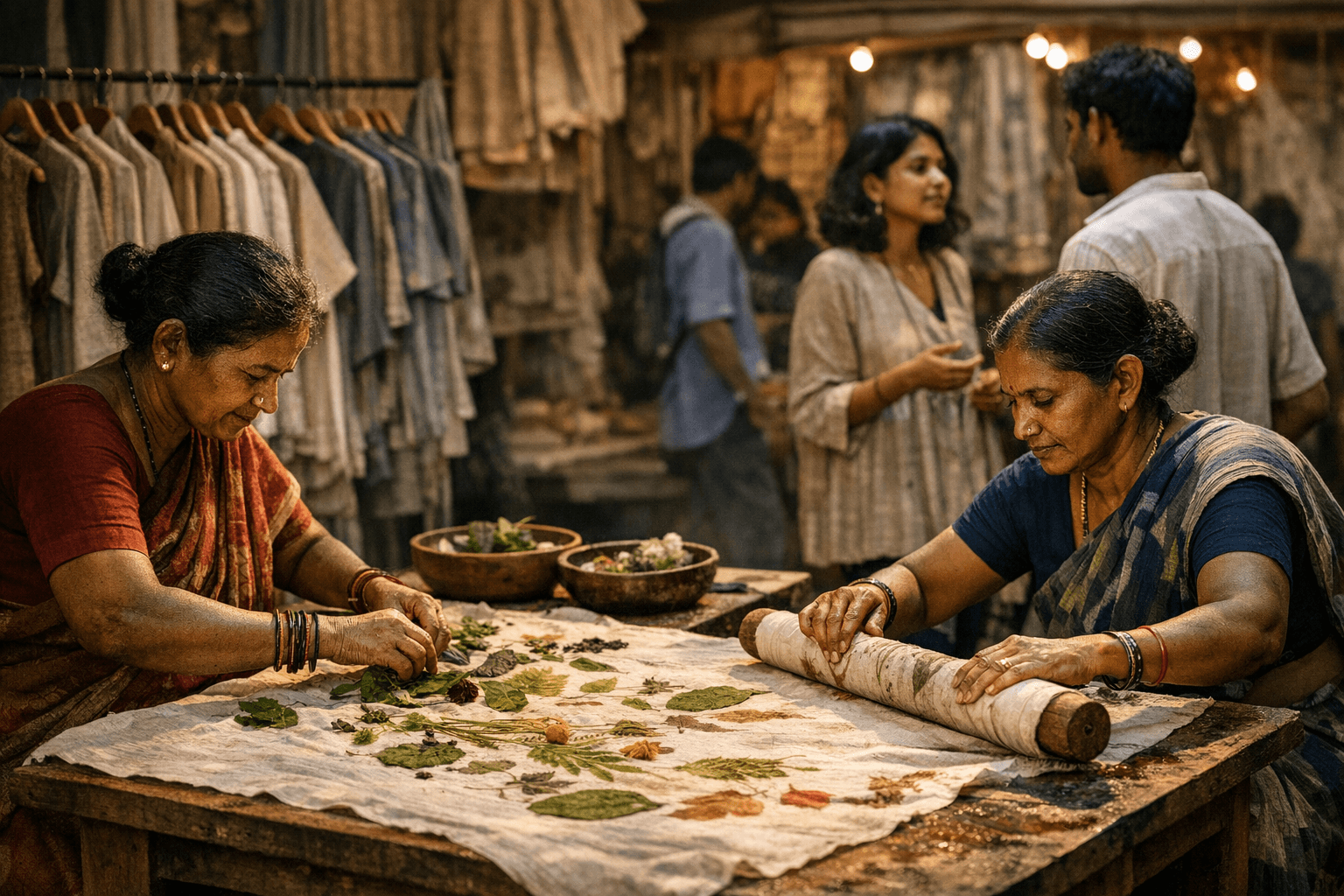
The workshop component is what gives the event its edge. Over the two days, five eco-printing sessions are built into the program, and participants aged eight and above can join. That makes the experience unusually open, especially for a textile event that could have easily stayed locked inside a craft-world niche.
Eco-printing is one of those techniques that looks simple until you watch it happen. Leaves and flowers are used to transfer natural dyes onto fabric, so the print is not merely applied, it is coaxed out of the plant itself. The result has a softer, more unpredictable beauty than machine repetition, and that irregularity is exactly the point: the cloth carries evidence of touch, season, and material choice.
For a sustainable fashion reader, this is where the event gets interesting. Eco-printing is low-impact not because it is a trend label, but because it pulls pigment and pattern from the environment rather than leaning on industrial processing. It also gives younger visitors a direct way into textile making, which is smarter than just hanging finished garments on racks and hoping the idea of sustainability sells itself.
The CoEK connection gives the event its backbone
The Centre of Excellence for Khadi, or CoEK, is not just a branding flourish here. It was conceived by the Ministry of MSME and established through the Khadi and Village Industries Commission with technical support from the National Institute of Fashion Technology. The structure matters: a hub at NIFT Delhi with spokes in Gandhinagar, Kolkata, Shillong, and Bengaluru signals an effort to take khadi out of the realm of sentiment and into systems of design, production, and market development.
CoEK frames itself as an experimentation, innovation, and design center for khadi products, including fabrics, apparel, accessories, and home fashion. That is the right move for a category that has often been flattened into the same visual shorthand, beige, earnest, handwoven, slightly predictable. What CoEK offers is differentiation, and that is what keeps heritage textiles from becoming decorative nostalgia.
At Gandhigram, that strategy is visible in the muslin saris and the kalamkari pieces associated with CoEK. These are not token additions. They are the evidence that khadi can be reworked with better design discipline, sharper merchandising, and a wider fashion vocabulary without abandoning the labor structure that makes it meaningful in the first place.
Why Gandhigram’s history still matters now
Gandhigram Khadi & V.I. Public Charitable Trust was founded in 1947 by Dr. T.S. Soundaram and Dr. G. Ramachandran, both described as disciples of Mahatma Gandhi. That origin story is not background noise. It explains why the institution still talks in the language of village empowerment and holistic development instead of pure retail growth.
The numbers on the institutional side are small enough to feel human and large enough to matter: CoEK lists Gandhigram’s khadi operation with 140 spinners and 30 weavers. That is the kind of workforce that gives a garment its moral and material weight. Every piece carries the fact of labor, and in a market flooded with synthetic speed, that level of visibility feels almost radical.
The sale proceeds also feed back into rural artisans and development programmes, which is the real architecture behind the event. This is not charity dressed up as commerce; it is commerce structured to keep skill, income, and production tied together. That matters because sustainable fashion without livelihood support is just better packaging.
A Chennai pop-up with a track record
This is not Gandhigram’s first Chennai moment, and that matters. A prior Magic of Khadi exhibition and sale was promoted in the city in May 2022 at Sarangi, the Store, which tells you the brand has been building this bridge for a while. The current pop-up also sits inside a larger shift already visible in Chennai’s fashion scene, where khadi is being pushed into more contemporary language rather than left in the archive.
That direction was already clear in Gandhigram’s collaboration with the Chennai label Kaveri, which worked to modernize khadi through sustainable design and natural dyes. Taken together, these moves show a strategy, not a one-off event: keep the hand-spun core, refresh the styling, and let the market see khadi as something that can hold both heritage and appetite.
The bigger takeaway
The Magic of Khadi pop-up works because it refuses to separate beauty from process. The fabrics are tactile, the color story is grounded in plant-based techniques, and the institutional model links every purchase back to rural livelihoods in a concrete way. In a fashion moment obsessed with cleaner supply chains and more honest material stories, Gandhigram is offering one of the few examples that feels both culturally rooted and commercially legible.
This article was produced by Prism’s automated news system from verified source data, official records, and press releases, then run through automated quality and moderation checks before publishing. The system is built and supervised by the people who set the standards it runs under. Read our full AI policy.
Did this article answer your question?


