Icebreaker reaches 98% plastic-free fibers with Merino wool push
Icebreaker moved to 98% plastic-free fibers in 2025, but the last 2% shows how hard it is to strip petrochemicals from performance apparel without losing function.

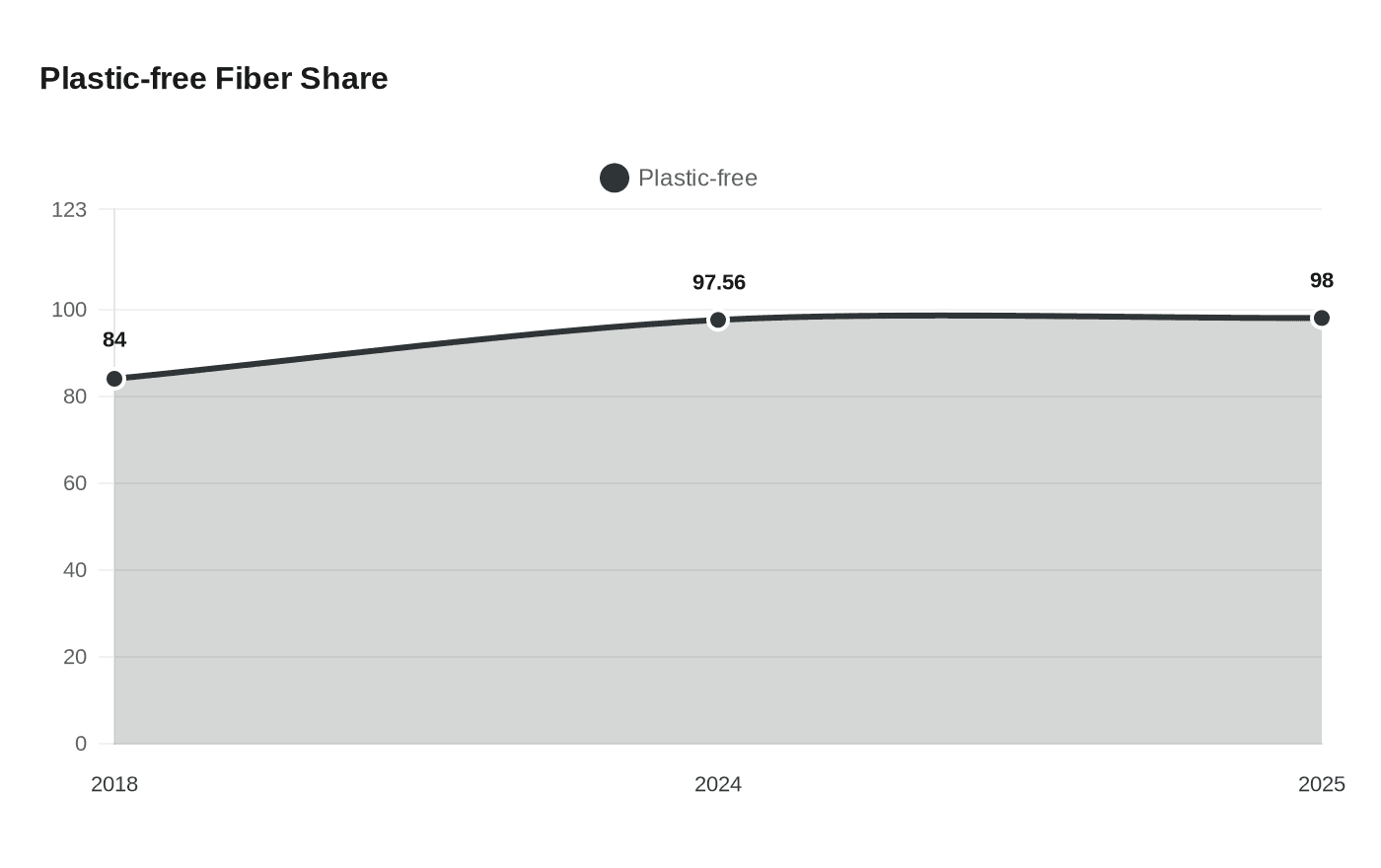
Icebreaker has pushed 98% of its textile fibers into plastic-free territory, a modest 0.44-point gain from 97.56% in its 2024 collection, but one that still matters in a category where synthetic convenience has long ruled. The deeper story is not the headline number. It is how stubborn the last sliver remains, and how deliberately the New Zealand brand is using Merino wool to pry performance apparel away from fossil-fuel-based inputs.
The shift began in 2018, when Icebreaker says 84% of its fiber composition was already plastic-free. Since then, the brand has moved from 84% to 97.56% in its 2024 collection and now to 98% in its 2025 materials overview. Merino wool is doing most of the heavy lifting. Icebreaker says Merino accounted for 84.25% of the fibers used in 2025, and that 100% of its Merino wool is traceable back to source. In a market still heavily dependent on polyester, nylon and other petrochemical fibers, that is a meaningful tilt toward natural materials rather than a token capsule of greenwashed basics.
What makes the final 2% difficult is also what makes performance clothing work. Icebreaker says it is still testing bio-based substitutes where full elimination of plastics is constrained by performance or supply chain realities, and it has pointed to natural alternatives such as TENCEL as part of that effort. That is the familiar friction point for the industry: the more a garment has to stretch, hold shape, resist wear or survive repeated washing, the harder it is to remove every synthetic element without compromising the product. The last percentage points are rarely about the main fabric alone.
Icebreaker’s strategy is tied to regenerative agriculture, with a goal of sourcing 100% of its wool from growers using regenerative practices by 2028. That gives the brand a cleaner narrative than many outdoor labels, where sustainability often stops at recycled content claims. It also reflects Icebreaker’s long-running dependence on Merino, the fiber that has defined the company since Jeremy Moon founded it in New Zealand in 1995. VF Corporation completed its acquisition of Icebreaker in 2018, but the brand still frames its identity around a “Move to natural” positioning rather than a race to invent another synthetic substitute.
The broader question is whether Icebreaker is a blueprint or an exception. Its numbers show a credible path for brands that already sit close to natural fibers and can build long-term relationships with growers. But for the wider fashion industry, especially mass-market sportswear, 98% plastic-free is still less a finish line than proof of how hard it is to make modern clothing without the fossil-fuel crutch.
This article was produced by Prism’s automated news system from verified source data, official records, and press releases, then run through automated quality and moderation checks before publishing. The system is built and supervised by the people who set the standards it runs under. Read our full AI policy.
Did this article answer your question?


