Paris Fashion Week 2026 Embraces Nature, Heritage Craft, and Mindful Design
Nicolas Ghesquière built a fake mountain range inside the Louvre — and somehow, that was just the beginning of Paris Fashion Week's wildest, most nature-obsessed season in years.

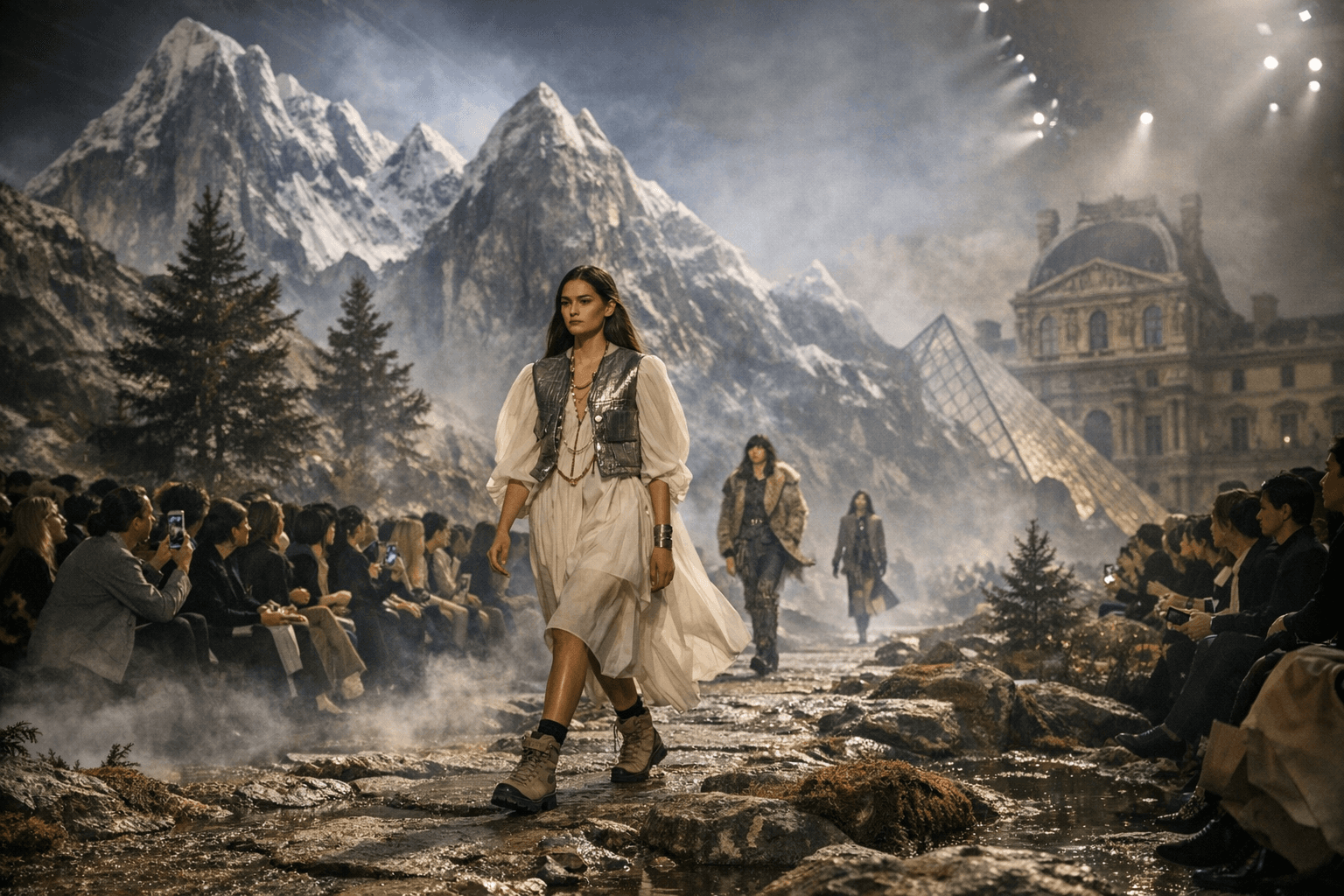
Nicolas Ghesquière built a fake mountain range inside the Louvre and sent models climbing through it. That image — part alpine theater, part art installation, entirely Louis Vuitton — crystallized something the Fall/Winter 2026 Paris runways had been circling all season: a collective hunger for the elemental, the handmade, and the deliberately considered. Nature wasn't a mood board reference this time. It was load-bearing.
Louis Vuitton: Folklore as High Fashion
Ghesquière closed Paris Fashion Week with a show that treated folklore not as costume but as creative language. Capes, cowbells, shearling caps, and walking sticks draped with handbags populated the constructed mountain terrain inside one of the world's most recognizable museums. The effect was deliberately strange and precisely beautiful: rural Alpine iconography elevated through the vocabulary of luxury fashion, the pastoral made monumental by its setting.
The garments themselves operated on a principle of studied restraint. Stripped-back silhouettes formed the foundation, with the conceptual weight carried by embellishment and material detail rather than volume or structure. Wolves, sheep, and rabbits appeared embroidered across jackets and skirts, while Ukrainian artist Nazar Strelyaev-Nazarko painted lambs directly onto pieces, bringing a painterly specificity that separated this animal imagery from seasonal trend decoration. These weren't woodland motifs lifted from a print archive; they were commissioned works of craft.
Ghesquière also reached into fashion history for one of the collection's most resonant gestures: a reinterpretation of a Man Ray parure once worn by Catherine Deneuve, now studded with the nailheads of a Louis Vuitton trunk. The piece collapsed decades of French cultural mythology into a single object, merging surrealist art, cinematic glamour, and the house's own archival hardware. Tuxedo trousers traded their satin side-stripes for strips of fluff; rain capes in scarlet and baby blue crackled against the earthy palette. Coats were lined in hemp-based faux fur, a material choice that nodded toward mindful production without announcing itself as a sustainability statement.
The Accessories Did the Heavy Lifting
At Louis Vuitton this season, the accessories were not supporting cast. As the AP observed, "The accessories did the work the clothes refused to." Where the garments pushed toward the conceptual, the objects grounded everything. Embellished chapkas, crystallized belts, and bedazzled sneakers each served as the one loud element against all that quiet fabric. Heels were carved to look like antlers, a detail so committed to the collection's woodland logic that it read as both absurd and inevitable.
The bags told their own history. The Noé returned in its original 1932 shape, a reissue that carries genuine weight when you consider the bag's origins as a champagne carrier and its subsequent decades as a house icon. Mini Malles arrived in soft new versions, loosening the rigidity of the classic trunk format into something more tactile and wearable. The accessories pulled everything back to earth precisely because they were so specific — named pieces with known histories, not seasonal novelties.
A Cast That Earned Its Place
Casting at the Louis Vuitton show was as deliberate as the garments. TXT member Yeonjun appeared alongside actors Diana Silvers and Gemma Ward in a lineup that, as the AP noted, "spanned generations and gave the stripped-back clothes a weight that a cast of teenagers would not have." That observation matters. Cross-generational casting is a creative decision as much as a commercial one; it changes how clothes read, how they settle, how they communicate longevity rather than novelty. Ward, whose career stretches back to the early 2000s and whose face carries a particular kind of quiet authority, brought something to these pared-back pieces that no amount of styling could manufacture.
The Season's Larger Argument
Louis Vuitton did not exist in isolation. The Fall/Winter 2026 Paris season was, broadly speaking, a month of maximalism in a specific register: shows that "armored the body, padded it and buried it in texture," as the AP characterized the dominant mode. Within that context, Ghesquière's stripped-back approach to the clothes themselves — letting the embroidery, the accessories, and the staging do the speaking — registered as its own kind of counterstatement.
The most direct counter-argument came from Prada, which closed the season with what the AP described as the opposing position: "The body is already enough. The clothes just need to get out of its way." That sentence landed as a provocation against the month's prevailing instinct toward construction and weight. Two philosophies, then, bookending Paris Fashion Week: one that buries the body in craft and texture, another that insists the body requires nothing added. Neither is wrong. Both are, in their own way, a response to a fashion moment that is visibly reckoning with what clothes are for.
Miu Miu also closed the week, sharing billing with Louis Vuitton in what was framed as a presentation of "competing visions of nature." The specifics of that vision are worth examining on their own terms once full collection details are available; the headline pairing alone suggests Miuccia Prada's other house was operating in deliberate counterpoint to Ghesquière's folkloric mountain world.
Nature, Craft, and the Longer Thread
Pull back from any single show and the season's throughline becomes legible: designers returning to nature not as aesthetic but as argument. At Louis Vuitton, this materialized as embroidered fauna, painted lambs, antler hardware, hemp-based linings, and a constructed landscape that forced the entire audience to reckon with mountains inside a palace. Heritage craft entered through the Man Ray parure, through the 1932 Noé, through the commissioned work of Nazar Strelyaev-Nazarko. Mindful production showed up in the material choices, including the hemp-based faux fur that replaced conventional lining options without fanfare.
None of this was accidental. The throughline from nature to craft to mindful design describes a creative posture, a way of asking what fashion is accountable to. When Ghesquière studs a Deneuve-worn parure with Vuitton trunk nailheads, he is asking the house's own history to justify itself. When he lines coats in hemp-based faux fur, he is making a material argument that doesn't require a press release. When he builds a mountain range inside the Louvre and asks Gemma Ward to climb it, he is insisting that fashion can still be genuinely strange, rooted in something older and more durable than trend.
That insistence, repeated across houses and collections in different registers this season, is what makes Paris Fashion Week 2026 worth paying attention to. The clothes were asking questions the industry has been circling for years. A few of them, finally, felt like answers.
Know something we missed? Have a correction or additional information?
Submit a Tip