Retailers Face Trust Gap as Shoppers Demand Return Transparency
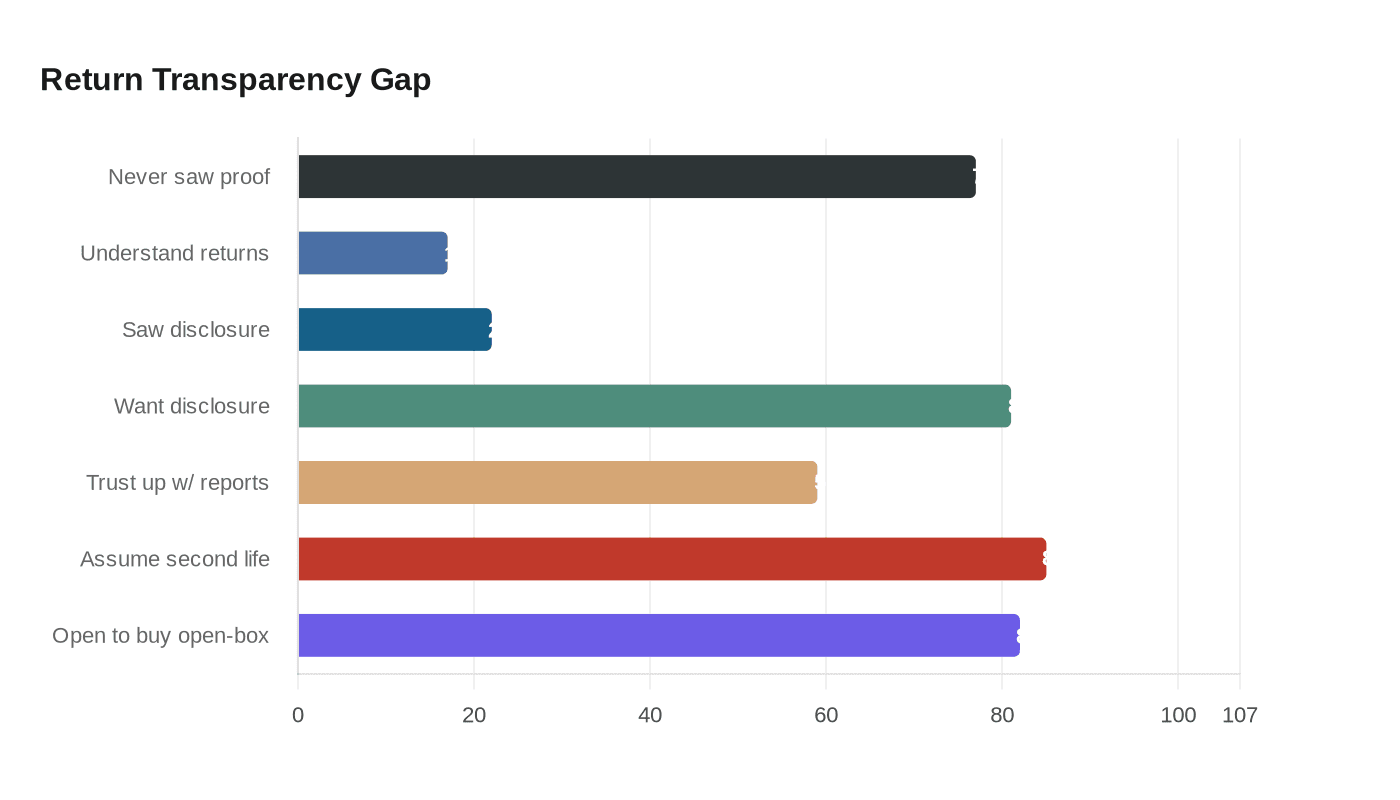
77% of shoppers say they never see proof of where returns go, even as 89% of retailers say their data would pass audit. That trust gap is leaving resale cash behind.

Retailers are sitting on sustainability data, but shoppers still cannot see where the returns go, and that missing proof is killing both trust and resale money. ReturnPro’s 2026 Sustainability Proof Gap Report says 77% of consumers have never seen proof of what happens to returned products, even though 89% of retailers said their sustainability-related data would withstand audit. That is the ugly little paradox in modern retail: the back end may be getting cleaner, but the front end still looks opaque.
The numbers are not subtle. In a survey of 1,000 consumers and 300 retail executives, only 17% of consumers said they understand what actually happens to returns, while just 22% have seen retailers disclose the outcome. Yet 85% assume returned products get a second life, and 82% said they are open to buying open-box or returned items. Recommerce still makes up less than 5% of retailer revenue, which means the category has demand, but not enough trust or visibility to convert that demand into real sales. ReturnPro’s read is blunt: the problem is not a measurement gap but a credibility gap, as co-founder and CEO Sender Shamiss put it.

That credibility gap matters because shoppers are not asking for abstract sustainability talk. They want receipts. In the same report, 81% of consumers said they want retailers to disclose what happens to returns, and 59% said clear reporting on reuse and recycling rates would increase trust. For a customer weighing a returned jacket, a deadstock sneaker, or an open-box bag, that disclosure is the difference between feeling smart and feeling duped. The product may already exist, but without a visible pathway to resale, repair, or recycling, the value gets trapped in the warehouse instead of reaching the customer.
ReturnPro has been circling this issue for years. Its 2025 consumer survey of 500 U.S. shoppers found that 29% did not believe returns cost retailers anything, while nearly half thought brands break even on returned items. That same survey found 55% would be more likely to buy from secondary marketplaces if tariffs pushed prices higher. The broader pressure is real too: ReturnPro’s 2024 report said U.S. retail returns generate 16 million metric tons of carbon emissions and 9.5 billion pounds of landfill waste annually, while 72.8% of retailers said they were focusing on sustainable improvements in reverse logistics.
The bigger market is already moving. The U.S. Government Accountability Office has said textile waste has risen over the past 20 years, with EPA data showing more than a 50% increase between 2000 and 2018 and 17 million tons generated in 2018. ThredUp’s 2025 Resale Report says online resale is on track to hit $40 billion by 2029. Retailers already have the inventory, the data, and the infrastructure. The ones that win next will be the ones that let shoppers see the afterlife of a return before that return becomes somebody else’s profit.
This article was produced by Prism’s automated news system from verified source data, official records, and press releases, then run through automated quality and moderation checks before publishing. The system is built and supervised by the people who set the standards it runs under. Read our full AI policy.
Did this article answer your question?


