Sulzer Joins Spinnova Ecosystem to Scale Wood-Based Fibre for Industry
Sulzer's engineering expertise joins Spinnova's wood-fibre consortium, applying pumping and process know-how to push the chemical-free material toward industrial-scale supply.
The bottleneck for bio-based textile fibres has rarely been the science. It has been the engineering. Sulzer, the Swiss industrial specialist headquartered in Winterthur, joined Spinnova's supply-chain consortium on April 1, formalising a partnership that places serious process muscle behind one of textiles' most closely watched material innovations.
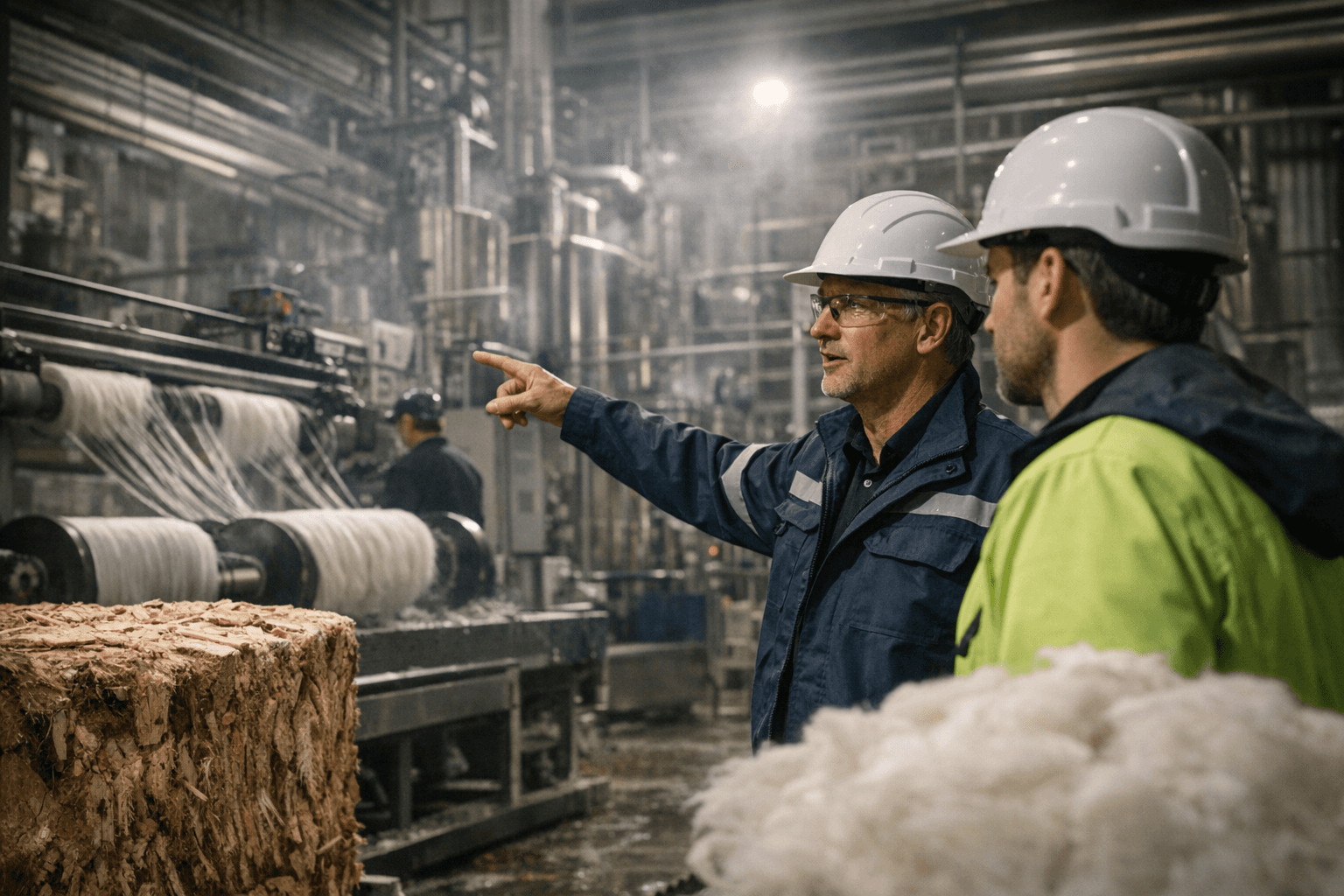
Spinnova, the Finnish technology company based in Jyväskylä, makes SPINNOVA® fibre from wood pulp and cellulosic waste, including leather offcuts, discarded textiles and agricultural residues, entirely without the chemical-dissolution solvents that define conventional viscose and lyocell production. The fibre produces no side streams, uses minimal water and CO2, and is both biodegradable and recyclable. Spinnova CEO Janne Poranen has described it as achieving a cotton-like hand without viscose's characteristic shine, which makes it commercially legible to brands already working in natural-feel textiles. What it has needed, in common with most novel bio-based materials, is a credible industrial pathway from a promising pilot to consistent, cost-competitive volume.
That is precisely what Sulzer brings. The company's expertise in pumping, mixing and fibre suspension flows maps directly onto the engineering demands of scaling a wet-process fibre line. Mikko Kautto, who manages technology concept and partners at Spinnova, framed the collaboration in operational terms: "By combining Sulzer's technology and engineering expertise in pumping, mixing and fibre suspension flows with our technology concept, we can industrialise more effectively. This partnership strengthens the entire process from planning to implementation, improving the concept competitiveness at large scale."
The two companies are not starting from scratch. Sulzer was involved in the Woodspin demonstration factory in Jyväskylä, a facility with a nameplate capacity of 1,000 tonnes of SPINNOVA® fibre per year that opened in May 2023, supporting both its planning phase and production ramp-up. Sulzer also assisted in developing the piloting environment for microfibrillated cellulose production. The April announcement formally extends that working relationship into Spinnova's broader ecosystem strategy, where the goal is not a single factory but a replicable, commercially viable process that other manufacturers can adopt at scale. Sirpa Välimaa, head of Sulzer's pulp, paper and board business segment, positioned the commitment as forward-looking: "Sulzer is committed to supporting companies that push the boundaries of innovation like Spinnova."
The consortium has been growing quickly. Textile recycler Circulose, whose patented process converts cotton-rich textile waste into dissolving pulp, joined in March 2026, adding a circular feedstock route. Tommy Hilfiger and German label Armedangels both signed on in December 2025, with Armedangels committing through a letter of intent to secure future fibre volumes for its collections. Innovation accelerator Fashion for Good and Portuguese yarn spinner Tearfil are also participating.
The assembled group now covers feedstock, engineering, spinning and brand demand, the full stack required to move a novel fibre from laboratory curiosity to supply-chain reality. Sulzer's arrival signals that the industrialisation phase, long the graveyard of promising sustainable materials, has begun in earnest.
This article was produced by Prism’s automated news system from verified source data, official records, and press releases, then run through automated quality and moderation checks before publishing. The system is built and supervised by the people who set the standards it runs under. Read our full AI policy.
Did this article answer your question?


