Sustainable Fashion’s End‑of‑Life Problem
Less than 1% of discarded clothing becomes new fiber, and even garments marketed as sustainable face the same dead end. Here's why the loop refuses to close.

The Number That Should Embarrass the Entire Industry
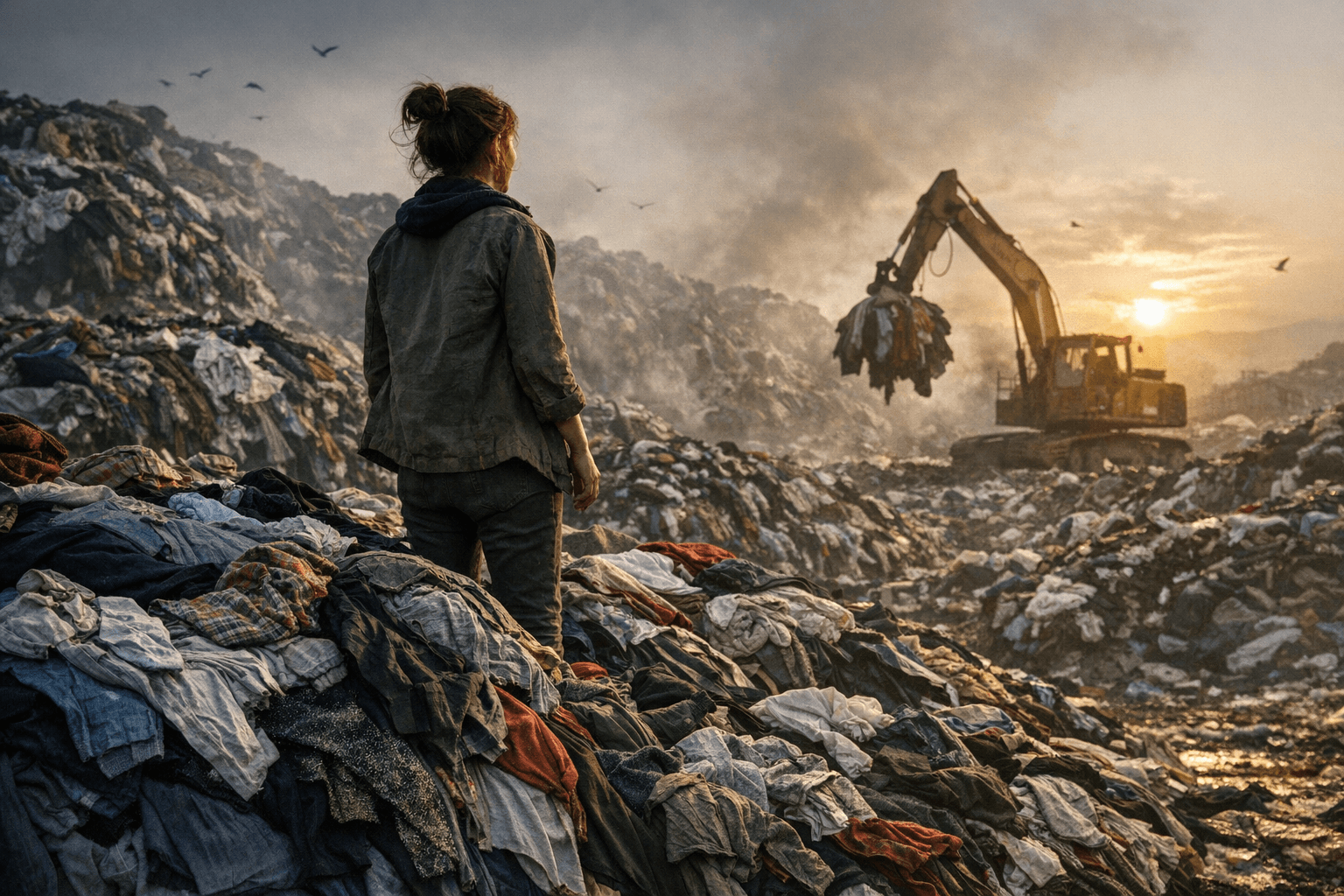
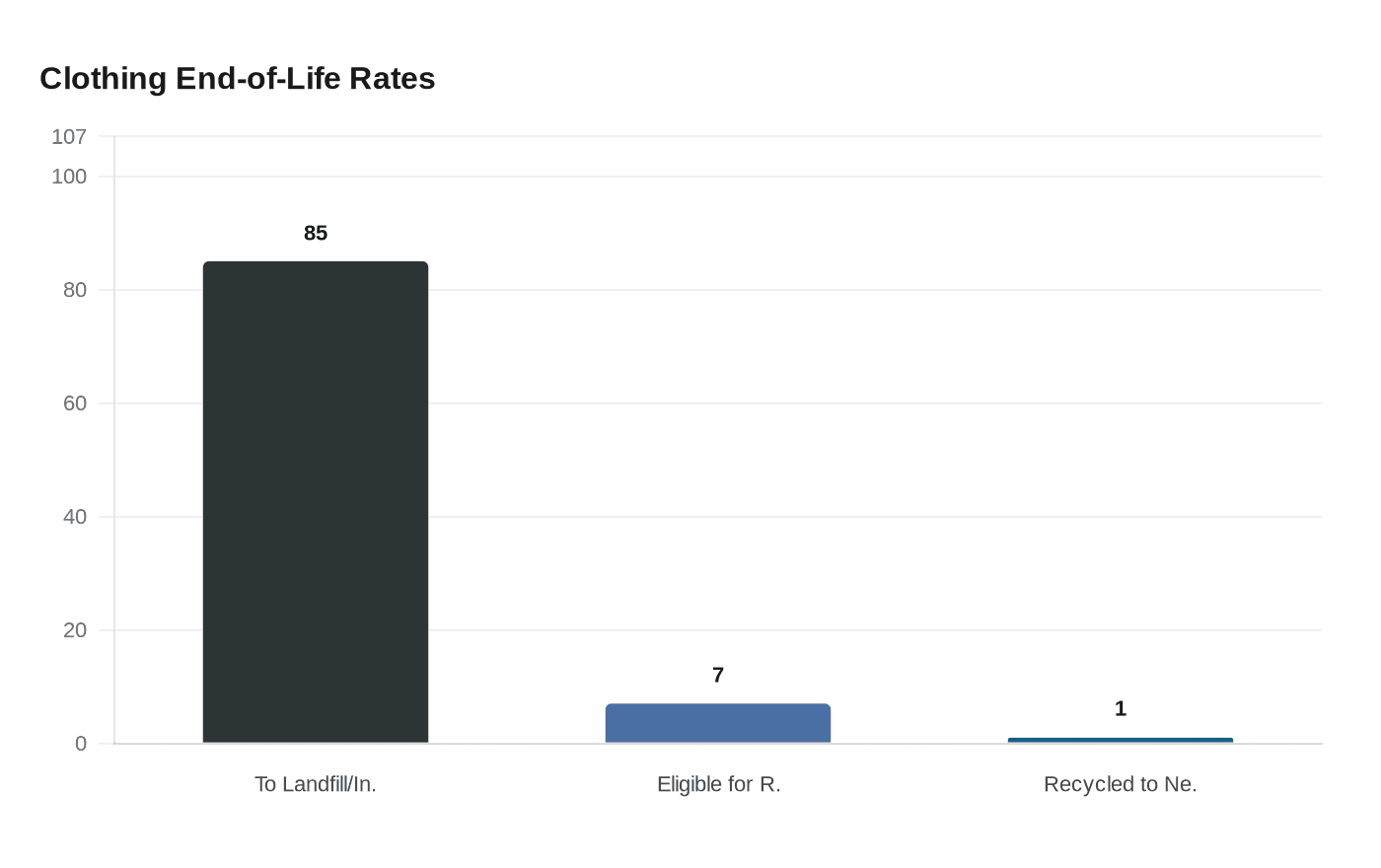
120 billion. That is the approximate number of garments produced globally each year. The figure that matters more, though, is this one: less than 1 percent of all clothing discarded globally is recycled back into new textile fiber, according to a Boston Consulting Group report. That statistic does not discriminate. It covers your organic cotton tee, your lyocell wrap dress, and your recycled-polyester puffer alike. The world now discards roughly 120 million metric tons of clothing annually, and the infrastructure to close that loop does not exist at the scale the moment demands.
The BCG's managing director and partner Catharina Martinez-Pardo put it plainly: "The costs of waste are staggering. We're throwing away billions in value while missing a huge opportunity to make the fashion industry more sustainable and resilient." That quote lands harder once you understand exactly where the system breaks down, because it breaks down in several places at once.
Why the Blue Bin Is a Dead End
Clothing cannot go into a household recycling bin. Unlike paper or glass, textiles wrap around and jam the sorting machinery at municipal facilities, making them functionally incompatible with curbside collection. Any garment dropped into a standard blue bin will likely be pulled out and sent straight to landfill, regardless of how conscientiously it was made.
A 2025 Government Accountability Office report, the first comprehensive federal study of U.S. textile waste, found that roughly 85 percent of discarded clothing ends up in a landfill or an incinerator. The GAO's investigation also revealed the scale of federal inaction: no national coordination mechanism for textile waste exists, no federal requirement for agencies to address it, and the report made seven recommendations to six different federal agencies, urging Congress to designate a lead entity to build a national strategy. California has moved ahead independently with its own producer responsibility legislation, but that action remains strikingly isolated.
The Charity Bin Illusion
For clothing deposited through what seem like responsible channels, including brand take-back programs, textile collection drops, and charity bins, the sorting process that follows determines almost everything. Of the clothes that do enter the collection system, a significant share is exported for resale in secondhand markets abroad rather than being recycled. The pipeline that was supposed to close the loop mostly reroutes it offshore.
A 2023 investigation tracked 21 items submitted to take-back schemes run by ten global brands. Despite being in good condition, those items met a variety of fates that belie sustainability claims. Seven were shredded, burned, or repurposed into rags or stuffing within weeks. Only five were resold as clothing, and just one stayed in its original country. Several ended up in warehouses for months; others were shipped to markets in Africa, where between 20 and 50 percent of imported secondhand clothing is estimated to become waste due to insufficient local waste management infrastructure.
The aggregate picture is damning: only about 7 percent of collected textiles are deemed technically eligible for fiber recycling at all, and of that portion, less than 1 percent actually becomes new textiles. Even in the best-case scenario, the collection system is processing a fraction of a fraction.
Why "Sustainable" Fibres Are Not Exempt
This is where the story gets particularly uncomfortable for the conscientious shopper. The very materials positioned as alternatives to conventional cotton and virgin polyester face their own recycling dead ends.
Organic cotton and lyocell, two of the most commonly marketed sustainable fibres, degrade significantly through mechanical recycling. Mechanical processes cut and shred textile waste before processing, which causes fiber damage and breakage. For cotton, successful fiber-to-fiber recycling depends on preserving a high degree of polymerization in the cellulose, and multiple home-laundering cycles alone age and weaken those fibers before they ever reach a recycling facility. The result is a shorter, weaker fiber that cannot produce quality new textile without blending in virgin material.
Recycled polyester, known commercially as rPET, carries a different set of complications. Polyester, one of the most environmentally damaging materials, is one of the most talked-about fibers in textile recycling. The majority of rPET currently used in fashion is derived from plastic bottles, which is a relatively straightforward process. Converting post-consumer textile polyester back into textile-grade polyester requires re-polymerization: breaking the polymer chains back to their chemical building blocks and rebuilding them. That process is technically complex and costly at scale, and most existing infrastructure is not equipped for it. The gap between "recycled polyester" as a marketing claim and "fiber-to-fiber polyester recycling" as an industrial reality is vast.
Where the Industry Is Directing Its Bets
The directions being pursued to fix this fall into three broad categories, each at a different stage of maturity.
- Collection and sorting infrastructure: The most immediate bottleneck is not chemistry; it is logistics. Scaling up dedicated textile drop points, investing in industrial sorting equipment that can identify fiber content automatically (optical and near-infrared sorting technology is advancing), and standardizing what qualifies for take-back are foundational steps that precede any recycling at all.
- Chemical recycling routes: Rather than shredding fibers mechanically, chemical recycling dissolves or depolymerizes textiles back to their molecular precursors, allowing reconstituted fiber that can match virgin quality. Enzymatic recycling, which uses biological catalysts to break down specific polymer types, has attracted serious commercial interest. In 2025, Lululemon and recycling innovator Samsara Eco announced a ten-year offtake agreement for enzymatically recycled nylon and polyester, a signal that at least some brands are prepared to make long-horizon commitments to scaling these technologies.
- Policy and producer responsibility: In September 2025, the European Parliament approved a significant revision to the Waste Framework Directive, introducing a mandatory Extended Producer Responsibility scheme for textiles and footwear. Under this framework, producers, including global brands selling into the EU, must finance and manage the collection, sorting, reuse, and recycling of textile waste rather than leaving those costs to municipalities and consumers. The directive entered into force in October 2025, with EU member states given defined timelines to build national EPR systems. These systems will set eco-modulated fees that reward durability and recyclability, imposing higher costs on products that are harder to reuse or recycle.
The Greenwashing Trap at End-of-Life
The danger of the current moment is not that brands are lying about what they make; most certified organic cotton is genuinely organic cotton. The greenwashing happens downstream, in the implicit promise that buying a "sustainable" garment creates a sustainable outcome. It does not, not yet, because the infrastructure that would honor that promise does not exist at scale.
For consumers, the most effective move is to delay a garment's entry into the recycling system entirely, through repair, resale platforms like ThredUp or Poshmark, or direct donation to organizations with the sorting capacity to place it with a second wearer. That is not a satisfying answer for an industry that has spent years building its identity around the materials at the point of purchase. But until brands, policymakers, and recycling technologists align on collection infrastructure, scalable fiber-to-fiber processing, and honest end-of-life labeling, the most sustainable thing a garment can do is stay in use, in the wardrobe of someone who will actually wear it.
The circular fashion economy remains, for now, more aspiration than architecture. The gap between what the labels promise and what the bins deliver is where the industry's credibility is quietly being lost.
This article was produced by Prism’s automated news system from verified source data, official records, and press releases, then run through automated quality and moderation checks before publishing. The system is built and supervised by the people who set the standards it runs under. Read our full AI policy.
Did this article answer your question?


