Aidan Colucci turns industrial labor into refined menswear
Colucci turns a waste-disposal job into menswear with real structure: less costume workwear, more precise silhouettes, durable logic, and grit.

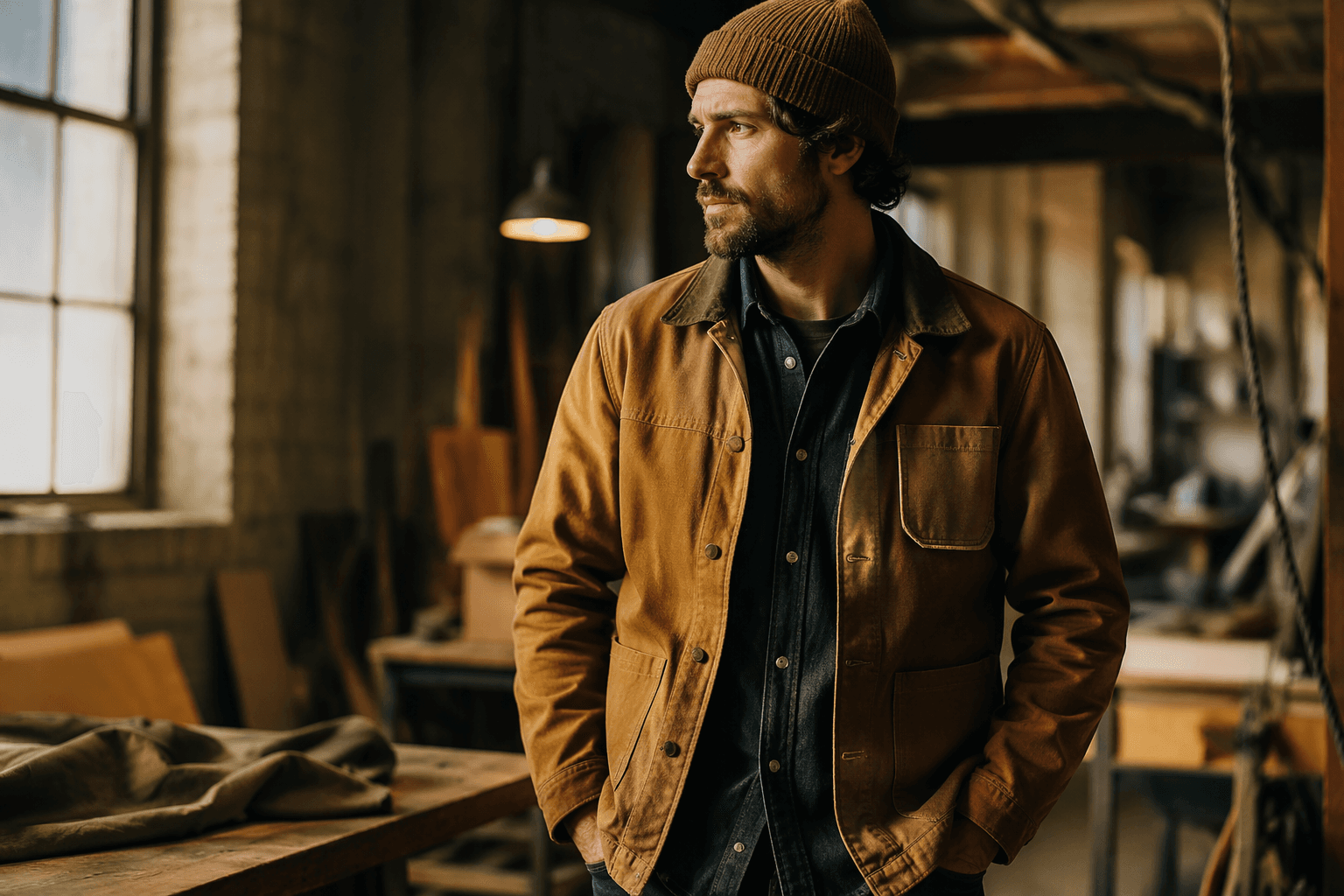
Aidan Colucci makes a sharp case for luxury workwear here, and he does it without falling back on the easy clichés of blue-collar dressing. The collection feels grounded in real labor, not borrowed attitude: its force comes from industrial memory translated into pattern logic, fabrication choices, and silhouette discipline. That is what gives the clothes their authority, and why they read as menswear with weight rather than a runway costume dressed up as grit.
Industrial memory, refined into design
What makes Colucci’s collection distinctive is the way it turns firsthand work experience into form. A former job at a waste-disposal company could have produced the usual references, camouflage prints, splashes of hi-vis color, or exaggerated pockets used as shorthand for hard work. Instead, the collection treats that world as a design system, where repetition, structure, and utility become the real source material.
That difference matters. When workwear is merely moodboarded, it often arrives as nostalgia with cleaner seams. Colucci’s version feels more convincing because it starts from labor itself, from the logic of garments that have to endure movement, weather, and repetition. The clothes do not need to shout about work to feel worked in.
The codes that make it feel authentic
The strongest workwear stories always begin with function, and this one does too. Industrial labor suggests garments built for durability, easy motion, and predictable performance, and those are the design ideas that give Colucci’s collection its edge. Instead of romanticizing the job, he appears to borrow its discipline: the kind of structure that keeps a garment useful, the kind of repetition that turns a silhouette into a uniform, the kind of grit that comes from clothes earning their shape over time.
That is why the collection lands as a menswear proposition rather than a costume exercise. The visual language is less about quoting a job site and more about absorbing the conditions of labor into the cut of the clothes. In a good workwear-inspired collection, you should feel the weight of the fabric, the practicality of the line, and the discipline of a silhouette that knows what it is for. Colucci’s strength is that he understands how to make those ideas feel elevated without sanding them down.
The result is especially persuasive because it treats utility as a refinement strategy. The more the collection resists theatrical gestures, the more the underlying intelligence comes through. This is not workwear as spectacle. It is workwear as structure.
Why SCAD FASHION 2026 gave the collection the right stage
SCAD FASHION 2026, presented May 13 to 15 in Savannah, gave Colucci a runway large enough to support that kind of thinking. The showcase concluded Friday, May 15, at 8:30 p.m. ET at the SCAD Museum of Art, with a livestream reaching audiences around the world. SCAD said the 2026 runway featured more than 60 designers from the School of Fashion’s largest graduating class ever and debuted nearly 200 looks, which made the event feel less like a single student presentation and more like a full picture of where the school’s fashion voice is headed.
The production values reinforced that scale. Janet Echelman’s aerial fibers installation veiled the runway with a sense of movement and suspension, while creative contributions from Lil Buck and SCAD student Jeremiah Elias pushed the event beyond a standard graduation show. Coco Rocha returned to coach the student models, bringing the kind of runway discipline that can sharpen a collection’s visual message. In that setting, Colucci’s industrially informed menswear did not get lost in the spectacle. It held its own.
Workwear’s longer lineage gives the collection weight
Colucci is working inside a much older fashion story. Workwear has roots in 19th-century labor, when garments were built for manual workers such as carpenters, mechanics, and builders and judged first by durability and utility. Over time, brands such as Carhartt, Dickies, and Levi’s helped move that language into a more fashion-forward audience, where workwear became part of streetwear, menswear, and the broader wardrobe vocabulary of clothes that signal competence as much as style.
That history helps explain why the best workwear references do not look borrowed when they are done well. They carry a social memory. A garment cut with that lineage in mind has to feel useful first, decorative second. Colucci understands that distinction, and his collection feels smarter for it. The clothes suggest labor without pretending to have lived it, which is the difference between fashion that observes work and fashion that merely performs it.
Menswear at SCAD, and why this conversation matters now
The collection also sits neatly inside SCAD’s wider menswear conversation. On February 19, 2026, SCAD FASH Museum of Fashion + Film hosted Menswear Matters: Craft, Identity, and Expression, featuring Guerre, Darryl Lesure, and Sid Mashburn. The panel focused on storytelling, craftsmanship, custom tailoring, and menswear’s role in contemporary culture, which makes Colucci’s collection feel less like an isolated student project and more like part of a larger argument about how men dress now.
That argument is increasingly about clothing that can do more than look sharp from a distance. Menswear is moving toward pieces that carry a usable proposition, whether that means commuting ease, durability, or a sharper balance between practicality and polish. Colucci’s collection slots into that shift because it treats labor as a design grammar rather than a costume theme. It is that restraint, that confidence in structure over spectacle, that makes the collection feel like a real advance in refined menswear.
In the end, Colucci proves that industrial labor can become elegance when it is translated with enough discipline. The clothes do not merely reference work. They absorb its logic, and that is what gives them their force.
This article was produced by Prism’s automated news system from verified source data, official records, and press releases, then run through automated quality and moderation checks before publishing. The system is built and supervised by the people who set the standards it runs under. Read our full AI policy.
Did this article answer your question?