Filson Tin Cloth Cruiser defines rugged workwear outerwear
Filson’s Tin Cloth Cruiser turned waxed cotton, mapped pockets, and a weatherproof work shape into the outerwear code rugged brands still copy.

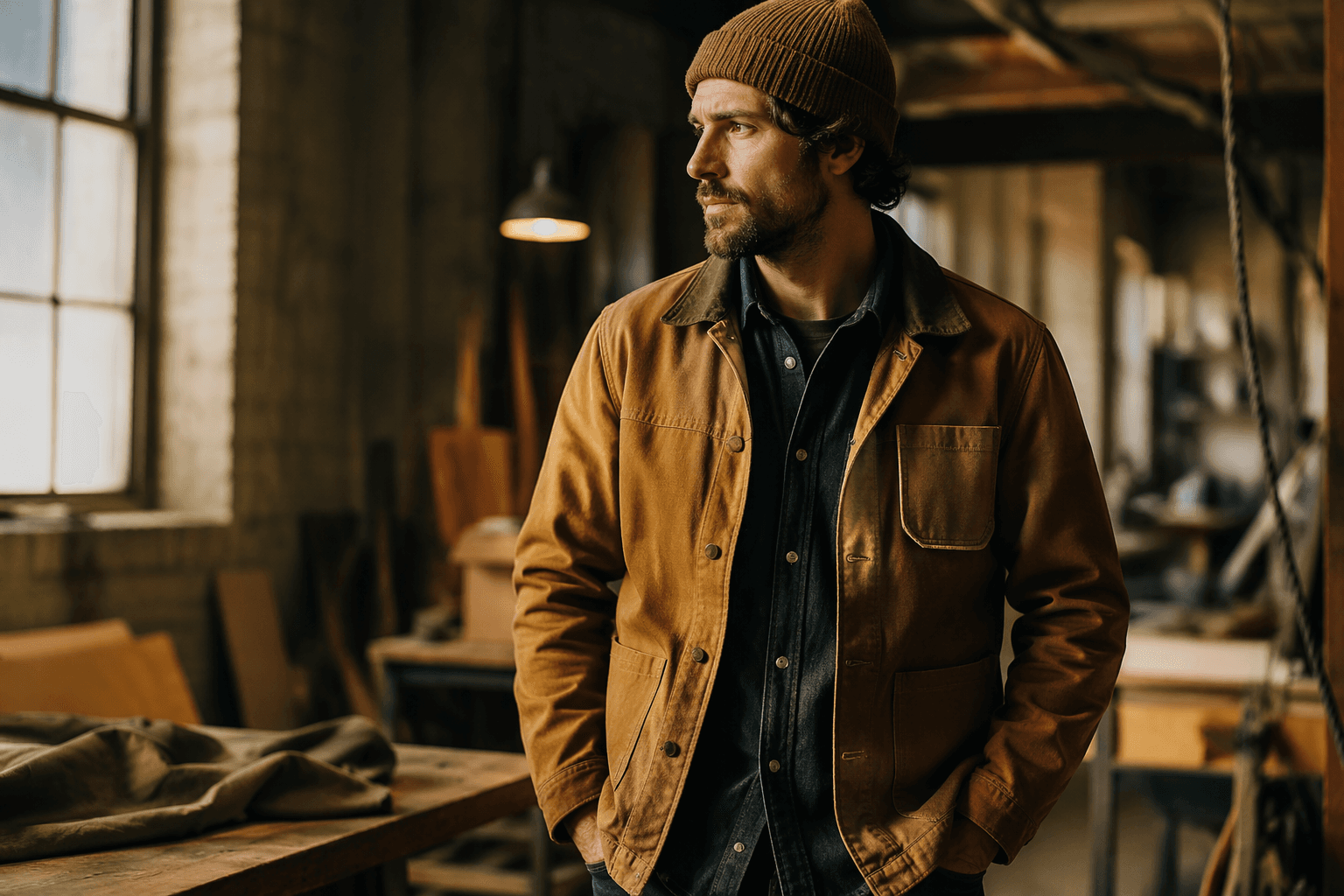
Filson’s Tin Cloth Cruiser reads less like a heritage icon and more like a working diagram with sleeves. Founded in 1897, C.C. Filson Company was already outfitting men for the Klondike by 1898, and that early purpose still shows in every ounce of the jacket’s logic: weatherproof fabric, practical pocketing, and a cut that puts movement ahead of polish.
A jacket built for labor first
The Cruiser did not emerge to flatter a mood. It came out of a world where clothes had to survive wet timber, cold mornings, and long miles on foot, which is why its shape feels bluntly efficient rather than styled. That utility-first attitude is what makes the jacket so important now, because the outerwear we call rugged today still borrows from this same formula: protection, storage, and enough ease to layer over real clothes.
The appeal is structural as much as visual. A good work jacket has to earn its silhouette, and the Cruiser earns its by being built for people who were carrying tools, maps, and weather on the same route. That is the difference between outerwear that merely looks field-ready and outerwear that has a field logic baked into the pattern.
The pocket map that set the standard
Filson’s archive places the Wool Cruiser Shirt patent on October 28, 1912, with approval two years later, and the design’s four-pocket front plus large back pocket became the garment’s defining utility layout. That arrangement matters because it turns the torso into a working surface, with storage placed where the body can reach it without breaking stride.
The back pocket, in particular, gave the Cruiser an unusually direct relationship to labor. Timber cruisers in the Pacific Northwest used it to pull out a map while moving through wet forests, a detail that says more about the garment than any mood-board language ever could. This is how workwear becomes canonical: not by borrowing the look of use, but by solving a real task so cleanly that the layout outlives the job site.
That same pocket logic still reads clearly on modern utility outerwear. Overshirts, chore coats, field jackets, and hybrid shells now lean on the same principles, with pocket placement doing as much aesthetic work as decorative trim ever could. When a jacket looks balanced because its storage is distributed with purpose, it is participating in the Cruiser’s design language whether the label says so or not.

Tin cloth made the silhouette believable
Filson introduced the Tin Cloth Cruiser in the 1920s, using waxed cotton imported from England through Britain Millerain for workers’ clothing that had to handle weather and heavy labor. The material itself is the point: tin cloth is tightly woven cotton with a wax treatment that gives the jacket waterproofing and abrasion resistance, which is exactly the sort of technical honesty that workwear shoppers still respond to now.
The fabric also explains the jacket’s presence on the body. Waxed cotton has a denser, more deliberate hand than a light shell, so the garment hangs with a kind of weather-ready authority instead of collapsing into softness. That matters in rugged outerwear, where the tactile difference between a flimsy layer and a protective one is visible before it is even tested.
Filson adjusted the finish in the 1990s, shifting to an oil-finish wax treatment that was less stiff and easier to maintain while keeping the same protective intent. That change is a useful reminder that durability does not have to mean rigidity. In modern workwear, the best pieces often balance protection with wearability, and the Cruiser’s evolution shows how a functional garment can adapt without losing its purpose.
Why the Cruiser still speaks to the workwear revival
The Cruiser’s staying power comes from the fact that it was never built as nostalgia. It belongs to a clothing system that includes timber cruisers, prospectors, and logging crews, and it was shaped by the same conditions that produced the broader backcountry uniform of the era. A 1925 testimony described logger’s boots, water-repellant pants and jackets, wool underwear, and socks as the standard Forest Service uniform, which places the Cruiser in a real working ecosystem rather than a romanticized frontier fantasy.
That is why the jacket feels so relevant to the current workwear revival. What is changing now is not the idea of utility, but the way utility is styled for contemporary life. The most convincing rugged outerwear still relies on the same ingredients the Cruiser established: weather resistance, abrasion resistance, disciplined pocketing, and enough room to move from a truck cab to a city block without looking out of place.

Filson still foregrounds work jackets made with Tin Cloth and Mackinaw Wool, and that continuity keeps the Cruiser from becoming a costume piece. It remains a template because its design DNA is legible in the clothes people are reaching for now, especially in utility outerwear that wants field credibility without giving up urban versatility. The best modern versions do not copy the Cruiser literally; they borrow its priorities.
What the Cruiser code looks like on the rack today
- Waxed cotton or another weatherproof shell that can take rain and abrasion without feeling delicate.
- Pocketing that is arranged for actual use, especially chest, lower-front, or back storage that makes hands-free movement easier.
- A boxy but controlled silhouette, roomy enough for layers but not so oversized that it loses structure.
- A finish that improves with wear, because rugged outerwear still looks best when it can develop character instead of simply aging out.
The reason the Tin Cloth Cruiser endures is not that it looks old, but that it solved the same problems rugged outerwear still has to solve now. It gave labor a silhouette, gave weather a fabric, and gave modern utility dressing a blueprint that still holds up every time the forecast turns rough.
This article was produced by Prism’s automated news system from verified source data, official records, and press releases, then run through automated quality and moderation checks before publishing. The system is built and supervised by the people who set the standards it runs under. Read our full AI policy.
Did this article answer your question?