Qasimi’s Undercurrent turns workwear into process-driven craft
Qasimi keeps the utility, but softens the edge: exposed seams, modular cuts and earthy dyes turn workwear into a hand-finished craft language.
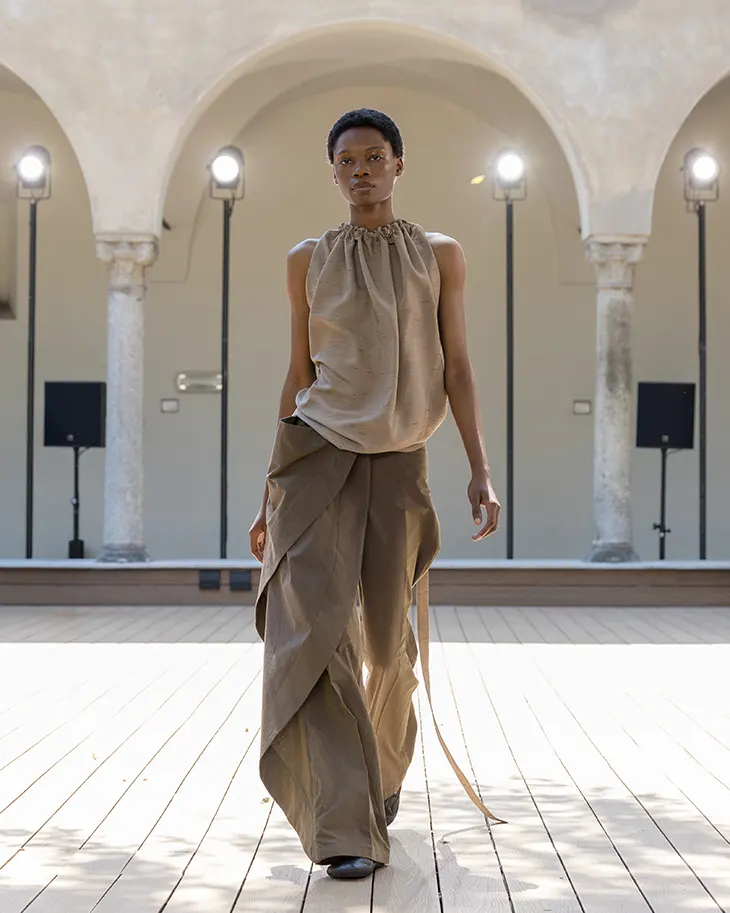
Qasimi’s latest move is not a retreat from workwear, it is a redesign of its grammar. Presented in Milan in June 2026, the Spring/Summer 2027 collection, Undercurrent, takes the label’s utilitarian DNA and turns it into something softer, more modular, and far more exacting, with exposed seams, inside-out tailoring, relaxed twill, and earthy dyes that make every piece feel built, not just styled.
Workwear, rewritten as process
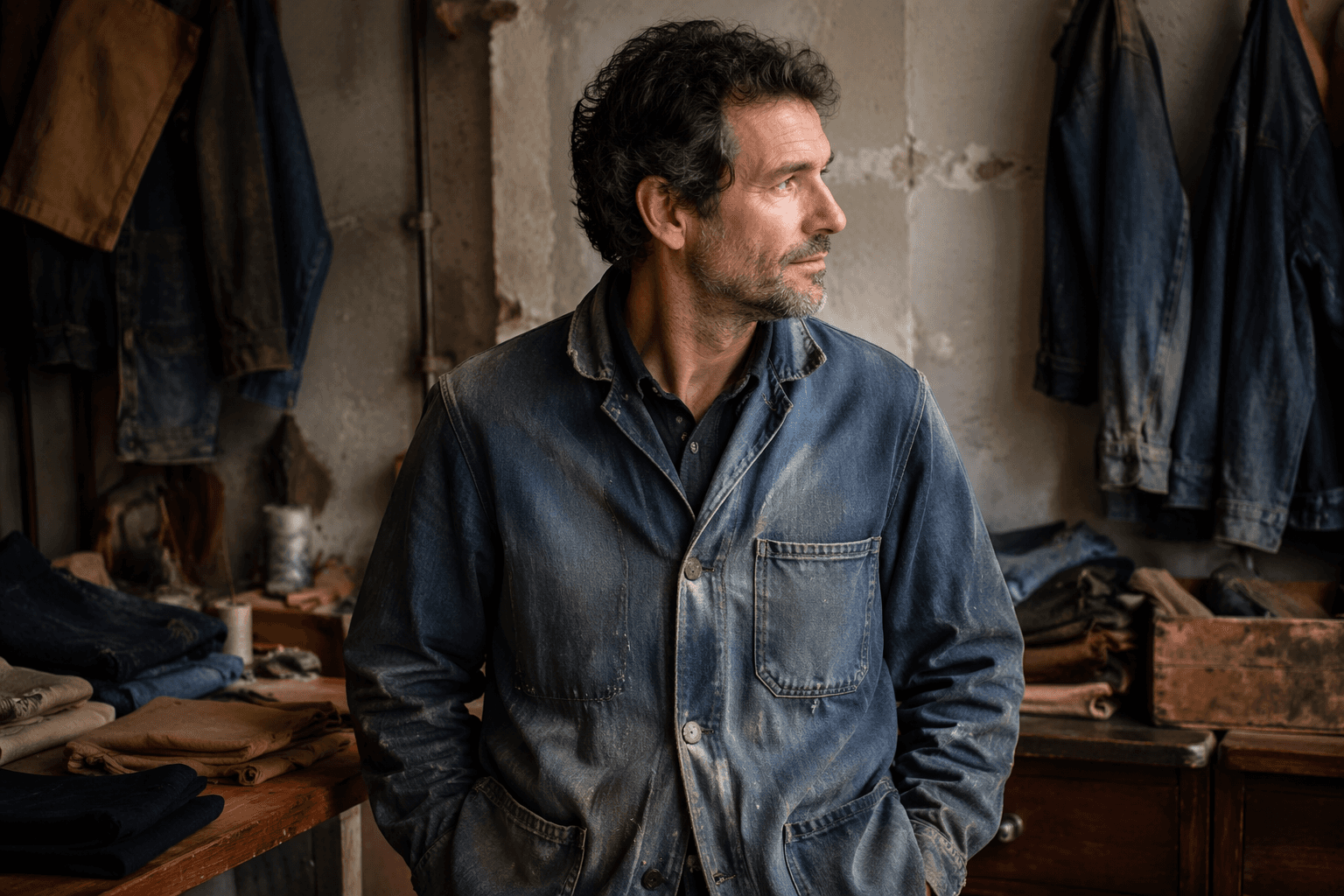
The clearest shift in Undercurrent is that function is no longer the point by itself. Hoor Al-Qasimi leans into soft workwear, but she keeps the construction visible: modular panels, displaced seams, loose threads, and material manipulation all stay out in the open, like the garment is showing you how it thinks. That matters because Qasimi has already spent seasons returning to utilitarian language, and this collection pushes that language toward craft, not costume.
The result is workwear that feels artisanal in the same way a hand-planed table does. The clothes still carry the honesty of pocketed, practical dressing, but the finish is less blunt-force utility and more careful infrastructure. This is not ruggedness for its own sake; it is structure with a pulse.
Hassan Sharif is the real reference point
The collection is the first chapter of a two-season exploration inspired by Hassan Sharif, one of the Gulf’s most influential contemporary artists and a foundational figure in conceptual art in the UAE. That influence shows up less as literal graphic quoting and more as a belief in process, repetition, and residue. Hoor Al-Qasimi said, “Undercurrent is about how making leaves a mark,” and framed Sharif’s repetition as cumulative rather than mechanical.
That idea gives the collection its tension. The clothes are built around the notion that making is never invisible, and that labor should leave evidence. In practical terms, that means deep pleats, sheer layers, exposed threads, visible construction details, and seams that look deliberately displaced rather than polished into submission. The clothes do not hide the act of assembly, they insist on it.
The brand also describes the season as working in someone’s absence rather than alongside them, which adds a quiet emotional charge to the whole thing. Instead of treating Sharif as a decorative reference, Qasimi uses his logic as a method: repetition becomes accumulation, and clothing becomes a record of touch.
Earth tones, but with an undertow
Color does a lot of the heavy lifting here. The palette stays in Qasimi’s familiar territory of brown, mocha, camel, olive, agave green, rose dawn, and white, but the shades feel dusted and lived-in rather than flatly neutral. These are colors that sit close to skin and stone, which is exactly why the collection feels so grounded.
The manual dyes on the relaxed twill tailoring sharpen that effect. The staining is visible, which is the point: the dye does not disappear into the fabric, it marks it. In a season obsessed with perfection and crisp finishes, Qasimi is betting on surfaces that look handled, layered, and slightly altered by the process of becoming clothing.
The pieces that make the argument
The strongest reads in the collection come from the clothes that blur categories without losing clarity. Pleated denim and barrel-leg silhouettes bring workwear volume into a more sculptural register, while a poplin shirt is engineered to read like a sweater layered over a shirt, without the actual layering. That kind of construction trick is very Qasimi right now: it creates visual density without adding bulk.
Lightweight modal returns the house signature check in a way that feels almost airy, which is smart because it keeps the pattern from hardening the silhouette. The knitwear silhouettes also reach back to Khalid Al-Qasimi’s earlier work, tying the season to the founder’s archive and reminding you that this label’s present tense is built on its own past. That connection matters, because it keeps the collection from drifting into abstract concept territory. It still has family resemblance.
Why the brand is doubling down now
Qasimi’s Spring/Summer 2026 collection already signaled where the house was headed. That season marked the brand’s tenth anniversary and the eleventh collection under Hoor Al-Qasimi’s guidance, and it revisited the label’s utilitarian roots through modular and pocketed garments. Spring/Summer 2027 does not break from that path. It extends it, with more finesse and less obvious force.
That continuity is the real story. Qasimi is not abandoning workwear, not softening it into pure luxury, and not flattening it into trend-driven utility. It is betting that the next version of workwear is modular, quiet, and intellectually built, with seams, dyes, and construction details that act like visible thought. In a market full of loud tactical gestures, that kind of restraint feels sharper than armor.
This article was produced by Prism’s automated news system from verified source data, official records, and press releases, then run through automated quality and moderation checks before publishing. The system is built and supervised by the people who set the standards it runs under. Read our full AI policy.
Know something we missed? Have a correction or additional information?
Submit a Tip