Recycling Reflective Workwear Demands New Material Separation and Supply-Chain Partnerships
Reflective trims send nearly 90% of the 33 million workwear garments produced annually straight to incineration. Here's the spec checklist that changes that.
The Detail That's Killing Your Recycling Rate
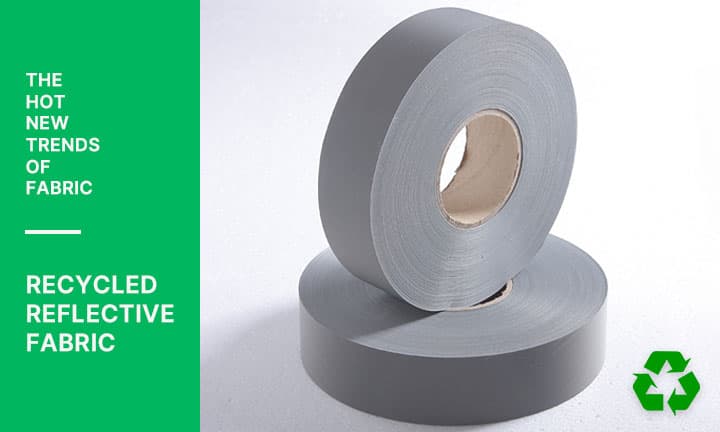
Nearly 90% of the 33 million workwear garments supplied annually in the UK end up in landfill or incinerated. The base fabric is almost never the problem: most hi-vis shells are polyester, a material with established mechanical and chemical recycling pathways. The thing blocking circularity is the 50mm strip of reflective tape running across the chest. That single trim component, engineered to retro-reflect at 150 metres and survive 50 industrial washes, is precisely why hi-vis PPE has been one of textile recycling's longest-standing dead ends.
Understanding why requires looking inside the construction. Reflective trim used in EN ISO 20471-certified garments is not a simple woven tape. It is a composite: retroreflective glass microbeads embedded in a polymer binder, bonded to a woven or knit carrier fabric, and attached to the garment shell either by sewing, heat-seal adhesive, or pressure-sensitive film. Each of those bonding layers introduces a material incompatibility. Heat-transfer films and PSA (pressure-sensitive adhesive) films, widely used because they speed up production and eliminate stitch holes in waterproof outer shells, fuse permanently to the base fabric at a molecular level. When that garment reaches a standard mechanical shredder, the trim doesn't separate cleanly; it contaminates the polyester fibre stream with glass particles and adhesive residue, making the output unusable for high-quality re-spinning.
Why Contamination Compounds the Problem
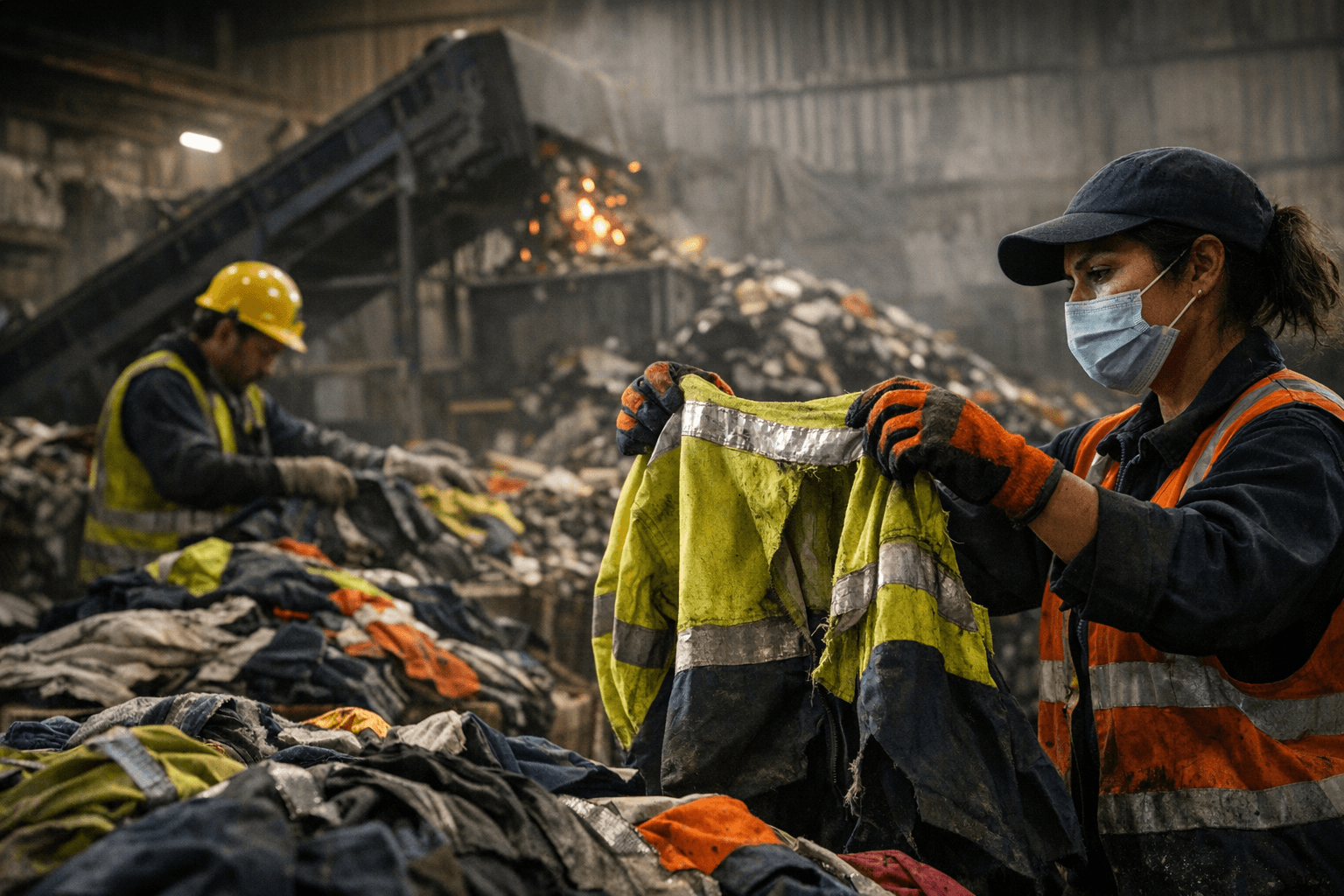
On-job soiling layers a second challenge on top of the material one. Hi-vis garments worn in road maintenance, rail, construction, and logistics pick up hydrocarbons, cement dust, cutting fluids, and general particulate matter over their service life. Industrial laundering removes surface soil but cannot fully reverse chemical absorption into the fabric or reflective binder. By the time a garment reaches end-of-life, the polymer matrix holding the glass beads may have degraded unevenly, and the fluorescent background fabric, dyed with UV-reactive pigments, presents its own dye-contamination problem for any mechanical recycler trying to produce clear or light-coloured output. The combination of glass, adhesive, dye, and absorbed workplace contamination means standard textile recycling facilities simply reject the load, and the garment moves straight to energy recovery: effectively, it gets burned.
The Constructions to Avoid
Not all reflective trims are equally problematic, and the choice made at spec stage determines whether a garment can ever re-enter the material loop. Procurement and product teams should treat the following as red flags:
- Full-width heat-transfer films bonded continuously across the garment surface: the adhesive layer cannot be delaminated without damaging the substrate, and the glass bead/binder composite is inseparable from the polyester shell post-bonding.
- Mixed-material segmented patches combining woven reflective fabric, a contrast backing panel in a different fibre type (cotton, FR aramid), and a heat-seal perimeter: the multi-layer composite creates three incompatible material streams in a single 80mm component.
- PSA adhesive-backed reflective tape applied directly to waterproof membranes: the permanent adhesion specification, by design, means it cannot be removed without destroying the membrane.
- Combined functional trims where retroreflective and FR (flame-retardant) performance are engineered into a single laminated tape: separating the FR chemistry from the glass bead layer is not currently viable at industrial scale.
The industry standard 3M Scotchlite sewn-on fabric trim, by contrast, sits in a more tractable category. Because it is mechanically attached, it can be cut away or removed during a pre-processing disassembly step. That does not solve the problem automatically, but it creates an entry point for the separation processes now being developed.
Processing Approaches: From Delamination to Depolymerisation
The most advanced work in this space is happening at the chemistry level. Stuff4Life, a circular economy company focused on polyester workwear, has developed a patented polyester depolymerisation process using alkaline hydrolysis, validated in collaboration with Teesside University. The process breaks down polyester (PET) into its constituent monomer, terephthalic acid (TPA), which can be reused to synthesise new polyester. The critical breakthrough, demonstrated in partnership with Alsico and components supplier Coats, is that the glass microbeads used in retroreflective strips survive the hydrolysis bath intact. Laboratory analysis confirmed that up to 100% of glass beads can be captured, and the recovered beads retain up to 80% of their reflectivity compared with virgin material, remaining intact, spherical, and optically functional.
Vincent Siau, Head of the Alsico Academy, framed the stakes clearly: "Recycling reflective strips has long been a critical challenge for hi-vis workwear. Until now, garments containing these materials were typically destined for incineration." John Twitchen, Founder of Stuff4Life, described the result as "a major step toward genuinely circular protective garments," noting that the work "shows that we can close the loop not only on polyester, but on complex components such as reflective beads."
This is the most significant proof point the industry has produced, but it is a controlled pilot result, not yet an industrial-scale system. The pathway to scale requires the upstream garment design to cooperate with the downstream chemistry: garments built on mono-material polyester substrates with sewn-on reflective trim are straightforward inputs to the depolymerisation bath; garments with heat-transfer films, FR liners, and polycotton panels are not.
Selective delamination using solvent treatments is a parallel research direction: specific solvent systems can dissolve adhesive layers without degrading the glass bead geometry or the polyester carrier, potentially allowing the reflective strip to be removed as a discrete component before the base fabric enters a mechanical recycling stream. The challenge is designing a solvent process that is commercially viable at laundry scale, safe for industrial use, and compatible with the range of adhesive formulations currently used across the supplier base, which is wide and largely undocumented in any centralised spec database.
The Spec Checklist: What to Demand From Suppliers
Circular outcome starts at the purchase order, not at the recycling gate. For procurement teams specifying hi-vis garments, and for product teams developing them, the following construction principles keep EN ISO 20471 compliance intact while preserving end-of-life options:
- Specify mono-material base fabrics: 100% polyester shells, liners, and contrast panels wherever FR performance is not required. Polycotton blends and polyester/elastane composites contaminate mechanical recycling streams.
- Require sewn-on reflective trim only: mechanical attachment via lockstitch or zigzag allows manual or automated disassembly. Reject heat-transfer and PSA bonding on garments intended for take-back programmes.
- Demand single-layer retroreflective tape on a woven polyester carrier, without FR additive chemistry in the binder: this is compatible with both manual strip removal and polyester depolymerisation.
- Insist on full material disclosure from trim suppliers: bead composition, binder polymer type, carrier fabric fibre content, adhesive chemistry (where used). This data is essential for recyclers to route garments correctly and to validate chemical process compatibility.
- For high-risk applications where heat-transfer bonding is unavoidable (waterproof garment seam-sealing requirements), design in a disassembly seam: a perforated or weakened stitch line at the trim-to-shell junction that allows industrial cutters to remove the trim zone cleanly before recycling.
- Align your certification evidence with recyclability: EN ISO 20471 Class 2 and Class 3 requirements set minimum retroreflective area thresholds, but do not mandate a specific bonding construction. Sewn-on tape meets the same photometric performance requirements as heat-transferred tape; the difference is purely a manufacturing cost consideration.
Closing the Loop Requires Supply-Chain Architecture, Not Just Product Design
Even a perfectly specified garment cannot reach a circular outcome without the operational infrastructure to collect it, sort it, and route it to the right processing partner. The model that is emerging in the UK and Europe requires brands to work with industrial laundries as collection and pre-processing nodes. Laundries already handle end-of-life garment returns in rental workwear programmes; with relatively modest process additions (a dedicated end-of-life lane, basic disassembly tooling, and a digital tracking system linking garment ID to material spec), they become the first stage of a closed-loop pipeline. The laundry strips removable trim, sorts garments by base material, and passes them to a chemical recycler like Stuff4Life, which depolymerises the polyester and recovers the glass bead fraction for Coats or equivalent trim manufacturers to reprocess into new reflective strips.
Arco, the UK's largest safety products and services company, has backed this model with seed funding for Stuff4Life's chemical recycling demonstration plant, recognising that nearly 90% of the garments it distributes annually currently have no viable end-of-life pathway. That kind of distributor-level commitment to closing the loop is what separates a pilot result from a market transformation.
The reflective strip is 50mm wide and has been blocking textile circularity for decades. The chemistry to recover it now exists. The spec discipline to design for it is achievable today, with no compromise to visibility performance or certification compliance. What remains is the decision, made at the purchase order level, to treat end-of-life as a design requirement rather than an afterthought.
Know something we missed? Have a correction or additional information?
Submit a Tip