Chef Anh Sung-jae Moves to Larger Home, 'Really Happy' — Housewarming Gifts Mentioned
Chef Anh Sung-jae traded his cramped cooking corner for a spacious white-toned kitchen, marking the move with a moon jar and pollock from his production team.
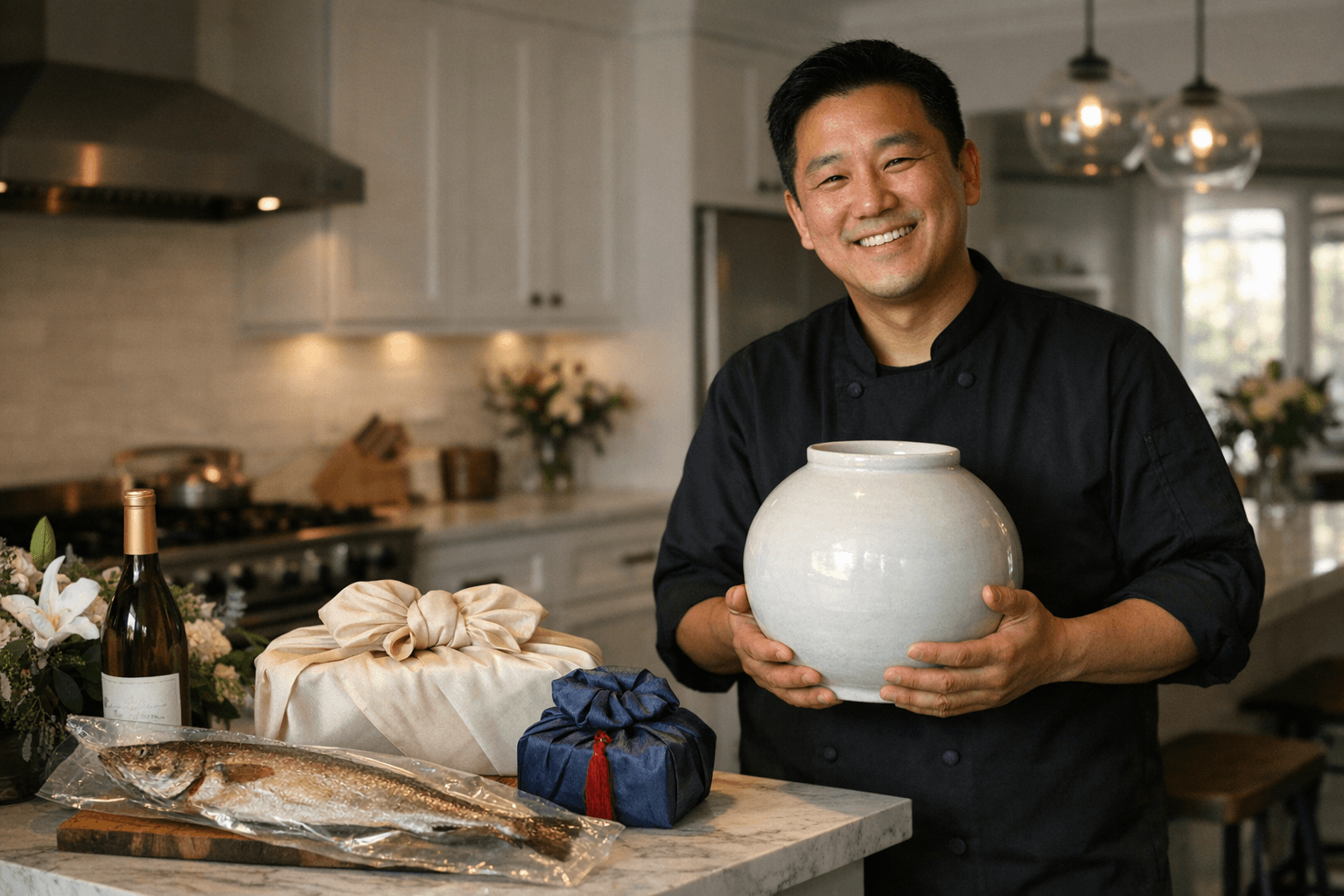
The worst housewarming gift you can give a chef is something that earns a polite thank-you and a permanent spot in a closet. Anh Sung-jae, the Michelin-starred chef behind Mosu Seoul and a judge on Netflix's "Culinary Class Wars," has no patience for imprecision, whether in a kitchen or in a gesture. So when his YouTube production team arrived at his new home with a moon jar and a pollock decoration in hand, the choice registered: two objects drawn from Korean ritual tradition, neither of them generic, neither of them forgettable.
Anh posted the home tour on his YouTube channel "Chef Sung Anh" on April 1, walking viewers through a white-toned, noticeably larger space than the apartment where he had been shooting cooking content. He opened the tour with the kitchen. He told the camera it would likely be the space that appears most in his future videos, then offered a candid admission about the previous setup: he had been cooking in a cramped corner, squeezed into a space that didn't match his ambitions. "I'm really happy," he said simply about the change.
The belongings had arrived but not yet found their places. Anh mentioned that he was still working out where to put things and which furniture to buy, a detail that reads less like a complaint and more like a specific, solvable problem. The move itself was motivated at least partly by the goal of producing better cooking content, which means the kitchen will function as both a workspace and a studio. A chef who checks whether the onions in a jjajangmyeon delivery were properly caramelized, and who celebrated the new house by ordering noodles and field-testing a local restaurant, is not going to settle for a kitchen that looks good without functioning well.
That combination of culinary precision and practical self-awareness is the best frame for choosing what to bring to a kitchen upgrade like this one.
THE GIFTS THAT PASS A CHEF'S STANDARD
Under $25: premium Korean pantry staples. Anh spent the early months of 2026 promoting Korean beef, pork, and seaweed through agricultural export campaigns in Singapore, a signal about what he considers ingredient-worthy. A small selection of specialty Korean pantry items, a bottle of properly aged sesame oil, a tin of premium roasted gim (seaweed), or a tub of good doenjang (fermented soybean paste), says to a Korean-American fine dining chef that you understand flavor from the ground up. These are things he would buy himself but rarely prioritizes. Price range: $10-24.
Under $25: toilet paper and laundry detergent. Before you skip this one, know that in Korea these are among the most culturally appropriate gifts at a jipdeuri (집들이, housewarming). Toilet paper symbolizes a life that unrolls smoothly and without interruption; detergent represents a clean start and the clearing of misfortune. These are not consolation prizes. They are the correct move, grounded in tradition, and they will be used.
Under $50: a heavy-gauge half-sheet pan. Every cook who moves to a larger kitchen discovers the same issue within the first week: the pans calibrated for the old oven are the wrong size for the new one. A commercial-weight half-sheet pan, around $28-32, is the kind of workhorse a professional cook uses constantly and rarely bothers to replace proactively. It is also the rare gift that says "I thought about your actual kitchen" without overstepping.
Under $50: a finishing salt and pepper grinder pairing. For any chef working across Korean and Western culinary traditions, as Anh does at Mosu, the question of finishing salt is constant. Maldon sea salt flakes paired with a solid adjustable pepper grinder, together around $35-45, is a compact, high-utility gift that signals attention without presumption.
Under $100: a Japanese whetstone, not a knife. There is a folk tradition in Korea of not giving knives as gifts, on the logic that a blade can "cut" a relationship. Whether one follows that belief or not, presenting a Michelin-starred chef with a knife set is a confidence test most people will lose. A King or Shapton whetstone in the 1000/6000 grit range ($40-80 depending on grade) is a gift that quietly communicates: I know you already have the right knife. I'm giving you the means to keep it right. It is a more respectful choice.
Under $100: a cohesive countertop storage system. Anh said directly that he was still figuring out where to put things in the new space. For a kitchen that will also serve as a content backdrop, visual organization is not trivial. A set of matching airtight glass canisters in graduated sizes transforms a counter from provisional to purposeful. OXO Pop Containers or the IKEA Korken series ($25-60 for a set) solve the problem he named on camera, which is the clearest possible reason to give a gift.
KOREAN HOUSEWARMING ETIQUETTE: WHAT TO BRING AND WHAT TO CONSIDER
The jipdeuri (집들이) has roots in a ceremony where families would pray for protection and blessing in a new home, inviting good spirits and warding off bad ones. That ritual logic explains the production team's gift choices for Anh: the moon jar (달항아리), a white rounded ceramic vessel associated with the Joseon dynasty and long tied to luck, abundance, and prosperity, and the pollock (명태), a fish with a specific tradition of guarding against evil spirits. These are not arbitrary decorations. They carry precise symbolic weight.
For anyone attending a Korean housewarming, the traditional practical gifts carry their own symbolism. Toilet paper, as noted, reads as a wish for smooth fortune. Candles suggest warmth and brightness in the new home. Red flowers are sometimes considered inauspicious, as red carries associations with death in certain Korean folk customs. Sharp objects like scissors or knives follow a similar cautionary note in folk belief, though many families neutralize this by attaching a coin to "buy" the blade and dissolve the omen.
What Anh's production team understood, and what makes the moon jar and pollock the right call for this particular household, is that symbolic gifts and useful gifts are not opposites. The best version of either is something that earns its place in a space someone is genuinely building. That is the standard worth meeting.
This article was produced by Prism’s automated news system from verified source data, official records, and press releases, then run through automated quality and moderation checks before publishing. The system is built and supervised by the people who set the standards it runs under. Read our full AI policy.
Did this article answer your question?