How Mass Production Turned Valentine Cards Into Commercial Romance
Mass production did not erase Valentine’s Day sentiment, it made affection portable, affordable, and wildly profitable, from penny cards to lace-and-satin showpieces.
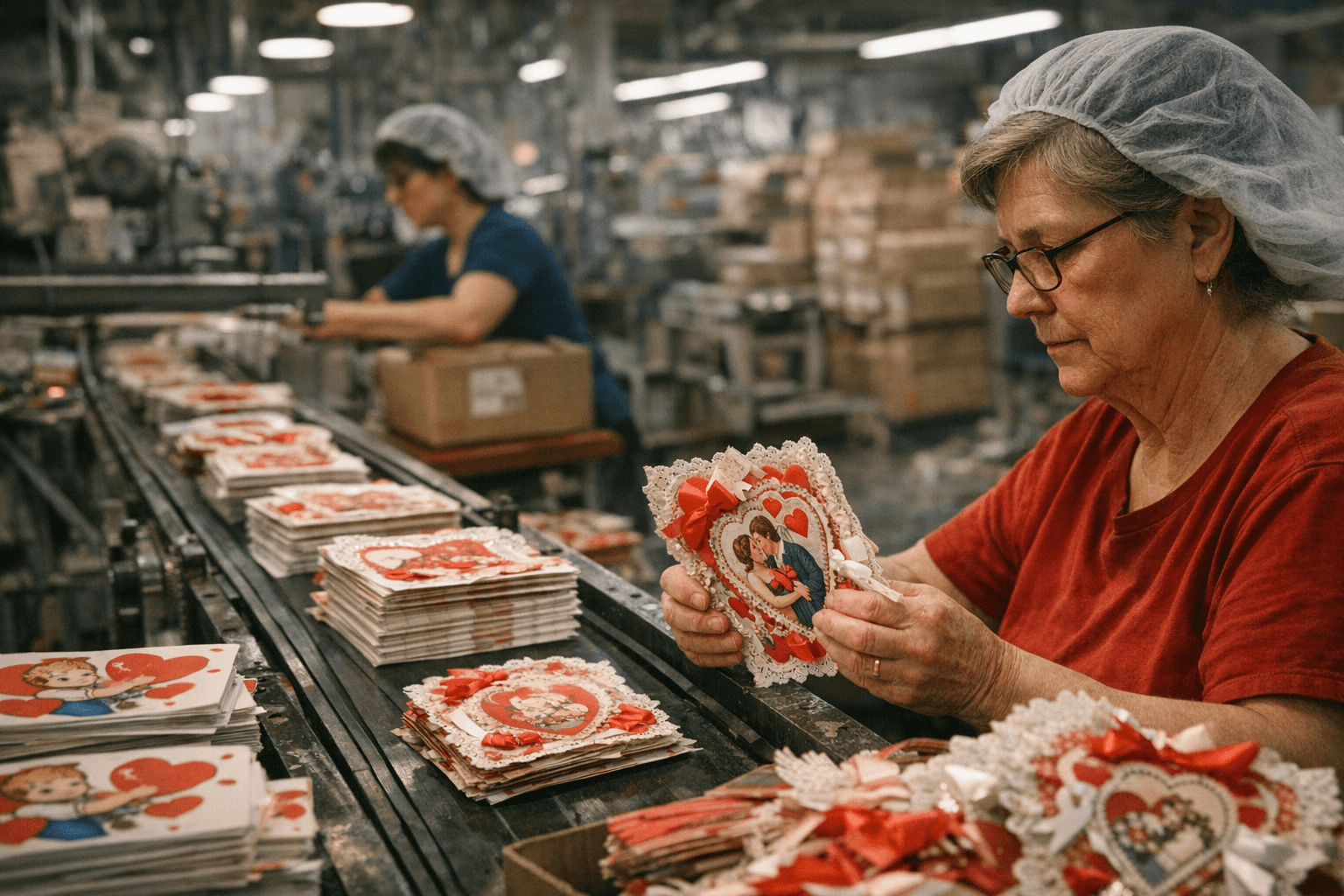
Valentine’s Day began as a date with uncertain origins and ended as a marketplace for feeling. What changed was not love itself, but the way love could be packaged, posted, and sold, until a handwritten note gave way to what one historian called “manufactured intimacy.”
From ritual to romance
Valentine’s Day did not become firmly associated with romance until about the 14th century. Its roots are often linked, though not definitively, to the Roman festival of Lupercalia and the feast of St. Valentine, and Lupercalia itself was an annual fertility festival held on February 15 before Pope Gelasius I banned it in 494 CE. That long stretch between ritual and romance matters, because it shows that February 14 was not always a marketplace holiday at all. It became one only after centuries of cultural layering.
By the time the modern Valentine card arrived, the holiday had already been transformed from ancient observance into a social ritual. The card did what the old feast could not: it gave private feeling a physical form that could be repeated, mailed, and bought. That is the quiet revolution at the center of commercial romance.
How industry made affection reproducible
At the beginning of the 19th century, Britons still made most of their valentines by hand. Those cards were personal, but they were also slow, limited, and fragile, which made them the opposite of mass culture. By the 1850s, manufactured cards had replaced many handmade valentines in Britain, and the change was powered by two practical forces: the Uniform Penny Post and chromolithography.
The Uniform Penny Post made exchanging cards inexpensive and efficient, which helped valentine giving move from a private habit to a public seasonal ritual. Chromolithography made the cards colorful and plentiful, allowing printers to produce elaborate designs at scale. By the 1860s, more than 1 million Valentine cards were reportedly circulating in London alone, a number that captures the speed with which sentiment became a commercial system.
That scale did not eliminate feeling. It changed the terms of it. A printed card could still carry tenderness, but it now arrived through a machine-made aesthetic, where lace borders, bright flowers, and sentimental verses stood in for the slower labor of handcraft. The result was a new kind of intimacy, one that could be reproduced across a city.
Esther Howland and the American breakthrough
In the United States, the decisive figure was Esther Howland of Worcester, Massachusetts. She is credited with creating the first commercially mass-produced Valentine’s Day cards in the country, and her work turned imported sentiment into an American business. Her first advertisement for valentines appeared in the Worcester Daily Spy in February 1850, linking the holiday to local retail in a way that would become familiar far beyond New England.
Howland’s family workroom helped shape the enterprise, and her sample assortment showed how quickly Valentine’s Day could move from craft to industry. Her business made elaborate lace-and-satin valentines a commercial success, proving that luxury and mass production were not opposites so much as partners. The finest examples were still expensive and ornate, but they now lived inside a market that could also sell a penny card to anyone with a stamp.
That range is what made the holiday durable. A Valentine could be cheap without feeling careless, or extravagant without needing to be custom-made. The best cards, then and now, are the ones that use a mass-produced form to carry something specific enough to feel singular.
The dark joke beside the love note
Mass production also created a darker Valentine tradition: the Victorian-era “vinegar valentines.” These were mocking cards meant to shock or offend the recipient, a reminder that once affection became a commodity, ridicule could be printed with the same ease. The same industrial systems that turned flowers and hearts into a seasonal language also made insult easy to circulate.
That uneasy pair, tenderness and cruelty, tells the real story of commercial romance. A Valentine card was never only about sincerity. It was also about performance, about how a feeling could be staged for another person, and about how cheaply or lavishly that performance might be bought. In that sense, the holiday became a test of intention long before it became a test of taste.
What the surviving cards reveal
Museum collections preserve the full spectrum of the 19th-century market, from penny cards to examples that cost as much as three guineas. That spread matters because it shows how quickly Valentine’s Day became both a sentimental ritual and a profitable consumer practice. The same holiday could support mass circulation in London and hand-finished extravagance in a collector’s cabinet.
Institutions such as the London Museum, the V&A, and the Library of Congress keep that history visible, while collections elsewhere remind us that Valentine’s cards were never merely pretty paper. They were evidence of an economy built around emotion, where design, postage, and social expectation converged in a single envelope.
The lesson is not that mass-produced gifts are empty. It is that they only work when they are chosen with specificity, then made personal by the words, the timing, or the care around them. Valentine cards became commercial romance because industry learned how to imitate feeling at scale, but the cards that still land are the ones that carry something no machine can supply: a clear sense of why this one, for this person, at this moment.
This article was produced by Prism’s automated news system from verified source data, official records, and press releases, then run through automated quality and moderation checks before publishing. The system is built and supervised by the people who set the standards it runs under. Read our full AI policy.
Did this article answer your question?