How Valentine’s Day Became a Global Gift-Giving Tradition
Valentine’s Day began as a romance story, then became a retail machine. The smartest gifts are the ones that feel personal, not expensive.
The holiday that made affection into a budget line
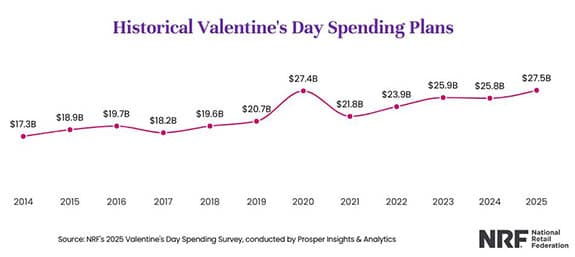
Valentine’s Day looks intimate on the surface, but it has been shaped by commerce for generations. The National Retail Federation projected U.S. spending of $29.1 billion for 2026, up from $27.5 billion in 2025, and the average celebrant was budgeting $199.78. That is the real modern Valentine’s dilemma: not whether to spend, but how to make the money feel like a message.
The numbers also reveal where people still think value lives. In 2025, spending on significant others alone hit a record $14.6 billion, while candy, flowers, greeting cards, an evening out, and jewelry led the gift categories. That spread is useful because it separates the ritual gifts that feel personal from the larger gestures that can either seem generous or simply expensive.
How romance got attached to February 14
The holiday’s romantic meaning did not arrive fully formed. Britannica says Valentine’s Day did not become associated with romance until about the 14th century, and its roots may reach back to the Roman festival of Lupercalia. Several Christian martyrs named Valentine may also lie behind the feast, which is one reason the holiday has always carried a slightly blended identity, part legend, part liturgy, part social custom.
That messy origin story matters because it explains why Valentine’s Day became so easy to adapt. A holiday with uncertain beginnings can absorb new rituals without losing its shape, which is exactly what happened as the day moved from religious and folkloric associations into the modern market for cards, confectionery, and gifts.
Hallmark, Cadbury, and the industrial scale of sentiment
Hallmark helped turn Valentine’s Day into something that could be bought in bulk and still feel personal. The company first offered Valentine’s Day cards in 1913, began printing its own designs in 1915, and had cards on store shelves by 1916. Its early hand-fed press could produce 500 to 700 cards an hour, a small but revealing detail that shows how industrial printing made a private feeling repeatable at scale.
Cadbury sits on the other side of that same commercial story. In the UK, the brand continues to market Valentine’s-themed chocolate gifts, and chocolate has long been one of the holiday’s most reliable tokens because it sits in that sweet spot between indulgent and accessible. It feels considered without demanding the kind of outlay that comes with a major piece of jewelry or a formal night out.
Japan’s version is the clearest sign the holiday is still evolving
If the U.S. version of Valentine’s Day is built around broad spending, Japan’s custom shows how a holiday can be rearranged into a social script. There, women traditionally give chocolates on February 14, and White Day follows a month later as the reciprocal occasion. Travel Japan says Valentine’s Day sections in Japanese department stores begin appearing from mid-January, which means the retail calendar starts long before the actual exchange.
That reversal is more than a novelty. It shows how the holiday can be made culturally specific while still remaining recognizable, and it gives the global Valentine’s market one of its most memorable details: the expectation that giving may begin with women, then return a month later in a different form. It is one of the clearest examples of how a commercial ritual can still carry social rules that feel distinctive rather than generic.
What still feels worth paying for
The smartest Valentine’s spending usually follows a simple rule: pay for the gesture that changes the emotional temperature of the day, and skip the parts that only inflate the receipt. Cards, candy, flowers, an evening out, and jewelry all matter, but they do not matter equally in every relationship. In 2025, Americans spent $1.4 billion on greeting cards, $2.5 billion on candy, $2.9 billion on flowers, $5.4 billion on an evening out, and $6.5 billion on jewelry, which shows how quickly the holiday can move from thoughtful to costly.
A good card is still the best-value purchase in the entire holiday ecosystem because it can carry the most specific language for the least money. Candy works when it is chosen with care, especially when it echoes a favorite flavor or memory rather than a generic heart-shaped box. Flowers justify themselves when the arrangement feels deliberate, not merely abundant, and an evening out earns its price when it gives the couple a real change of scene instead of a standard reservation.
Jewelry is the category where restraint matters most. It occupies the highest end of the spending spectrum, so it lands best when the piece has clear wearability and the recipient’s taste is already understood. That is why the holiday’s most luxurious gifts are not always the most expensive ones; a well-chosen card, a specific box of chocolates, or a dinner arranged with precision can feel more personal than a much larger purchase made without intention.
A global ritual, but a selective one
Hallmark says Valentine’s Day is celebrated in Canada, Mexico, the United Kingdom, France, Australia, Denmark, and Italy, which makes the holiday feel less like a single-country invention and more like a portable ritual. What began as a loosely defined feast attached to medieval romance now appears in department stores, candy aisles, and greeting-card racks across multiple markets.
That is why the holiday still rewards discernment. Valentine’s Day became a global gift-giving tradition by absorbing mass production, retail calendars, and local customs, but the most successful gifts still do the oldest job of all: they say something true, and they do it without wasting the recipient’s time or your money.
This article was produced by Prism’s automated news system from verified source data, official records, and press releases, then run through automated quality and moderation checks before publishing. The system is built and supervised by the people who set the standards it runs under. Read our full AI policy.
Did this article answer your question?