Short,
Valentine's jewelry buying is a sprint, not a marathon: Bain & Company data shows the window is short, sharp, and concentrated, with most shoppers capping budgets under $100.
The Window Is Smaller Than You Think
If you missed the Valentine's Day jewelry rush this year, you blinked at the wrong moment. Bain & Company's analysis of 2026 payment-card signals found that jewelry demand in the weeks before February 14 was short, sharp, and highly concentrated, a buying sprint rather than a slow seasonal build. High-end pieces actually sold better pre-Valentine's than in the same window in 2025, confirming the occasion still moves serious merchandise. But those luxury spikes, impressive as they look on a revenue chart, represent a small share of total gift counts. In plain terms: a handful of people spent a lot, while the majority spent carefully.
That majority matters more than the headlines suggest. Most Valentine's Day budgets stayed under $100, a ceiling that effectively limits mass-market jewelry penetration regardless of how urgently people want to give something meaningful. It's the central tension in every Valentine's gift guide: the emotional stakes are high, but the financial reality is almost always modest.
What Under $100 Actually Buys You
The good news is that $100 goes meaningfully further in jewelry than it did five years ago, thanks to a wave of direct-to-consumer brands and gold-filled (rather than solid gold) construction that holds up beautifully to daily wear. For Valentine's Day specifically, consider:
- Gold-filled or sterling silver heart pendants, ranging from $40 to $85 at most DTC jewelers, remain perennially strong because they read as intentional without requiring a budget conversation.
- Huggie earrings in 14k gold-filled or vermeil: widely available in the $50 to $90 range, wearable every day, and gender-inclusive enough to work for a wide range of recipients.
- Birthstone stacking rings, a personalization play that lands well when you actually know your recipient's birth month, typically price between $35 and $75.
- Layered necklace sets, often sold as two- or three-piece bundles under $80, photograph well and feel like a considered gift rather than a last-minute grab.
The key distinction at this price point is finishing quality, specifically whether pieces are plated or filled, and whether closures feel solid. Heavier chain links and lobster clasps signal durability in a way that reassures the recipient this wasn't bought at a checkout counter.
The AI-Assisted Shopper Has Arrived
Here's the data point that changes how to think about Valentine's gifting going forward: roughly 30% of shoppers used generative AI tools during the gift research phase this year, according to Bain & Company's findings. That number, essentially zero just two years ago, signals a structural shift in how people arrive at a purchase decision.
What does that mean practically? AI tools tend to surface well-reviewed, well-described products with clear price anchors. Vague category pages lose; specific, curated picks with context win. If you're the kind of person who used to ask a friend "what should I get her?", you're now asking a chatbot first, then cross-referencing on your phone while commuting. The entire research journey, from "I need a gift idea" to "add to cart," increasingly happens on mobile in short, intent-driven sessions.
This changes the gift-giver's calculus. The most giftable items right now are ones you can describe in a sentence, justify in a price range, and order with two taps. Complexity, even beautiful complexity, becomes friction when your shopper is operating on a tight timeline and a phone screen.
Where Luxury Fits (And Who It's Actually For)
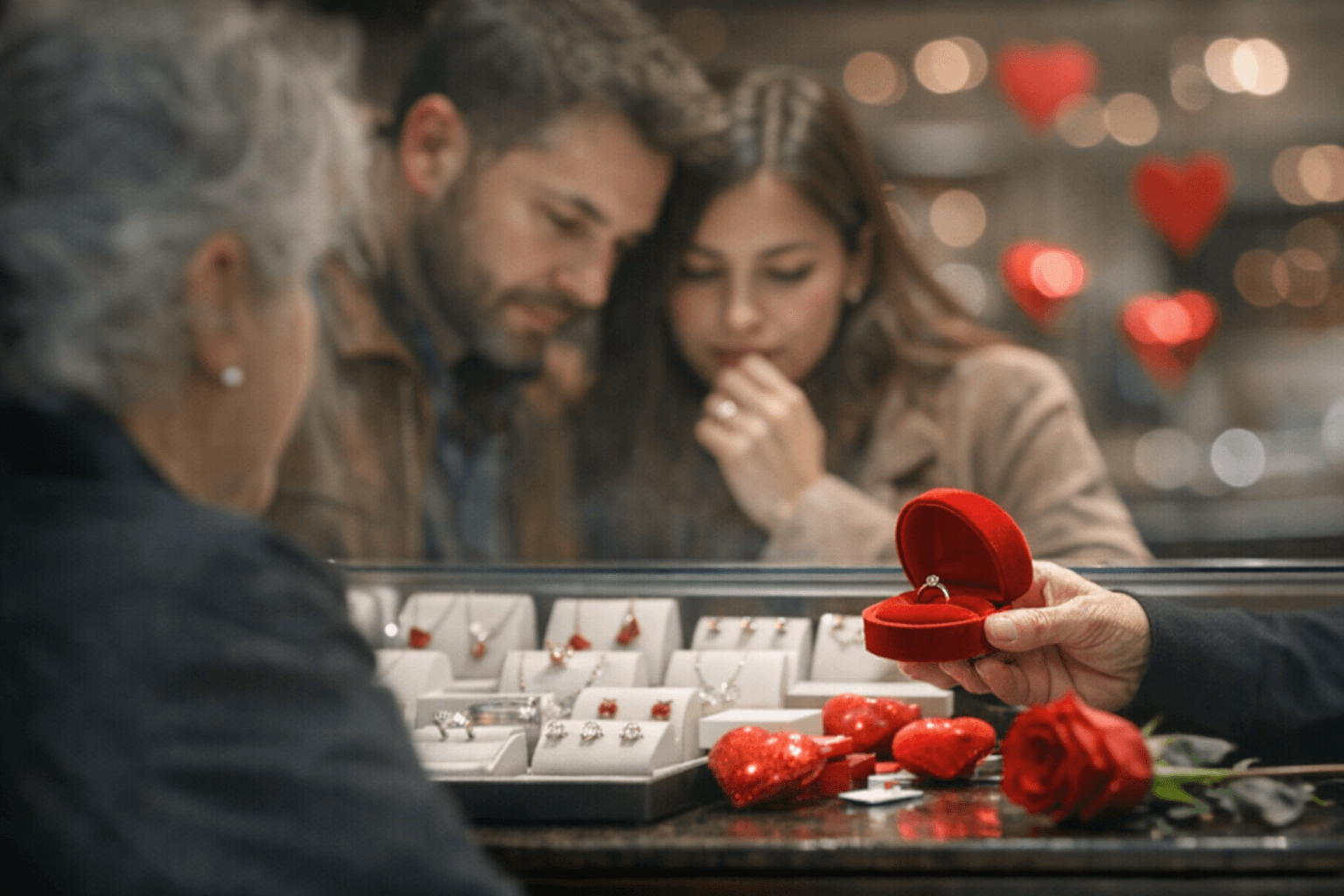
Strong pre-Valentine spikes in luxury jewelry tell a specific story: a small number of buyers, confident in their budget and their recipient, made decisive high-dollar purchases in the days immediately before February 14. These aren't browsers. They're not using AI to narrow down options; they already know they want a tennis bracelet or a diamond pendant. They're using their phone to confirm availability and shipping speed.
For luxury giving, the under-pressure window actually favors established names over emerging designers, because brand recognition short-circuits doubt. A piece from a jeweler your recipient already knows and trusts lands better than a beautiful unknown when you're buying on deadline. That's not a knock on independent jewelry designers; it's an honest read of how decision-making compresses under time pressure.
If your budget clears $250, personalized fine jewelry (think engraved coordinates, initials set in solid gold, or birthstone pieces in genuine metal settings) adds the emotional specificity that separates a memorable gift from a decorative one. Brilliant Earth's Valentine's collection, for example, spans from accessible gold hoops to diamond pendants, with meaningful options available well under the $250 ceiling.
The Gifts That Win When Jewelry Doesn't Fit
Given that most Valentine budgets land below $100 and jewelry can feel high-stakes even when it's affordable, the smartest alternative is an experience or a consumable that delivers the same "you were thinking of me" signal without the sizing or style risk.
- A curated tasting set (wine, chocolate, cheese) from a specialty retailer typically runs $50 to $80 and requires zero guesswork about taste.
- A cooking class or evening experience booked for two communicates effort and shared time, both of which outperform any object in long-term relationship satisfaction research.
- A skincare or fragrance gift set from a brand your recipient already uses signals that you pay attention, which is arguably the most romantic thing a gift can communicate.
The through-line across all of these: they're easy to research, easy to describe, and easy to buy on a mobile device in under ten minutes. Conveniently, that matches exactly how most people are shopping right now.
The Timing Lesson Worth Keeping
Bain's data makes the shopping window legible in a way gut instinct never quite did. Valentine's Day gifting doesn't ramp gradually; it surges in a tight cluster of days, then stops. The practical upshot for anyone who perpetually ends up paying express shipping: set a reminder for late January. The best pieces at every price point tend to go first, and the mobile-first, AI-assisted shopper who started researching in early February had already claimed them. Next year, be that person.
Know something we missed? Have a correction or additional information?
Submit a Tip