30 Mechanical 3D Printed Puzzles for Weekend Makers
Thirty puzzle prints turn your weekend into a calibration gauntlet, testing tolerances, bridging, and assembly in one shareable run.
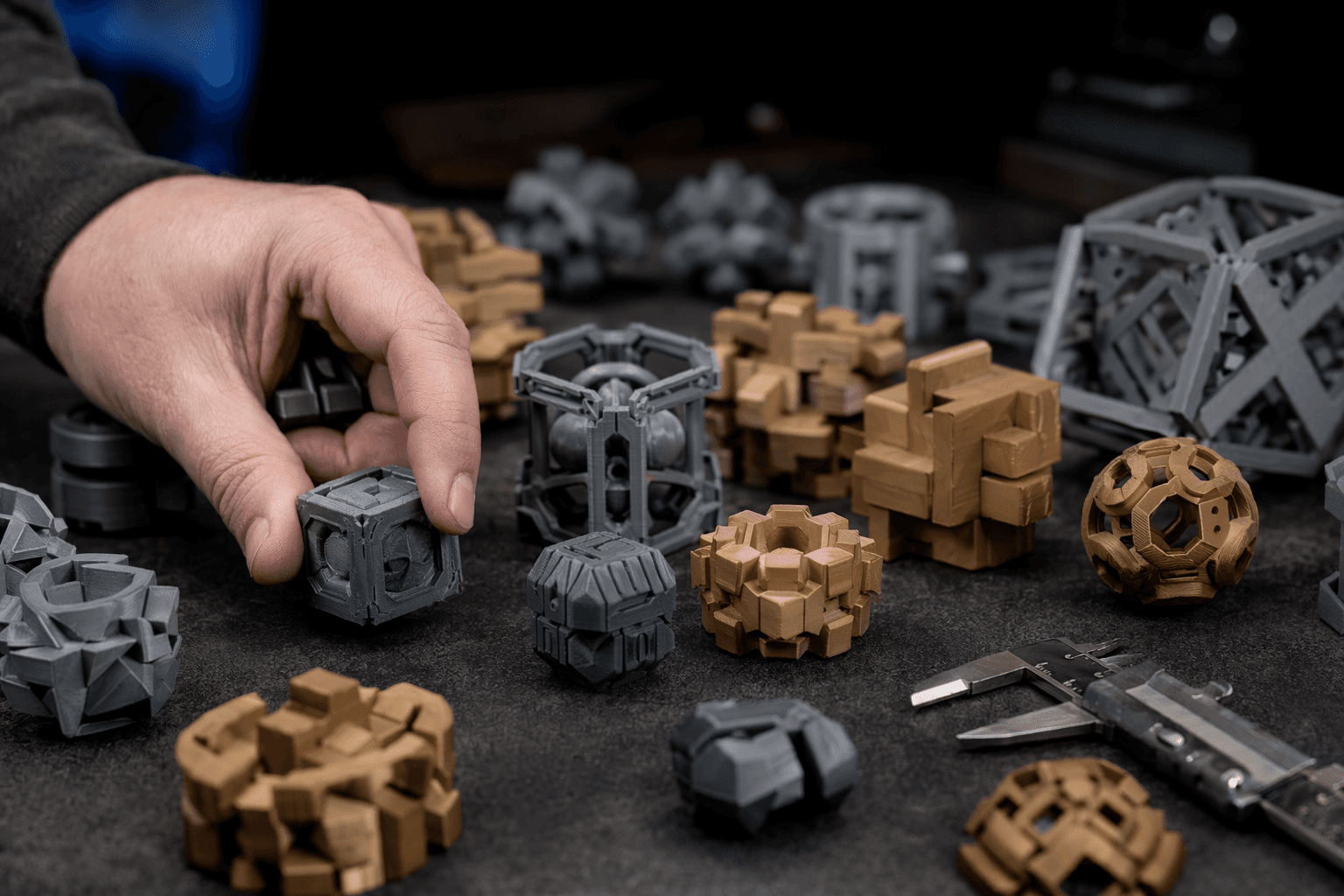
1. Secret boxes.
Hidden compartments are the gentlest entry point, but they still expose whether lid clearance and latch geometry line up cleanly. If the reveal feels sticky or vague, the print is telling you your tolerances are off.
2. Complex jigsaws.
Flat puzzle pieces seem easy until edge consistency and first-layer accuracy decide whether the pattern snaps together cleanly. They are a fast read on repeatability across the bed.
3. Cryptexes.
Rotating letter rings need smooth axial motion and crisp layer definition, or the code wheel binds before the lock ever feels clever. They reward clean extrusion more than brute force.
4. Maze cubes.
Internal channels make stringing and overhangs impossible to hide, which is why these prints are such honest tests. A clean run-through says your retraction and cooling are in good shape.
5. Rubik's cube variants.
These are less about solve speed than about whether corner cuts and alignment survive a real print. Any drag in the turn tells you the machine or the post-processing still needs work.
6. Sliding-tile puzzles.
Repeated contact surfaces show whether your printer leaves a smooth enough finish for motion without sanding everything to death. They are ideal when you want a mechanical build that reads every tiny layer defect.
7. Hidden-latch boxes.
The catch has to flex, release, and return without snapping or scraping, which makes these boxes a direct test of material behavior. They are also some of the best little desk toys for a second print.
8. Rotating-dial locks.
Concentric parts need to stay round, centered, and consistent from layer to layer. If the dial wobbles, the whole puzzle loses its satisfying click.
9. Drawer puzzles.
Tiny tracks and stops expose warp immediately, especially on longer prints that cool unevenly. When they work, the pull feels as good as any commercial trinket.
10. Snap-fit capsules.
These are tolerance ladders in miniature, where one shell catches only if your perimeters land exactly where they should. Too tight and it fails; too loose and the trick is gone.
11. Print-in-place twisty puzzle boxes.
Thingiverse warns that clean overhangs and minimal stringing are essential here, because the mechanism depends on free movement straight off the bed. That makes them a perfect weekend yes-or-no test for your printer.
12. Gear puzzles.
Teeth, backlash, and layer accuracy all show up at once, which is why gears are so satisfying to tune and so unforgiving when you miss. A crisp gear train is instant proof that the machine is dialed in.
13. Interlocking ring puzzles.
Circular parts sound forgiving, but tiny clearance errors become obvious the moment the rings start to slide or twist. They are especially good at exposing uneven extrusion.
14. Ball-in-labyrinth builds.
If the top surface droops or the channels pinch, the ball never feels like it belongs in the maze. A clean labyrinth shows both bridging control and finish quality.
15. Multi-stage sequence boxes.
These puzzles ask for more than one motion, so each stage becomes a checkpoint for fit, alignment, and repeatability. They are the kind of print that teaches patience one latch at a time.
16. Combination safes.
Dials, sliders, and locks all have to land in the right order, which makes timing as important as geometry. Miss one step and the whole safe turns into a very sturdy box.
17. Sliding-block mazes.
These rely on smooth rails and consistent spacing, so rough walls or elephant foot can ruin the motion instantly. They are one of the cleanest ways to see whether your first layer is helping or hurting you.
18. Twist-lock cylinders.
A slight turn should engage the mechanism without chewing up the surface, which means torsion and surface finish have to balance perfectly. If the lock grinds, the fit is too aggressive.
19. Layered code boxes.
Stacked components are great at revealing how well supports release and how neatly the layers register after cleanup. The best versions feel like a hidden mechanism, not a pile of parts.
20. Friction-fit assemblies.
These live in the narrow band between wobble and seizure, and that is exactly what makes them so useful. If the fit is right, you learn more about your machine than any bench test can tell you.
21. Bridging challenge prints.
Long spans are where sag starts talking, so a puzzle that depends on bridges is a direct read on cooling and speed. Good bridges make the whole build look cleaner and feel more deliberate.
22. Overhang challenge prints.
Steep angles show whether the printer can support itself without drooping into mush. They are one of the fastest ways to spot a fan or temperature problem.
23. Clearance gauge puzzles.
These are the prints that tell you, in plain sight, whether your settings are too tight, too loose, or just right. When a moving part slides with almost no resistance, you know the calibration stuck.
24. Assembly-heavy lockboxes.
More pieces mean more opportunities for tolerance drift, cleanup mistakes, and missed alignment. That is exactly why they make such satisfying proof-of-concept gifts when everything clicks together.
25. Print-in-place fidgets.
They are fast to start and even faster to judge, because any seam, blob, or string can kill the motion. When they come off the plate working, they are hard not to show off.
26. Gift-ready desk toys.
These are the prints that turn calibration into something tactile enough to live on a desk instead of in a drawer. The practical win is simple: a machine that can make a clever toy cleanly can make a lot of other parts cleanly too.
27. Impossible puzzle boxes.
The genre thrives on that first glance where the object looks ordinary until the hidden logic starts to appear. It is a reminder that in 3D printing, the cleverest parts are often the smallest tolerances.
28. Advanced jigsaws.
The harder the geometry gets, the more every edge, corner, and layer line matters. They are a satisfying way to see whether your printer can keep complex parts crisp across an entire build plate.
29. Platform classics like Rubik's cube, cryptex, and maze cube.
Printables and MakerWorld both keep these staples in dedicated puzzle sections because they are readable, repeatable, and easy to calibrate against. Cults3D's roughly 5.9k puzzle-related models show the appetite for these formats is massive.
30. All3DP's evolving challenge box lane.
The May 5, 2026 roundup joins the March 14, 2026 puzzle-box list and the broader 3D Printing Ideas stream, which is why these prints keep coming back as a default weekend challenge. Names like Nutan Jaeger, Raphael Bertasius, Mohammad Usman Khan, Caleb Favela, Pranav Gharge, and Gloria E. Magarotto sit in that same maker orbit, keeping the genre fresh enough to print and simple enough to share.
This article was produced by Prism’s automated news system from verified source data, official records, and press releases, then run through automated quality and moderation checks before publishing. The system is built and supervised by the people who set the standards it runs under. Read our full AI policy.
Did this article answer your question?