3D printed silicone lattice resists fungi while damping vibration
A printed silicone lattice is pulling off two jobs at once: blocking fungal growth and damping vibration, which is exactly the kind of practical win makers can use.
Two problems, one lattice
A silicone lattice that shrugs off fungi while softening vibration is the kind of result that immediately clicks for anyone building parts for humid shops, marine gear, pump mounts, enclosures, or wearable hardware. The appeal is not just that it is 3D printed, but that the geometry and the material chemistry were tuned together so the part can cushion stress without becoming a sponge for biological growth.
The study behind it, from Zhenyu Wang, Xinyu Song, Tao Zhang, Peng Chen, Chenxi Hua, Changli Cheng, and Yu Liu, comes out of Jiangnan University and Jiangda Vibration Isolator Co., Ltd. in Wuxi, China. Published in *Advanced Composites and Hybrid Materials*, it focuses on a very practical design trade-off that has frustrated earlier approaches: surface coatings can wear down and lose antimicrobial effect, while heavy filler loading can make silicone too stiff to do its vibration-damping job.
Why printing matters here
This is where additive manufacturing earns its keep. Instead of relying on a conventional foam process with irregular pores and less predictable performance, the team could control both the internal lattice geometry and the material recipe. That matters because in a cushioning part, pore shape, filament spacing, and bond quality are not cosmetic details. They are the difference between a part that behaves the same way every time and one that acts like a lucky accident.
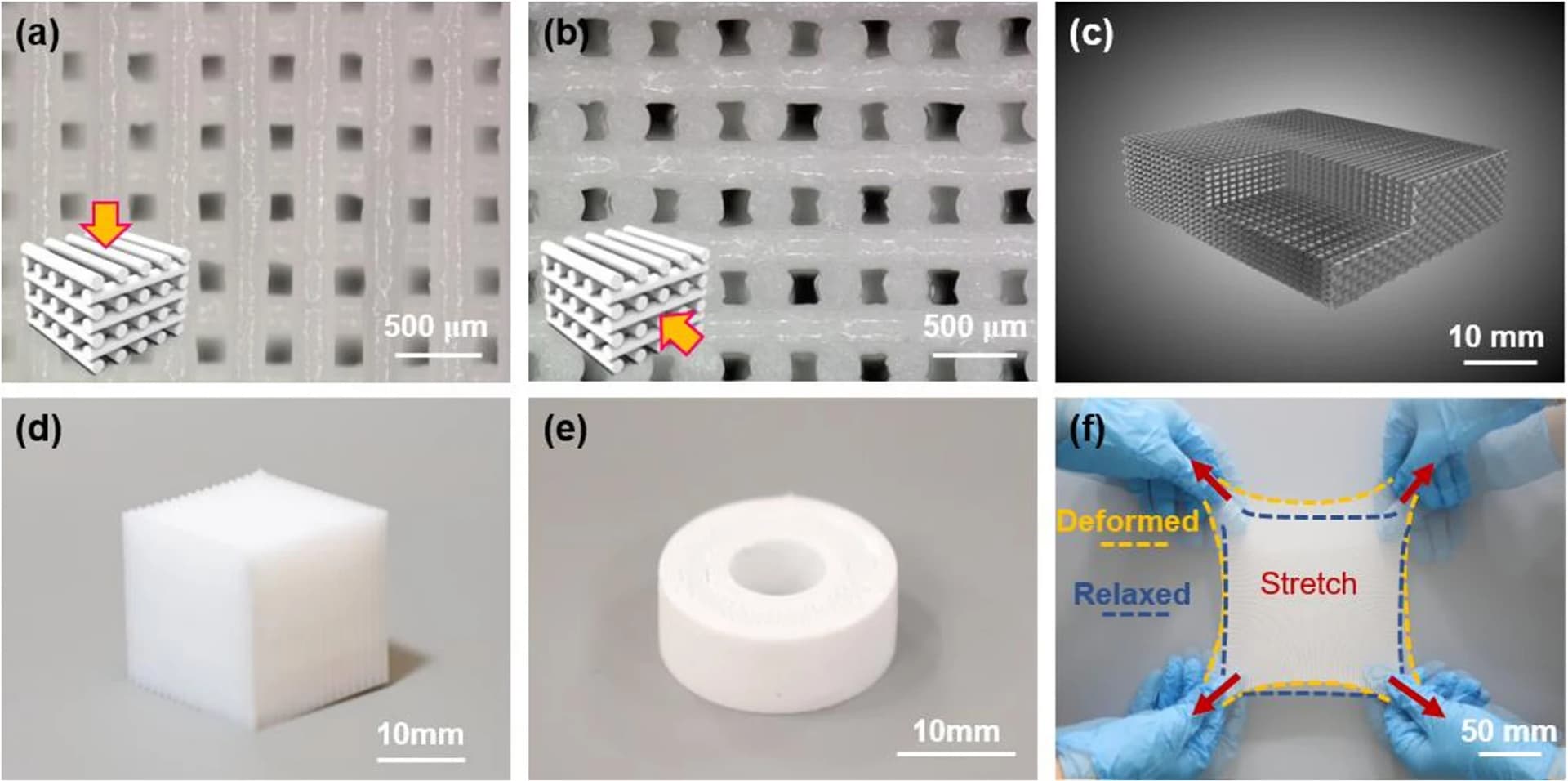
The researchers used a printable composite ink made from silicone rubber and hexagonal boron nitride, or hBN, then deposited it through a custom gantry-style 3D printing system with a 250 micron nozzle. Under microscopy and micro-CT imaging, the printed lattices showed ordered filaments, stable interlayer bonding, and retention of the intended architecture. In other words, this was not just a printable blob with a lattice look. The structure actually held together the way the design called for.
The material window is narrow, and that is the point
The most useful production detail for makers is the working range. The ink stayed printable between 1 and 5 weight percent hBN, but anything above 5 percent became too viscous to extrude reliably. That narrow window is a reminder that the best-performing printed elastomers are often a balancing act, not a brute-force material dump.
For readers who print functional parts, that balance matters in everyday builds. A little filler can improve performance without killing flexibility, but too much can clog the process or turn a soft mount into a rigid block. The paper makes the case that lattice design and filler loading need to be chosen together, especially when the goal is a part that must flex, recover, and stay clean in a harsh environment.
What the fungal tests actually showed
The antifungal results are the real headline. The team used ASTM G21, the standard fungal-resistance test for synthetic polymeric materials, which uses five fungal species and then rates visible growth after incubation. After 28 days, the hBN-free samples showed visible colonization. By contrast, the 5 percent hBN lattice essentially eliminated observable growth and scored a rating of 0.
That is a sharp practical result, especially for anything destined for damp or marine use. The study also found that geometry mattered, not just chemistry. When filler loading was low, larger filament spacing led to more fungal coverage, which means a lattice that looks “open” and efficient on the screen can become a liability if the spacing gives organisms more room to take hold.
A second accelerated test on carbon-rich medium reinforced the same pattern. The unfilled lattice degraded quickly, while the 5 percent hBN sample stayed clean. For builders who are used to thinking about strength and durometer first, this is a useful reminder that a part can fail long before it cracks if its surface biology is ignored.
Why it still cushions like a real isolator
The other half of the story is mechanical performance. The paper’s abstract says the work was aimed at harsh marine environments, where components face both mechanical stress and biological deterioration. In that setting, a part that survives fungus but turns stiff and noisy would miss the point entirely.
Here, the lattice did not. It retained over 90% of its stress resistance after 10,000 compression cycles and achieved vibration isolation efficiency of up to 92.5%. That combination is exactly what you want in a pump mount, a vibration pad under electronics, a protective insert in a damp housing, or a soft interface inside a wearable device. It suggests the lattice is not just durable in a lab sense, but durable in a way that preserves function over time.
What is doing the antifungal work
The paper attributes the antifungal effect to more than one mechanism. Enhanced hydrophobicity helps keep the surface less welcoming to growth, while hBN appears to contribute oxidative stress through reactive oxygen species generation. Taken together, that means the material is not just passively resistant. It is actively pushing back against the conditions fungi need to spread.
That matters because it explains why a printable lattice can outperform a simple coated surface. Coatings can wear away, but if the bulk material and the structure itself are part of the defense, the protection is less dependent on a thin outer layer surviving abuse. For printed parts that live in humid enclosures, near seawater, or around condensation, that is a much more realistic path to longevity.
What this means for real builds
The big lesson here is not that silicone got a new trick. It is that printable elastomer lattices are becoming a serious engineering platform, where geometry and chemistry do equal work. If you are designing a part for a humid enclosure, a wearable spacer, a vibration-isolating foot, or a pump mount, the winning move may not be a more exotic printer. It may be a smarter lattice, a better filler balance, and a material choice that solves two problems at once.
That is the practical shift this study points toward: a printed silicone structure that can keep its shape, keep its damping, and keep fungi off its back, all in the same part.
This article was produced by Prism’s automated news system from verified source data, official records, and press releases, then run through automated quality and moderation checks before publishing. The system is built and supervised by the people who set the standards it runs under. Read our full AI policy.
Did this article answer your question?