3D printer bakes cookies using heated bed as oven
An enclosed printer can double as a warm chamber, but this cookie stunt is really a lesson in food-safe limits, surface finish, and mechanical restraint.
A printer bed can fake an oven, but only up to a point
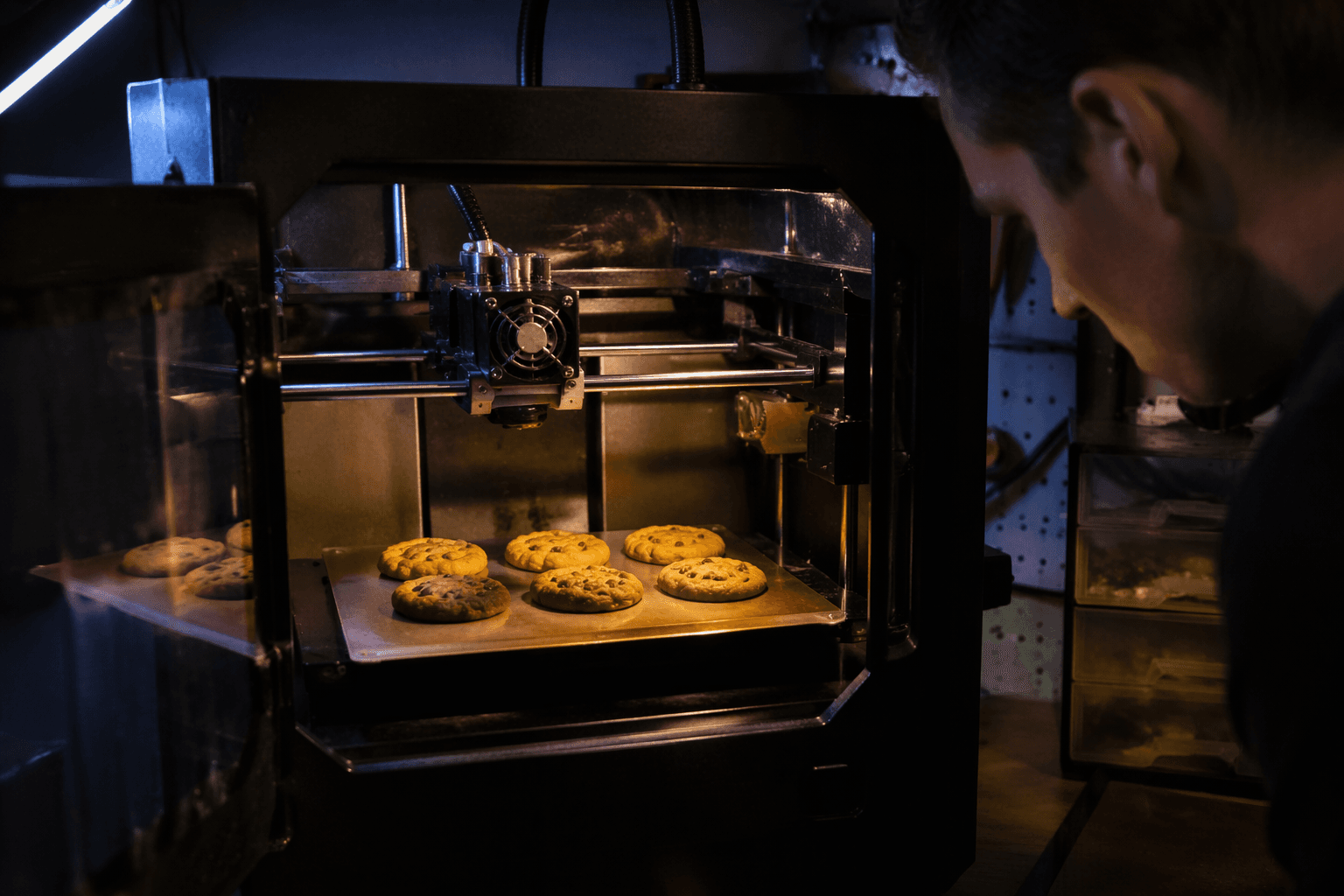
Startup Chuck’s cookie experiment is funny because it works, and that is exactly why it matters. He 3D printed the tools, mixed the dough, scooped the cookies, and then used a 3D printer itself as the final heat source, turning the heated bed into a low-temperature baking chamber. The result was recognizable cookies, but they were not browned, which tells you this was more controlled warm-box behavior than true oven performance.
That distinction is the whole maker lesson. A heated bed inside an enclosed machine can absolutely raise the internal temperature enough to set dough, but it is not the same as a kitchen oven with full convection, top-down radiant heat, and a proper bake profile. If you are thinking about repurposing a printer for food experiments, the real question is not whether it can get warm. It is whether it can sustain a consistent chamber environment without turning your machine into a cleanup problem or a safety headache.
The build was a printer-based kitchen workflow, not just a gag
Startup Chuck described the project as “part 3D printing experiment, part baking challenge, and part questionable idea,” which is the right level of honesty for a stunt like this. According to the video description, the workflow started earlier than the bake itself: he 3D printed all the kitchen tools needed to make chocolate chip cookies, then used them to mix, scoop, and cook the cookies inside the printer. The build also comes with GitHub, time-lapse material, and 3D print files, which makes it feel less like a one-off prank and more like a reproducible bench experiment.
The tool list is where the design thinking gets interesting. Hackaday’s summary calls out a printed mixing bowl and a beater for a KitchenAid mixer, plus scoops and a spatula. The spatula blade was printed in TPU, which is exactly the sort of material choice that makes sense in the hand because flexibility helps when you are handling dough, scraping, and moving sticky ingredients around. The cookie baking sheet was printed in nylon filament, another reminder that this project was built around practical motion and handling, not just novelty.
That is why the story lands with maker readers. It is not only about whether cookies can come out of a printer. It is about how far you can push a machine when you treat it as a motion platform, a heated chamber, and a toolmaking system all at once. Once you start printing the utensils too, the printer stops being a gadget and starts acting like a kitchen workstation with very odd boundaries.
Where the hack crosses into food-safety territory
This is where the fun experiment stops being purely silly and starts brushing up against real food-safety rules. The U.S. Food and Drug Administration says food contact substances used in packaging, storage, or other food handling need authorization through a food contact notification, a food additive regulation, or a Threshold of Regulation exemption. The agency’s food contact notification process dates to a 1997 amendment to the FD&C Act, and those authorizations are specific to the company and the intended use.
That specificity matters more than most makers realize. A filament being common, printable, or widely used does not automatically make a finished utensil food-safe for a given application. The FDA’s review framework includes migration testing and toxicological data, which is a very different standard from “it printed cleanly” or “it touched dough for five minutes.”
The maintenance side is just as important. Food and moisture create a long list of printer headaches, from contamination in the enclosure to residue in the toolhead and on printed parts. If you turn a machine into a baking chamber, you are also turning it into a cleaning project, and any porous, layered surface becomes harder to trust the next time you want to print something mechanical.
Surface finish is not a small detail when food gets involved
One of the biggest hidden problems here is texture. Research on 3D-printed materials has repeatedly noted that surface roughness can make printed parts more susceptible to microbial adhesion, and that is exactly the kind of issue that turns a clever prototype into a bad long-term habit. Layer lines are a strength when you are printing fast and iterating often, but they are not your friend when the part is expected to handle food repeatedly.
That is why the cookie project is more useful as a boundary test than as a recipe. It shows that printed tools can function for a single demo, but it also shows how quickly the question shifts from “can I print this?” to “can I clean this, certify this, and trust this again tomorrow?” In a mechanical context, roughness might only affect fit or finish. In a kitchen context, it can affect hygiene.
The nylon baking sheet and TPU spatula blade also underline the larger point about material choice. Flexible TPU is handy for scraping dough, but a good handling property is not the same thing as a food-contact approval. Likewise, a printable polymer that survives a warm chamber is not automatically a sensible surface for repeated food use.
3D food printing is growing up, but the constraints are still the story
The broader research around 3D food printing shows why this odd cookie experiment keeps resonating. Recent peer-reviewed reviews say the field can customize visual characteristics, nutritional content, texture, and organoleptic properties, which is a serious step beyond novelty printing. At the same time, those same reviews keep coming back to the same roadblocks: food safety, regulation, and consumer acceptance.
That tension is exactly what makes the cookie stunt worth paying attention to. The project shows how a printer bed can become a low-temperature heating source, how printed jigs and utensils can compress a kitchen workflow, and how a playful demo can still teach real lessons about enclosure behavior, temperature control, and material selection. It also shows where the experiment should stop, because not every printable idea deserves to become a permanent kitchen tool.
The smartest takeaway is not that a 3D printer can bake cookies. It is that the printer can reveal how close clever fabrication gets to food-safety, sanitation, and mechanical-risk territory. Once you understand that line, the stunt stops being a joke and becomes a very good maker lesson.
This article was produced by Prism’s automated news system from verified source data, official records, and press releases, then run through automated quality and moderation checks before publishing. The system is built and supervised by the people who set the standards it runs under. Read our full AI policy.
Did this article answer your question?