AML3D Wins US Navy Contract to 3D Print Submarine Replacement Parts
AML3D secured an A$2.61M contract to print five obsolete US Navy submarine parts in Ohio, showing how wire-arc AM is solving a problem no parts catalog can fix.
The five parts AML3D will print for US Navy submarines are not exotic geometry showcases. They are high-demand replacement components for systems whose original manufacturers stopped making them years ago, the kind of spares that strand vessels in maintenance backlogs while procurement teams chase dead-end supply chains. That obscure logistical problem is exactly why this A$2.61 million contract is worth paying attention to.
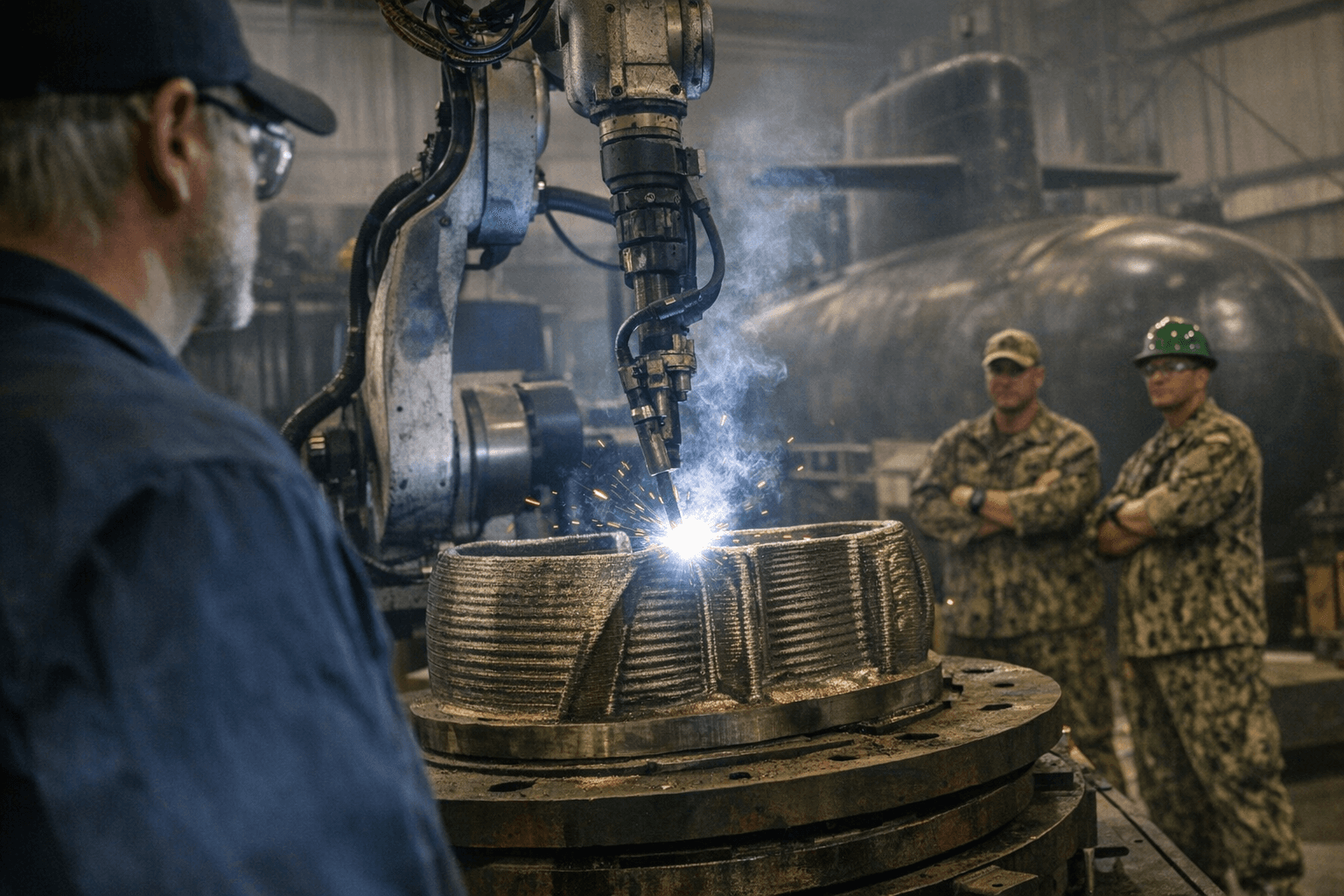
AML3D, an Australian metal additive manufacturing company listed on the ASX, announced the order in late March. The contract was placed through BlueForge Alliance, a US nonprofit that functions as a neutral integrator for the Navy's Submarine Industrial Base, and will be executed at AML3D's Ohio facility. The company will produce five non-safety-critical components using its proprietary ARCEMY wire-arc additive manufacturing process, a directed energy deposition method that combines an electric arc with welding wire to build large, dense metal parts. The engagement is expected to run approximately ten months.
Wire-arc AM is particularly suited to the Navy's problem. Where powder-bed fusion excels at small, intricate geometries, wire-arc handles large, structurally demanding parts with material properties comparable to castings. This contract also follows successful hydrostatic testing of ARCEMY-produced components conducted by the Navy itself, clearing a critical validation gate before any part can be considered for installation.
That sequence matters. The Navy's incremental adoption strategy, starting with non-safety-critical parts, qualifying them through rigorous inspection and testing, then expanding scope, mirrors a procurement philosophy built around traceability and accountability. A Letter of Intent issued to AML3D in June 2025 put a number on the ambition: roughly 400 additively manufactured components in fiscal year 2026, scaling to 1,600 per year by 2030, backed by plans for up to 100 large-format metal 3D printers across the Submarine Industrial Base.
None of that scale is possible without documented process controls. Industrial qualification for naval parts demands material certifications, weld procedure qualifications, full chain-of-custody records for every wire spool, and dimensional inspection against engineering drawings at multiple build stages. ARCEMY components are produced to American Welding Society standards and can be certified under Lloyd's Register and DNV guidance for marine additive manufacturing. These are not bureaucratic formalities; they are the institutional memory that proves a printed part behaves like the one it replaces.
That documentation discipline is where the defense contract carries a direct lesson for anyone running a desktop FDM or resin printer. The gap between a prototype that looks right and a functional part that performs reliably over time is almost always a process gap: unknown filament moisture content, uncalibrated extrusion, no record of which print settings were used when a part first succeeded. Industrial AM closes those gaps with mandatory traceability. Home printers can close them voluntarily.
Keeping a build log, noting filament brand and lot number, recording ambient temperature and calibration dates, and comparing finished dimensions against a simple print-and-measure template adds almost no time to a session. It creates the same feedback loop that lets naval engineers trust a printed metal component enough to install it inside a submarine. The Navy's bar is categorically higher, but the mindset scales down cleanly to any machine that deposits material in layers and calls it a part.
This article was produced by Prism’s automated news system from verified source data, official records, and press releases, then run through automated quality and moderation checks before publishing. The system is built and supervised by the people who set the standards it runs under. Read our full AI policy.
Did this article answer your question?