Argonne National Laboratory Uses 3D Printing to Advance Nuclear Reactor Components
3D-printed Alloy 709 outperformed wrought steel at 1022°F in a first-ever LPBF test, as Argonne pushes an ASME proposal that could let the nuclear industry print reactor parts.
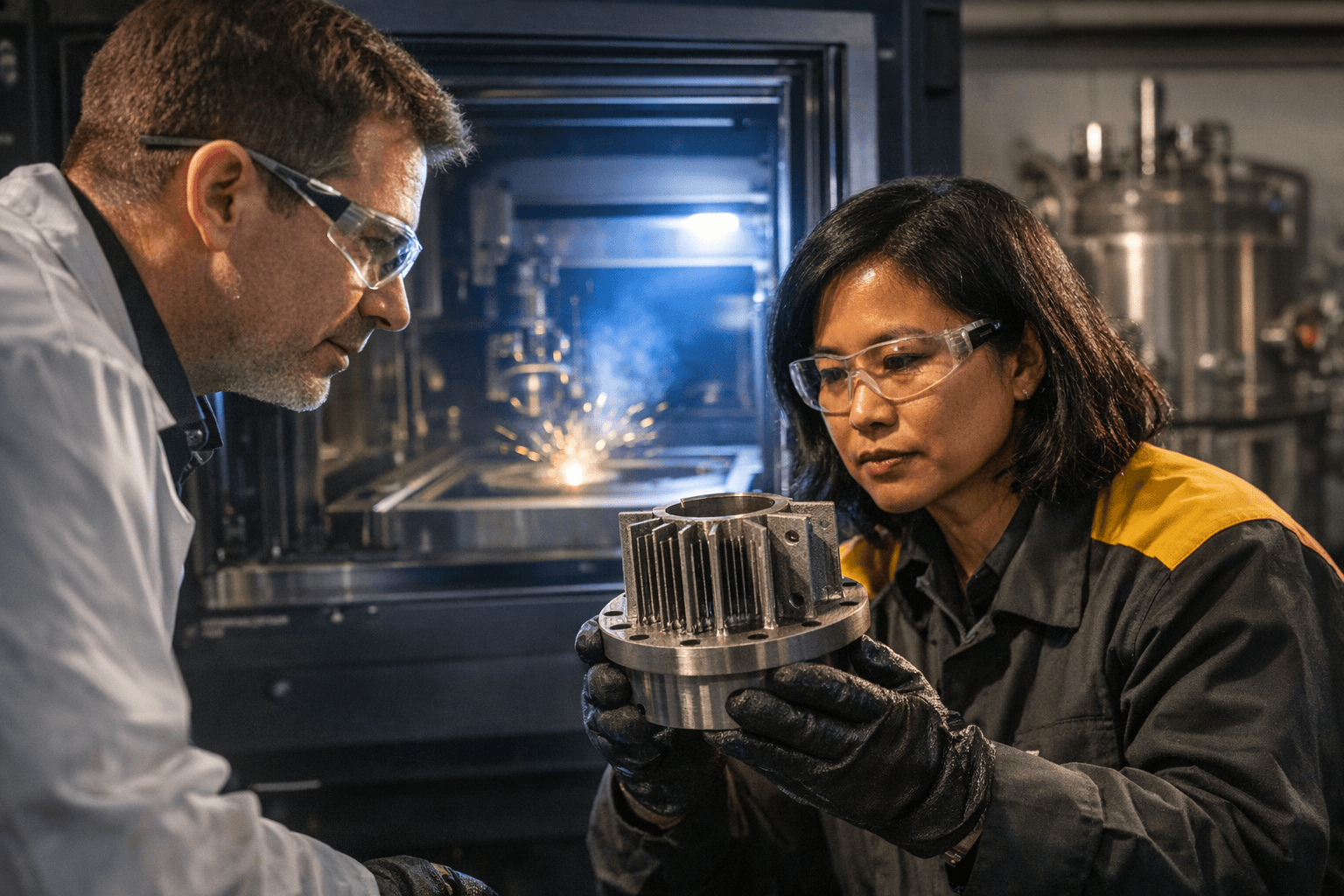
Additive manufacturing offers a way to produce complex stainless steel parts more efficiently and with greater design flexibility than conventional methods, but the process can leave behind defects in the microscopic structures of steel parts that affect their performance. That tradeoff sits at the center of two new studies out of Argonne National Laboratory, and the results are pushing the nuclear industry closer to a regulatory watershed.
The research team used laser powder bed fusion (LPBF) to print samples of two stainless steel alloys: 316H, an established material for nuclear reactor structural components, and Alloy 709, a newer alloy designed for advanced reactor applications. They employed X-ray diffraction and electron microscopy to compare the printed materials with conventionally produced steel. The studies revealed that 3D-printed steels contain higher numbers of dislocations, structural defects that can strengthen steel but also increase internal stress. Heat treatment processes showed different results between printed and conventional steels, with nano oxides in the printed materials acting as barriers to grain movement and growth.
The A709 results are the headline finding. In this study, Argonne researchers investigated samples of A709 printed with LPBF, marking the first experimental look at an additively manufactured form of the alloy. At both room temperature and 1022°F (550°C), a temperature relevant to sodium fast reactor applications, the printed A709 displayed higher tensile strengths compared to the wrought A709. This was likely because the printed samples began with more dislocations, which also promoted the formation of more precipitates during heat treatment.
The team also performed in situ X-ray diffraction experiments at the Advanced Photon Source (APS), a DOE Office of Science user facility at Argonne. At beamline 1-ID, the team probed the samples with high-energy X-rays as they underwent variations of a heat treatment called solution annealing. "The high flux of photons provided by the APS allowed us to track the evolution of the microstructures in real time during the dislocation recovery process," said Xuan Zhang, a materials scientist at Argonne and co-author on both studies.
Materials scientist Srinivas Aditya Mantri, also a co-author on both studies, added: "Our results will inform the development of tailored heat treatments for additively manufactured steels. They also provide foundational knowledge of printed steels that will help guide the design of next-generation nuclear reactor components." The studies on 316H and A709 are published in the journals Materials & Design and Materials Science and Engineering, respectively.
The work was conducted in collaboration with Oak Ridge National Laboratory and Los Alamos National Laboratory under the Department of Energy's Advanced Materials and Manufacturing Technologies (AMMT) program, which also counts Idaho National Laboratory among its partners on Alloy 709 code qualification efforts.
The bench science is now being pushed toward the standards bodies that actually determine what can go inside a reactor. The team has submitted a draft Code Case to the American Society of Mechanical Engineers, supporting Laser Powder Bed Fusion and seeking to allow its use in high-temperature reactor components. If ASME approves it, reactor engineers could stop waiting months for specialized forged and cast parts and begin printing critical structural components with far more geometric freedom.
Argonne is also looking at ways to speed up the testing process. Qualifying a new material typically takes years of empirical data and physical testing, and the team wants to use machine learning to help predict how materials will behave over time. That move toward digital qualification fits into the Department of Energy's "Genesis Mission," linking supercomputers and data across the national lab system. By combining AI with real-time monitoring during printing, the team hopes to make the leap from experimental to standard practice much sooner than expected.
The commercial stakes are escalating fast. Researchers at Oak Ridge National Laboratory, one of Argonne's collaborators on this program, have explicitly connected 3D-printed nuclear materials to the surging power demand from AI data centers, noting that small modular and microreactor designs, with their complex geometries and demanding assembly requirements, stand to benefit most from a qualified additive manufacturing supply chain. Getting LPBF across the ASME finish line would be the first major step in building that chain.
This article was produced by Prism’s automated news system from verified source data, official records, and press releases, then run through automated quality and moderation checks before publishing. The system is built and supervised by the people who set the standards it runs under. Read our full AI policy.
Did this article answer your question?