Arizona Startup EX3D Prints Launches Distributed 3D Printing Marketplace
EX3D Prints, an Arizona startup, launched a three-actor distributed print marketplace where designers earn 10% per sale and hobbyist printer owners fulfill orders locally.
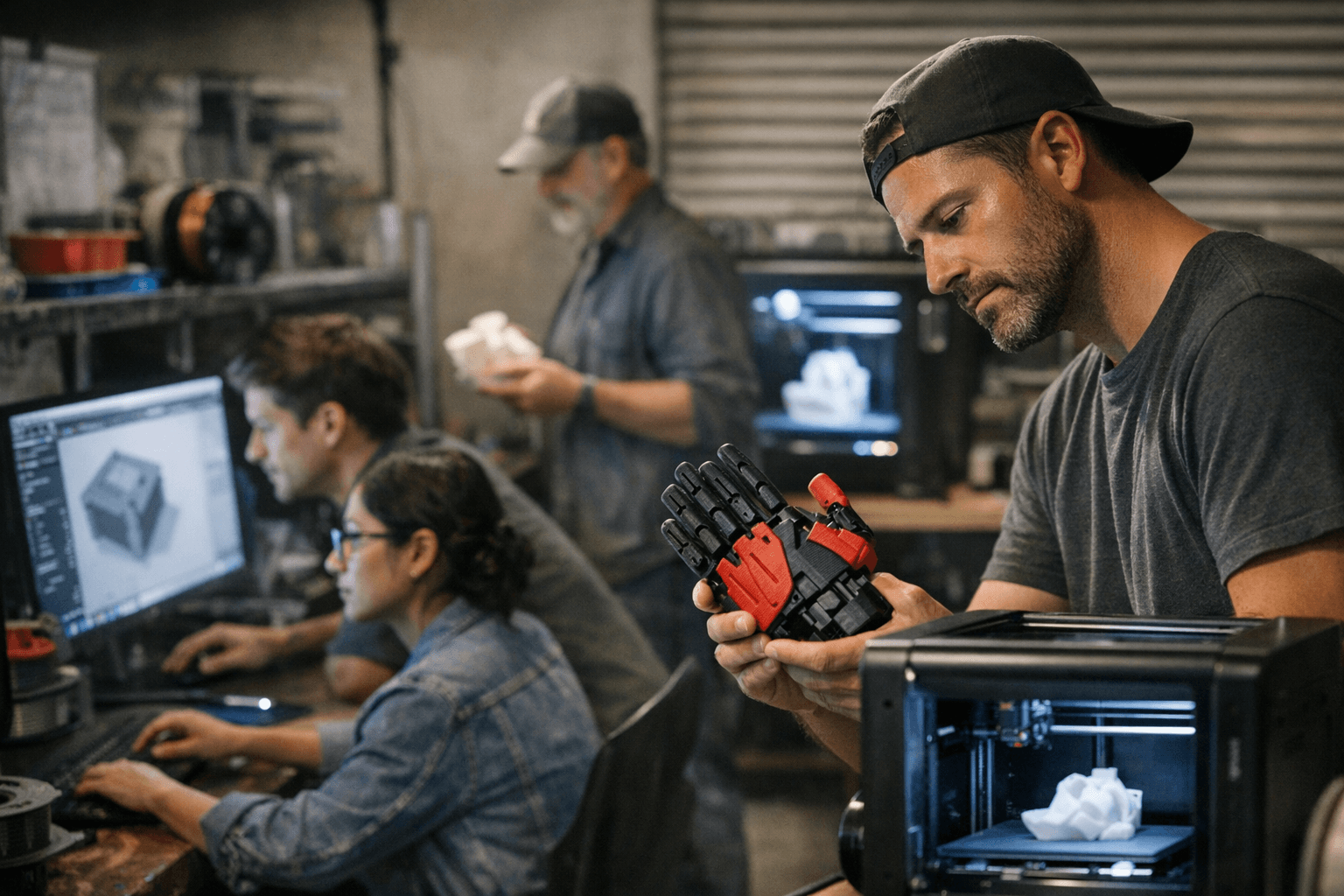
EX3D Prints, an Arizona startup, has built a distributed manufacturing marketplace that connects designers who create digital models, hobbyists who own 3D printers, and customers who want physical versions of those designs. The model is deceptively simple and carries real baggage: the 3D printing world tried this once before, and it didn't end the way anyone hoped.
The platform operates with three actors: print buyers, 3D printer operators, and 3D model designers. Buyers purchase prints, operators run jobs, and designers provide content. Buyers are the source of cash in the system; operators receive some unspecified portion of the fee, while designers receive 10% of the proceeds when one of their designs is printed and purchased. What the operator cut and EX3D's own platform commission amount to remains undisclosed.
Instead of relying on centralized print farms or traditional manufacturing, EX3D routes production through a network of independent printers. When a customer places an order, the product can be produced locally by a printer in the network and shipped directly to the buyer. In November 2025, the platform took first place at its university's Eagle Tank competition, a student version of Shark Tank, where a panel of industry experts singled out the platform's potential to democratize manufacturing.
The concept will feel familiar to anyone who's been in this hobby long enough. This was exactly the plan for 3DHubs, which launched back in 2013. Almost 15 years ago, that startup launched a portal to connect thousands of 3D printers sitting idle in makers' shops, experienced skyrocketing growth alongside the broader 3D printing industry, and was ultimately sold to Proto Labs, a large global manufacturing contractor. Kerry Stevenson, who has written over 8,000 stories on 3D printing at Fabbaloo since founding it in 2007, is skeptical history plays out better this time. "That's the situation facing EX3D Prints: decreasing need and margins due to the proliferation of inexpensive 3D printers. They may succeed on a smaller scale, but it is unlikely they will be able to scale up to a significant size for the same reasons that stopped 3DHubs."
The concerns don't stop at market dynamics. One process EX3D Prints has stated involves damaged parts: buyers are asked to contact the company by email and include images of damaged parts from several angles, with the case manually reviewed and a refund potentially offered. That could be a challenging process if "damage" shifts into "print quality," and it's not clear how any of that scales up. The printer network needs to be large enough and reliable enough to handle a growing volume of orders, and quality control in a distributed production model is something every marketplace of this kind has to solve in its own way. And then there is trust: the customer has to believe that an item printed by a stranger in another city will be exactly what they expected.
There is at least one functioning model that shows distributed print networks can reach meaningful scale. Michigan's Project DIAMOnD, led by Automation Alley and funded by Oakland County, launched in 2020 using CARES Act funding and has since provided grant-funded printers and training to more than 500 small manufacturers, technology companies, and engineering firms. Project DIAMOnD has completed 51,153 prints and built its marketplace as a secure, peer-to-peer platform where companies can submit jobs at scale and participating manufacturers fulfill them collaboratively. The platform explicitly addresses IP protection and shared payment mechanics, features EX3D's public materials have not yet detailed. Pavan Muzumdar, CEO of Project DIAMOnD and COO of Automation Alley, put the case plainly: "Designers don't even need a printer to benefit. They can simply submit their designs, have them produced securely across the network and know their intellectual property is protected."
EX3D does have one argument that rarely gets made explicitly in this space. 3D printing has been promising to democratize manufacturing for years, and for years that promise has remained mostly theoretical. EX3D Prints is trying to turn it into infrastructure. The environmental case is part of that pitch: production happening near the customer means fewer shipping kilometers, a smaller carbon footprint, and faster delivery than traditional logistics allow.
These are questions EX3D will have to answer as it scales. But the idea itself is solid. Whether an Arizona startup can thread the needle that 3D Hubs could not, this time against a backdrop of $200 Bambu printers in every maker's corner, is the real test.
This article was produced by Prism’s automated news system from verified source data, official records, and press releases, then run through automated quality and moderation checks before publishing. The system is built and supervised by the people who set the standards it runs under. Read our full AI policy.
Did this article answer your question?