AtrimusRx gets Sweden's first validation for 3D-printed pharmacy medicines
AtrimusRx turned 3D printing from a lab demo into a validated pharmacy workflow, with dosing that starts at 2 mg and steps down in quarter-milligram increments.
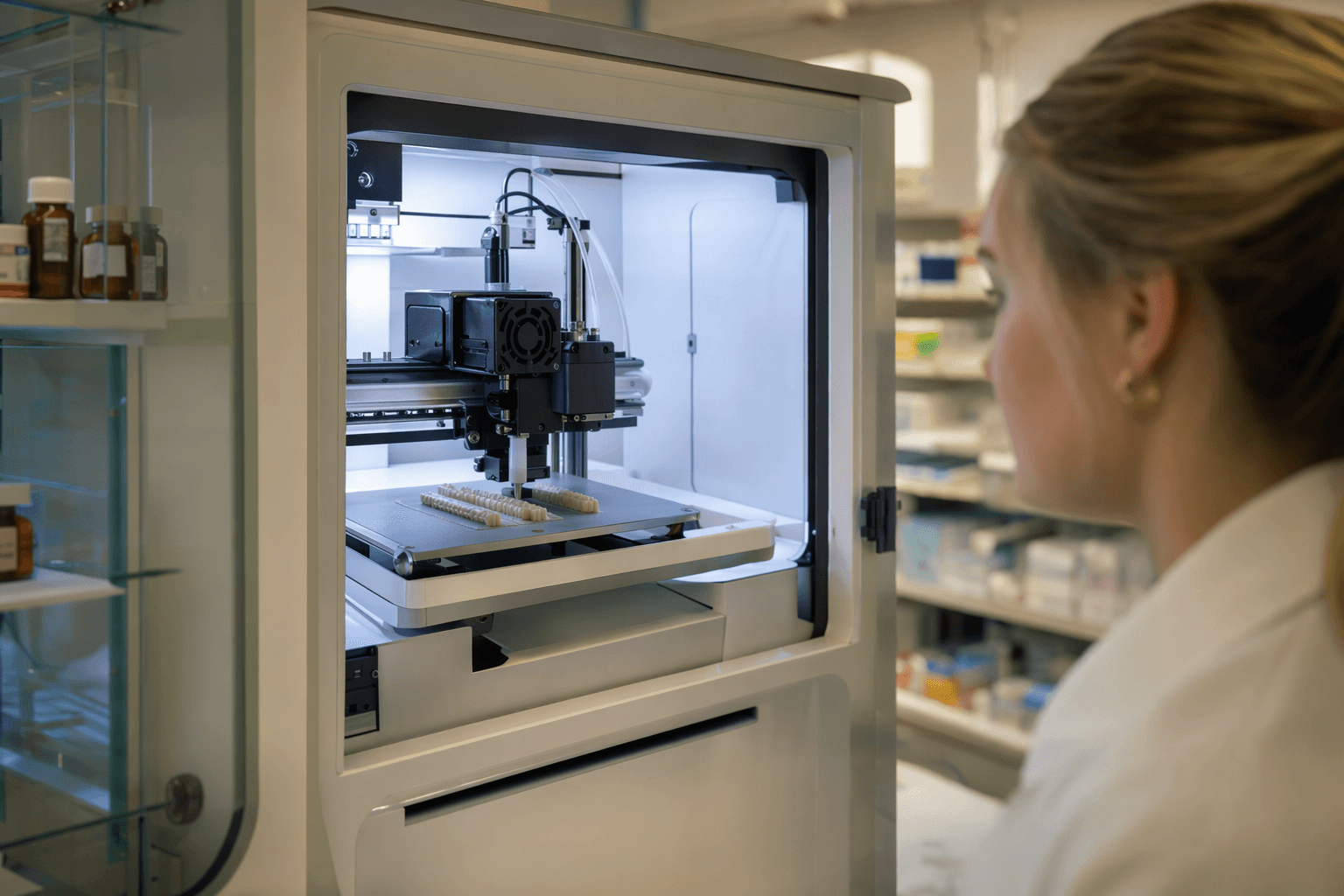
AtrimusRx has done something the 3D-printing world keeps promising and rarely proves at scale: it put additive manufacturing into a regulated, repeatable, end-use workflow. The Stockholm company said on May 6 that it became the first community pharmacy operator in Sweden to receive validation for using 3D printing in extemporaneous compounding inside outpatient pharmacy practice.
That matters because this is not about printing a flashy demo part. AtrimusRx’s Atrimus Px framework is built to make medicines to the patient, not the shelf, with doses tailored to age, body weight and the prescribed amount. The company says individualization starts at 2 mg, with quarter-milligram adjustments in the low-dose range. In practical terms, that kind of granularity is exactly where conventional medicine formats break down, especially for children.
The old workaround is familiar to anyone who has ever watched a process get forced to fit the wrong tool: split a tablet, crush it, mix it, hope the dose lands close enough. AtrimusRx’s pitch is that the dosage form should be created correctly from the prescription in the first place. The system is designed to support gradual titration, escalation and tapering, and, when clinically appropriate, it can combine multiple active ingredients into one form.
Nicky Nadem, AtrimusRx’s chief executive, cast the validation as a major step for precision medicine in Sweden, with the goal of bringing dosage precision and safety to vulnerable patients in daily pharmacy work rather than a research lab. That framing also gets to the heart of why this story reaches beyond pharmacy: regulated additive manufacturing only becomes credible when it can show repeatability, materials control and workflow quality, not just print speed or clever geometry.
Sweden’s rules make that bar explicit. The Swedish Medical Products Agency requires a license to open and run a pharmacy, and it oversees those operations. Sweden has also kept a national pharmaceutical strategy in place since 2011, with a renewed version covering 2024 to 2026. In earlier Swedish coverage, the lack of profitable extemporaneous pharmacy work was one reason no community pharmacies had really pursued it.
AtrimusRx is not emerging in a vacuum. APL and CurifyLabs announced a 3D-printed personalized medicines push in 2024, targeting children and critically ill patients, and APL reported its first delivery of a compounded medicine made with 3D-printing technology in January 2026. AtrimusRx is also tied to RoboPharma, the EU-backed EUR 5.6 million effort to build decentralized pharmaceutical manufacturing with AI and robotic dosing.
For 3D printing, the significance is plain: validation is the bridge between a printer on a bench and a process trusted to make what people actually take. AtrimusRx just crossed that bridge, and it did it with doses precise enough to matter.
Know something we missed? Have a correction or additional information?
Submit a Tip