Bambu Lab Relaunches PETG Basic Filament With Easier Printing for Hobbyists
Bambu Lab's PETG Basic is back, promising to fix PETG's notorious stringing problem with lower moisture sensitivity and plug-and-play profiles for Bambu printer owners.

PETG has long been the filament hobbyists reach for when PLA isn't tough enough, but stringing, bridging failures, and moisture headaches have made it a source of frustration as much as function. Bambu Lab's answer, relaunched on March 27, 2026: a reformulated PETG Basic that the company says delivers that same toughness with something closer to PLA-level printability.
The filament reappeared on Bambu Lab's US store alongside coverage from maker outlets and a wave of discussion in the official Bambu community forum. The timing matters because PETG Basic had previously been shelved when Bambu's PETG HF (High Flow) took its place, making this relaunch either a strategic reversal or a deliberate line extension. Forum members noticed quickly, and the threads that followed were characteristically thorough.
What Bambu is selling with PETG Basic is a specific proposition: you can get PETG's mechanical advantages, including impact resistance, UV tolerance, and water resistance, without the calibration overhead that typically comes with the material. The store copy and press coverage both point to reduced stringing as the headline improvement, tied directly to lower moisture sensitivity in the filament itself. Moisture absorption is one of PETG's most persistent real-world problems; a spool left in a humid print room can produce stringy, rough-surfaced prints even with otherwise solid settings, and addressing that at the material level is a meaningful change.
The positioning is squarely aimed at practical, functional printing: garden labels, outdoor clips, brackets, and fixtures, the kinds of parts that need to survive heat and rain but don't require an engineering print farm to produce. Bambu's store copy explicitly calls out outdoor applications and everyday functional parts as target use cases, which signals that PETG Basic is meant for the maker who wants to print something useful on a Saturday afternoon without opening a spreadsheet of retraction values.
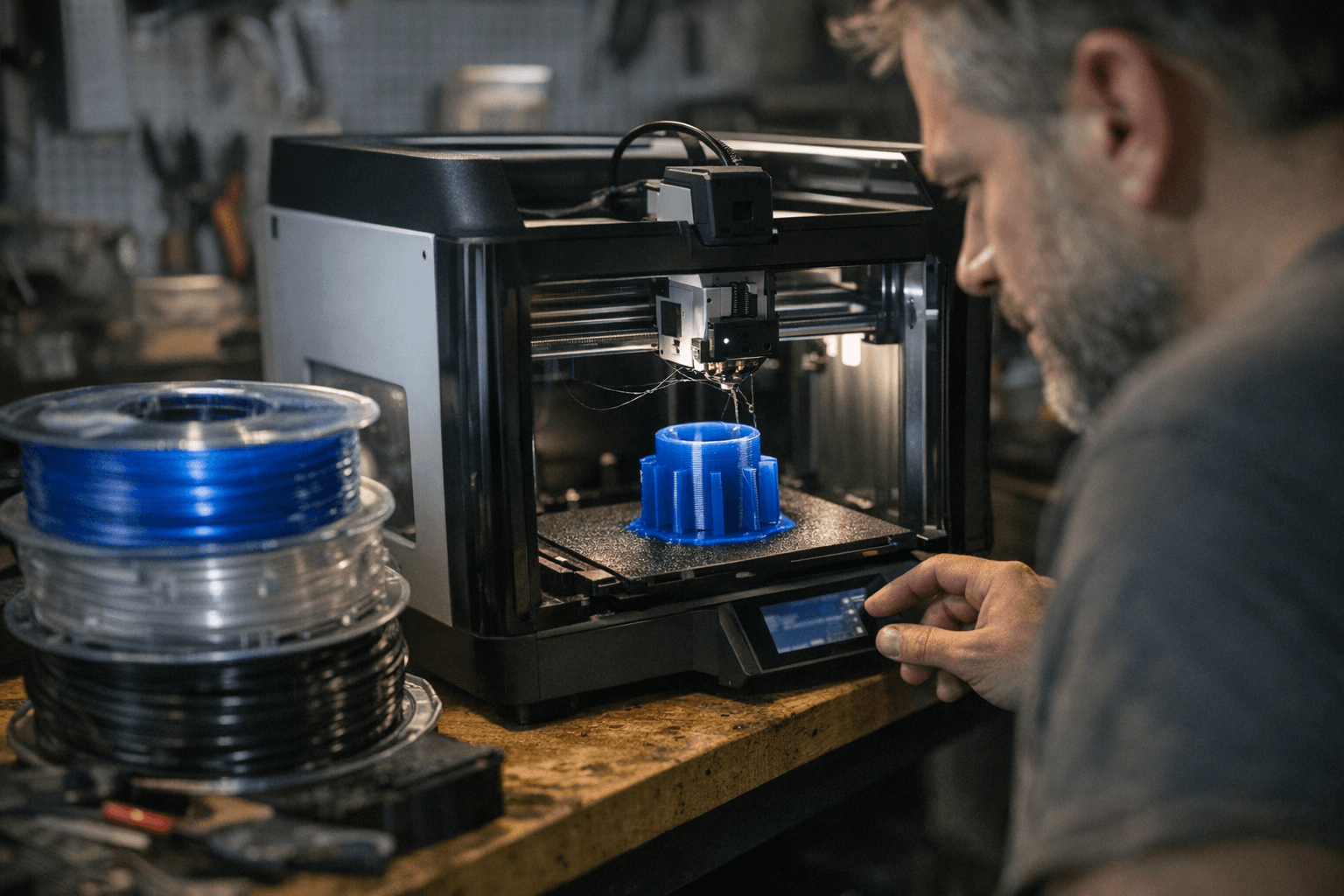
For Bambu printer owners, the practical upside is vendor-supplied profiles. Rather than spending an evening tuning retraction, temperatures, and fan speeds on a P1S, H2D, or A1, users get a validated starting point. Forum threads raised specific questions about AMS compatibility and whether drying is required before loading, the operational details that separate a smooth print session from a jam-clearing detour. Discussion also confirmed that Bambu Studio needs to be updated to access the new PETG Basic profiles, a minor friction point worth knowing before the first spool arrives.
The community reaction has generally weighed Basic against PETG HF, with members noting that the High Flow variant remains the stronger call for speed-focused workflows while Basic earns its place as the more forgiving option for users who prioritize reliability over throughput.
Bambu has been moving steadily toward tighter integration between its printers, software, and materials, and PETG Basic is another step in that direction. For makers already inside that ecosystem, it means one fewer calibration rabbit hole and one more reliable option for parts that actually have to live outdoors.
This article was produced by Prism’s automated news system from verified source data, official records, and press releases, then run through automated quality and moderation checks before publishing. The system is built and supervised by the people who set the standards it runs under. Read our full AI policy.
Did this article answer your question?