Bambu Lab X2D review spotlights a new workhorse 3D printer
Bambu Lab’s X2D lands as a $649 dual-nozzle workhorse for makers who want fewer support headaches and more hands-off printing.
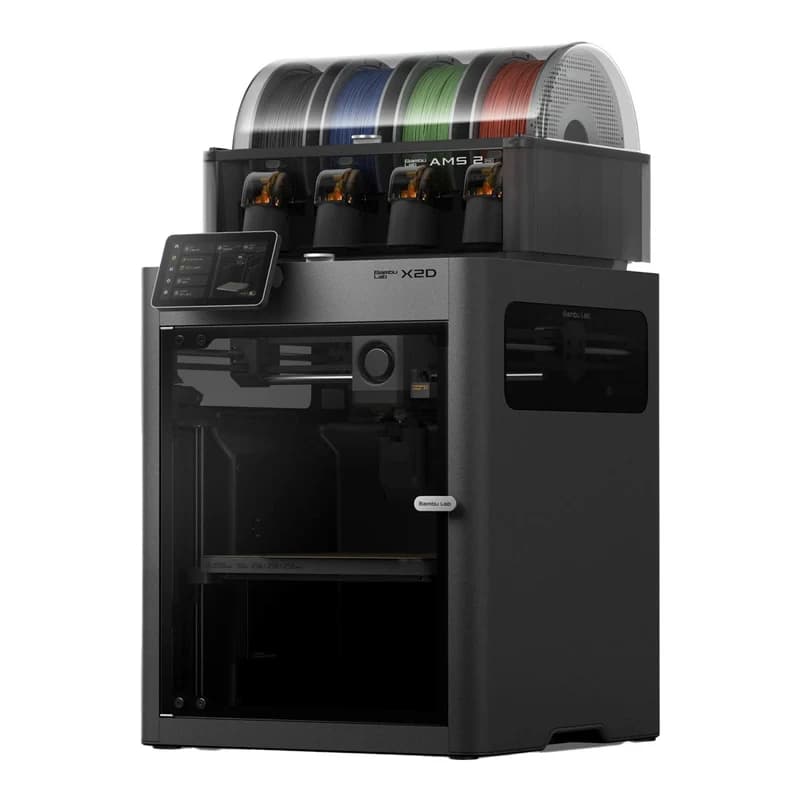
Bambu Lab’s X2D is being sold, and now reviewed, like the machine for people who want the convenience of a dual-extrusion setup without turning their bench into a troubleshooting station. That matters because the easiest way to waste money on a 3D printer is to buy one that looks exciting on paper and then babysit it through every long job. The X2D’s pitch is simpler: print more often, swap materials less painfully, and spend less time fighting supports.
What Bambu is actually promising
Bambu Lab launched the X2D on April 14, 2026 and introduced it as its “next-gen flagship 3D printer” with a dual-extrusion system. The company also wrapped the release in the slogan “Xcellence made simple,” which tells you exactly how it wants the machine to be read: not as a laboratory toy, but as a polished daily-driver. The other key line in the launch messaging was “No more compromises with supports,” and that is the real hook for anyone who has ever spent an evening picking broken scaffolding out of a cramped print cavity.
The X2D’s product page backs that up with features that are aimed squarely at convenience and consistency: dual nozzles, AI monitoring, active heating, dual-intake cooling, a servo extruder, adaptive calibration, and emission certification for home use. That is a very specific bundle of features, and it reads like a checklist for a printer that wants to do more than just look fast in a demo video.
The specs tell you where this machine belongs
The size and volume numbers make the workhorse label easier to believe. Bambu Lab’s wiki lists the X2D at 392×406×478 mm and 16.25 kg, with a maximum print area of 256×256×260 mm on the main nozzle. In common dual-nozzle use, the effective area drops to 235.5×256×256 mm, which is the number that matters once you actually start using both toolpaths.
That footprint puts the X2D in a useful middle zone. It is not a giant industrial box, but it is big enough to handle serious desktop jobs, prototypes, functional parts, and multi-material prints without feeling cramped. For home workshops and maker spaces, that is usually the sweet spot: enough volume to be useful, not so much bulk that the printer becomes a permanent furniture problem.
Who should look hard at the X2D
If you are already running a Bambu machine and it is meeting your needs, the X2D is not an automatic upgrade. The strongest case for moving up is if your current printer forces too many tradeoffs around supports, material changes, or unattended reliability. The whole point of a workhorse is that it reduces friction after the honeymoon phase, when novelty is gone and what you care about is whether the machine finishes the job cleanly.
The X2D makes the most sense for three kinds of users:
- People who print complex geometry often and want support removal to be less of a chore
- Users who need multi-material or multi-color capability without moving to a much pricier setup
- Small shops and serious hobbyists who care more about repeatability and throughput than gimmicks
If you mainly print simple single-material parts, the extra capability may be nice but not necessary. If you are already happy with the output of an existing Bambu printer and do not regularly hit support or material-change pain points, the X2D looks more like a lateral move than a must-have.
Why the price matters
Launch coverage put the U.S. base price at $649, with the X2D Combo listed at $899. That pricing is a big part of why the printer is drawing attention. Dual-extrusion has traditionally lived in the zone where you either pay a lot more or accept a lot more hassle, so a sub-$700 starting point changes the buying conversation immediately.
The combo bundle is the more revealing number for real buyers, because that is where Bambu Lab is clearly aiming at people who want a ready-to-run multi-color or multi-material setup. At $899, the X2D is no longer cheap in the casual sense, but it is still far more accessible than the sort of overbuilt systems many users would otherwise cross-shop for dual-nozzle convenience.
Early reception has been excited, but not blind
The first wave of YouTube coverage came from CNC Kitchen, The Real Sam Prentice, The Technology Man, Tech Fowler, and Tom’s 3D printing guides and reviews. Their focus lines up with what the product itself is selling: dual-nozzle printing, speed, and the practical compromises that come with a machine built around two nozzles instead of one.
That matters because a printer like this lives or dies on day-two and day-thirty ownership, not launch-day hype. The early feedback that has surfaced in the Bambu Lab community forum is especially useful because it points to the real-world friction points owners are already watching: auxiliary fan behavior, nozzle change behavior, print-bed space limits when both nozzles are used, and print-quality concerns with the auxiliary nozzle and third-party filaments. None of that kills the appeal, but it does separate a polished ecosystem from a perfect one. The X2D may be easier to use than older dual-extrusion machines, yet it still has the usual dual-nozzle tax in space, tuning, and material discipline.
What makes it a workhorse instead of a novelty
A printer earns workhorse status when it can do the boring jobs reliably, not just the impressive ones. The X2D’s case rests on a combination of hardware and software choices that are meant to lower the amount of babysitting: adaptive calibration to cut setup friction, active heating and dual-intake cooling to broaden material handling, and AI monitoring to keep tabs on the print when you are not standing over it. Add home-use emission certification, and Bambu Lab is clearly trying to make this feel like a printer that belongs in a room people actually work in.
That is also why the X2D’s value is tied to print volume and material use. If you are regularly making parts that need soluble supports, breakaway supports, or two materials with different properties in the same build, the machine starts to justify itself fast. If you are only chasing the idea of dual extrusion because it sounds advanced, the purchase is easier to admire than to defend.
Bambu Lab was founded in 2022, and the X2D looks like another step in the company’s quick march from fast-rising newcomer to ecosystem brand. The important part, though, is not the corporate storyline. It is whether the machine delivers the same thing the launch copy promised: less compromise with supports, fewer interruptions, and a printer that feels built for daily output instead of occasional spectacle. On that front, the X2D is being judged exactly where a true workhorse should be judged, and that is the right standard for it.
This article was produced by Prism’s automated news system from verified source data, official records, and press releases, then run through automated quality and moderation checks before publishing. The system is built and supervised by the people who set the standards it runs under. Read our full AI policy.
Did this article answer your question?