Barry Wark Studio's Tùr House Uses 3D-Printed Sand Blocks for Modular Living
Barry Wark Studio unveiled Tùr House, a conceptual modular dwelling using 3D-printed sand blocks to explore circular, reconfigurable architecture.
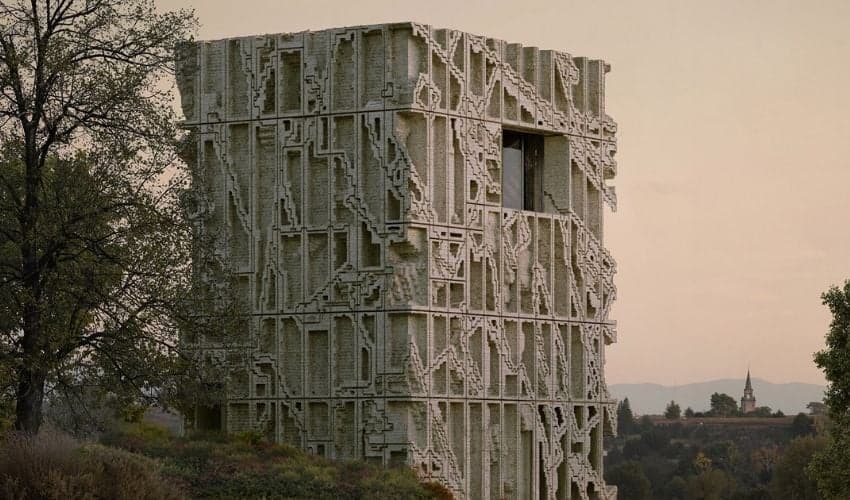
Barry Wark Studio revealed Tùr House, a speculative architecture research project that imagines modular dwellings built from 3D-printed sand blocks. The concept, released on January 22, 2026, frames additive manufacturing as a route to reusable, locally sourced building components and a new approach to on-site assembly and disassembly.
Tùr House envisions sand blocks printed as separate, interlocking modules that form a detachable outer skin of thermal blocks. Those blocks would be supported by printed columns and arranged into distinct public and private zones, giving the layout greater flexibility than conventional masonry. The proposal treats the blocks as reusable building units rather than one-off castings, emphasizing circularity and the potential for reconfiguration over the lifetime of a structure.
The project is explicitly conceptual. Barry Wark Studio has not finalized process details or raw-material sourcing, so Tùr House is not presented as a near-term construction program. Instead, the design exploration highlights how abundant local feedstocks like sand - and by extension recycled materials - could broaden the palette available to fabricators and architects. For those in the 3D printing community, the idea spotlights modular printing strategies that separate fabrication from assembly, reducing transport needs and allowing incremental adaptation of a dwelling as needs change.
Practical implications are immediate for makers, designers, and small-scale fabricators thinking beyond plastic filament. Modular sand blocks shift the engineering challenge from continuous, monolithic prints to repeatable unit production, which can fit into existing print-farm workflows and local assembly teams. The thermal-mass qualities of sand-based blocks suggest potential energy benefits for temperate climates, while the reuse-first mentality addresses embodied carbon concerns by prioritizing disassembly and material recovery.

Tùr House also underscores technical gaps that the community will need to close. Material testing, structural validation, long-term durability and moisture resistance, connection detail design, and compliance with local building codes remain open questions. Barry Wark Studio’s concept signals where those tests could focus: repeatability of block geometry, reliable interlocks or fastening systems, repairability of printed units, and viable local sourcing chains for sand and recycled feedstocks.
For readers involved in community fabrication, architecture, and materials development, Tùr House is a prompt to experiment with nonstandard feedstocks and modular workflows while keeping safety and code compliance front of mind. Barry Wark Studio’s exploration points to a future where buildings are assembled from replaceable, 3D-printed building blocks that can be repaired, reconfigured, and returned to local loops - a practical, testable direction for the next phase of sustainable additive construction.
This article was produced by Prism’s automated news system from verified source data, official records, and press releases, then run through automated quality and moderation checks before publishing. The system is built and supervised by the people who set the standards it runs under. Read our full AI policy.
Did this article answer your question?