BASF Launches World's First 3D-Printed Catalyst Production Plant in Germany
BASF's new Ludwigshafen plant 3D-prints industrial catalysts at scale, and the company behind it also makes the Ultrafuse filament on your shelf.
The same company that ships Ultrafuse spools to your door just turned additive manufacturing into a full factory. BASF started up the world's first production plant dedicated to 3D-printed catalysts at its Ludwigshafen, Germany site on March 19, a move that goes well beyond the chemical industry and carries a direct supply-chain thread back to your printer.
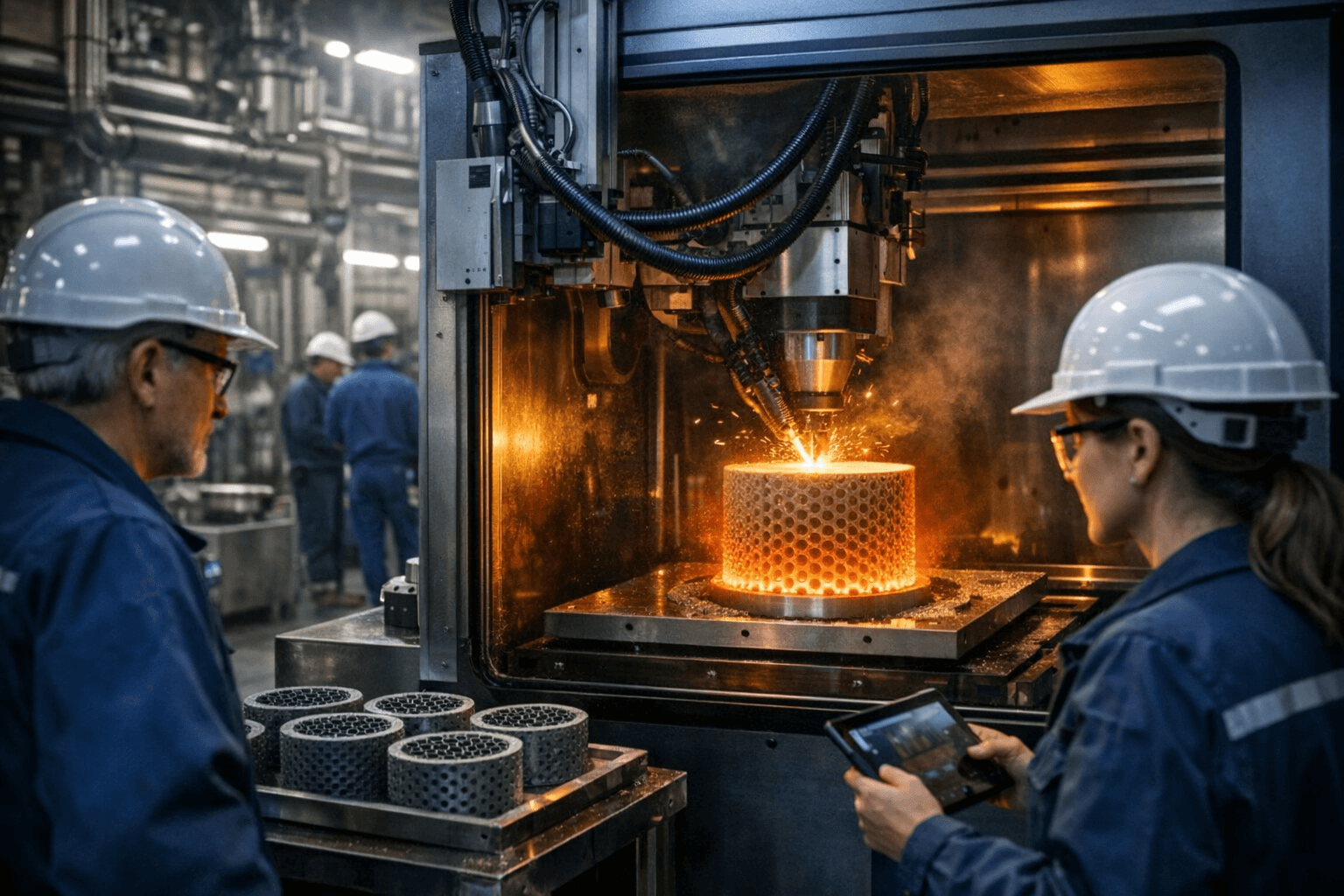
The facility is built around BASF's proprietary X3D technology, which prints catalysts in open, lattice-type geometries rather than the conventional dense pellets packed into industrial reactors. That architectural shift matters: the printed structures deliver a substantially larger catalytically active surface area while simultaneously reducing pressure drop across the reactor. The practical result is that plants running X3D catalysts can push higher throughput through the same reactor volume, or hold throughput steady while cutting energy consumption.
This is not a pilot line or a trade-show demonstration. BASF generated around 60 billion euros in sales in 2025 and employs 108,000 people worldwide. The Ludwigshafen plant represents a commercial, production-scale deployment of additive manufacturing by the world's largest chemical company, and the technology has been supplying customers since 2019.
The clearest performance data came in 2025, when Chinese fine chemical company An Hui Jintung loaded its production plant with BASF's sulfuric acid catalysts under the designation O4-115 X3D. "The plant started up smoothly, and plant performance has significantly improved compared to before," said Eter Zhu, General Manager at An Hui Jintung. "Production achieved a record high, generating substantial economic benefits for our company." Zhu added that An Hui Jintung plans to extend its use of X3D catalysts across additional reactor units.
Detlef Ruff, who served as Senior Vice President for Chemical Catalysts and Adsorbents at BASF, said the technology gives customers "a real competitive edge," citing the ability to supply catalysts tailored precisely to specific chemical processes, quickly and in large quantities. Ruff's successor, Yaqian Liu, stepped into that role on April 1.
For the desktop 3D printing community, the Ludwigshafen plant carries a signal that runs closer to home than sulfuric acid reactors might first suggest. BASF's Forward AM division, the same business entity, manufactures the Ultrafuse filament line: PLA, PETG, TPU, engineering materials, and metal composite filaments used by desktop and professional printers worldwide. When BASF improves the efficiency of its industrial chemical processing through better catalyst design, that efficiency touches the cost structure of the raw polymers and chemical additives that eventually reach its filament extrusion lines.
That is the supply-chain thread worth pulling on. X3D catalysts are already applied across a wide range of catalyst materials including precious metals, base metals, and various support matrices. Those categories cover processes central to polymer feedstock production. More efficient reactor performance means lower energy cost per unit of output and reduced waste, two levers BASF can translate into either price stability or improved margins across its entire materials portfolio.
What to watch in the next 12 months: Forward AM pricing movements on Ultrafuse engineering filaments, announcements of greener production credentials tied to reduced energy input per kilogram, and any new additive packages carrying sustainability language on spool labels. BASF is hosting a virtual media briefing in April to provide technical detail on X3D's manufacturing processes, including specifics on which catalyst chemistries are now in full production.
The lattice geometries developed for industrial reactors and the software that generates them also tend to filter downstream into desktop tooling over time, as complexity that once lived only in aerospace and chemical engineering finds its way into open-source slicers and generative infill algorithms. The Ludwigshafen plant is that process accelerating, with one of AM's most consequential materials companies now running it at factory scale.
This article was produced by Prism’s automated news system from verified source data, official records, and press releases, then run through automated quality and moderation checks before publishing. The system is built and supervised by the people who set the standards it runs under. Read our full AI policy.
Did this article answer your question?