Bentu Design Transforms Demolition Waste Into 3D-Printed Street Furniture
BENTU Design's Inorganic Growth project packed 85% recycled demolition rubble into 3D-printed street furniture, cutting transport emissions 70% with on-site mobile fabrication.
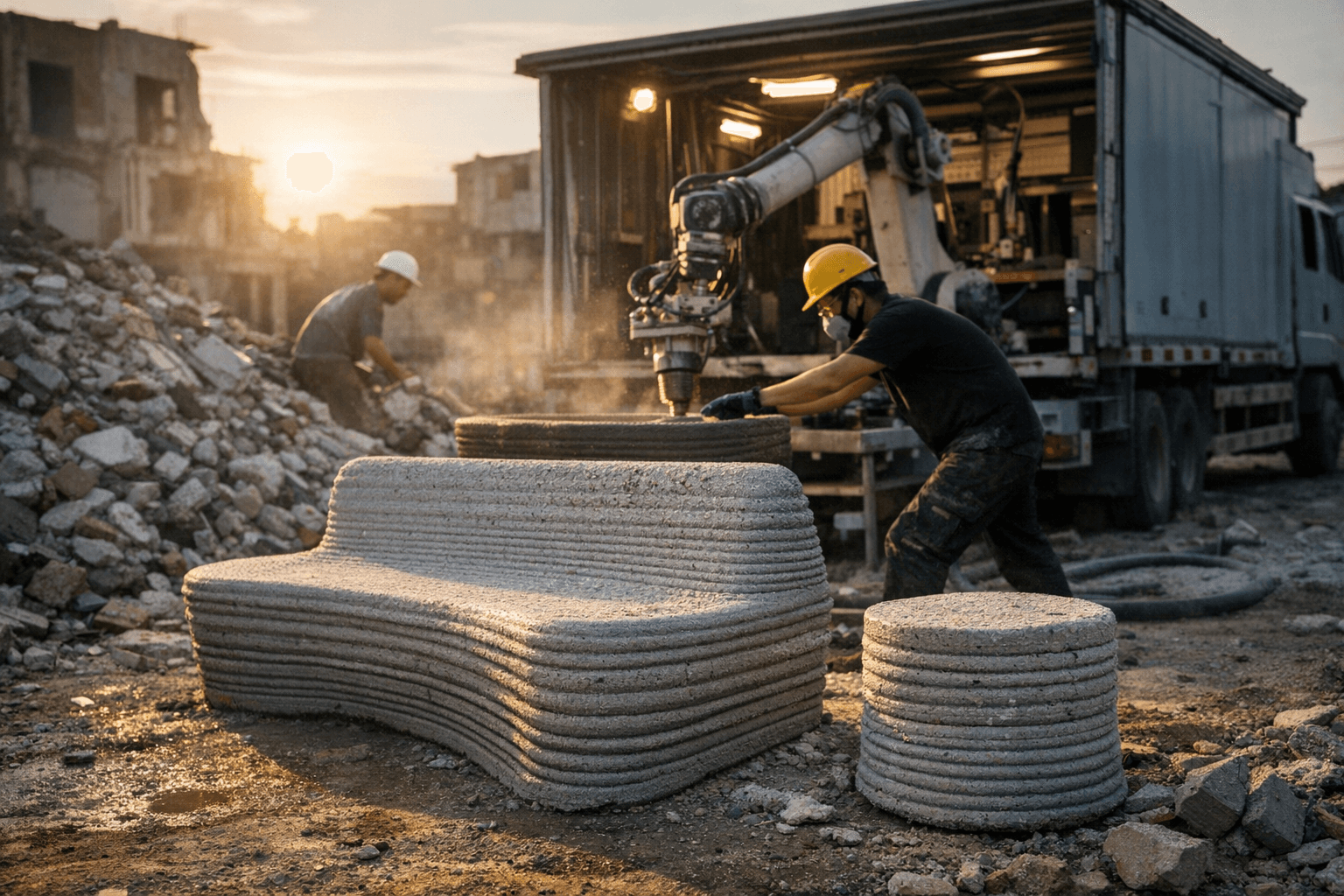
Chinese studio BENTU Design turned the rubble of demolished urban villages into functional street furniture through a project called Inorganic Growth: Regeneration of Urban Village Memory, developing a printable cementitious composite that contains up to 85% recycled solid waste sourced directly from construction and demolition debris.
The material pipeline begins with raw demolition waste, specifically discarded concrete fragments, red brick rubble, and mortar, processed through a two-stage crushing sequence. Primary jaw crushing breaks down the bulk material, followed by secondary impact crushing for shaping, with multi-layer vibrating screening separating the output by particle size. Coarse aggregates in the 3–6 mm range form the structural backbone of the printable composite, while the micro-fine powder fraction (0–3 mm), which accounts for approximately 30–35% of the waste stream, undergoes mechanical activation and chemical excitation before being blended with industrial by-products including fly ash, slag powder, and silica fume to produce a recycled cementitious binder.
Rather than transporting raw debris to a central facility, BENTU installed a mobile processing unit directly at demolition sites, integrating crushing, sorting, material preparation, and large-format printing into a single continuous on-site workflow. The studio reported that this localized approach reduced transportation-related carbon emissions by approximately 70% and achieved a material utilization rate of 92%. Compared to conventional concrete prefabrication or metal fabrication, the studio claimed the full process reduced carbon emissions by an estimated 65–80%. Intelligent slicing algorithms added further efficiency, reportedly cutting material consumption by an average of 40% without compromising structural performance.
"Recycling construction waste reduces the land consumption for landfilling of construction waste," the studio stated. "The precise material control of 3D printing avoids the material waste of traditional manufacturing. After the product is used up, its material can be crushed and remanufactured again, forming a closed loop of resource recycling."
The project produced two distinct street furniture pieces, designated PU and YOU. PU measures 715 x 580 x 720 mm, weighs 110 kg, and achieves a compressive strength of 106.25 MPa and a flexural strength of 12.28 MPa. Waterproof treatment brings water absorption down from 1.73% to 0.34%. The smaller YOU measures 580 x 430 x 540 mm. Both pieces share the same material formulation, incorporating BTPC, Chaozhou Daily-Use Ceramic Sand, fly ash, reactive silica powder, and polymer materials, and are available in five colorways: Ink Wash, Ink Green, Vermilion, Tea Brown, and Celeste.
The color work is not cosmetic. BENTU developed a dynamic gradient control system using dual print heads coordinated to adjust pigment ratios in real time, producing natural inorganic color transitions along the Z-axis through the FDM layer-by-layer deposition process. One configuration grades from deep gray at the base to brick red at the top; another replicates the weathered tonal erosion of an urban village wall across a chair's side profile. "By deconstructing the color palette of urban village living scenes, a dynamic color gradient control system was developed, making each piece of furniture a three-dimensional narrative embodying geological strata and emotional memory," Core77 described. Each finished piece functions as what the studio framed as a stratigraphic cross-section, converting the visual language of demolition into something people sit on in public space.
The material composition draws on ceramic aggregate sourced from Chaozhou, a city in Guangdong province known for daily-use ceramic production, integrating a regionally specific industrial material alongside the demolition waste inputs. The closed-loop ambition extends past the object's working life: when a piece is eventually retired, the cementitious composite is designed to be crushed and reprocessed back into the same production system.
This article was produced by Prism’s automated news system from verified source data, official records, and press releases, then run through automated quality and moderation checks before publishing. The system is built and supervised by the people who set the standards it runs under. Read our full AI policy.
Did this article answer your question?