China's Massive 3D Print Farms Are Disrupting Injection Molding Economics
Chinese print farms running 5,000+ Bambu machines are pushing 3D printing past injection molding's cost advantage, one 40,000-unit order at a time.
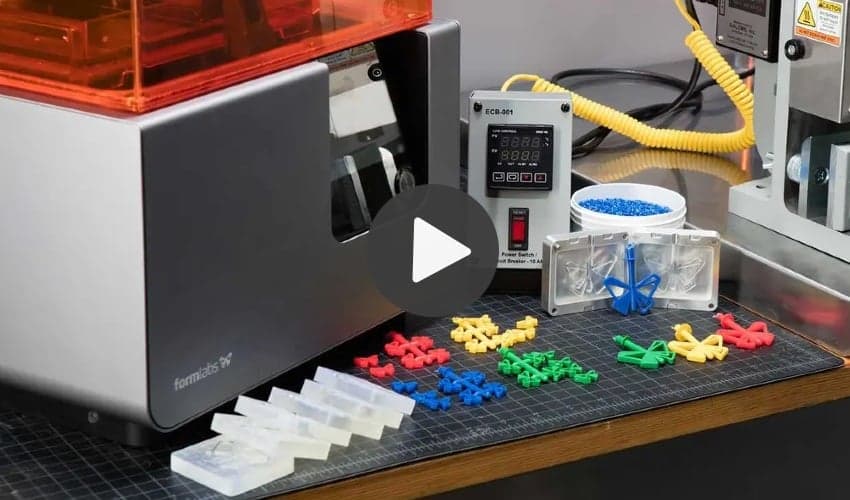
Forty thousand desktop ornaments, printed and delivered within a week. That single order, reported by Benji Chia in Hardware FYI's Weekend Wire #59 on March 7, 2026, captures something the additive manufacturing community has been theorizing about for years: 3D printing at volumes that genuinely compete with injection molding, not just on flexibility, but on economics.
The force behind that shift is the rise of massive-scale print farms in China, and the numbers involved are difficult to ignore.
What a Print Farm Actually Is, and What It's Becoming
The conventional definition is straightforward. As Benji Chia describes it in Hardware FYI, "A 3D printing farm, which really is just a centralized operation running racks of networked printers continuously, typically operates anywhere from ten to a few hundred machines." For most of the print farm's history, that upper bound, a few hundred machines, was also roughly its practical ceiling.
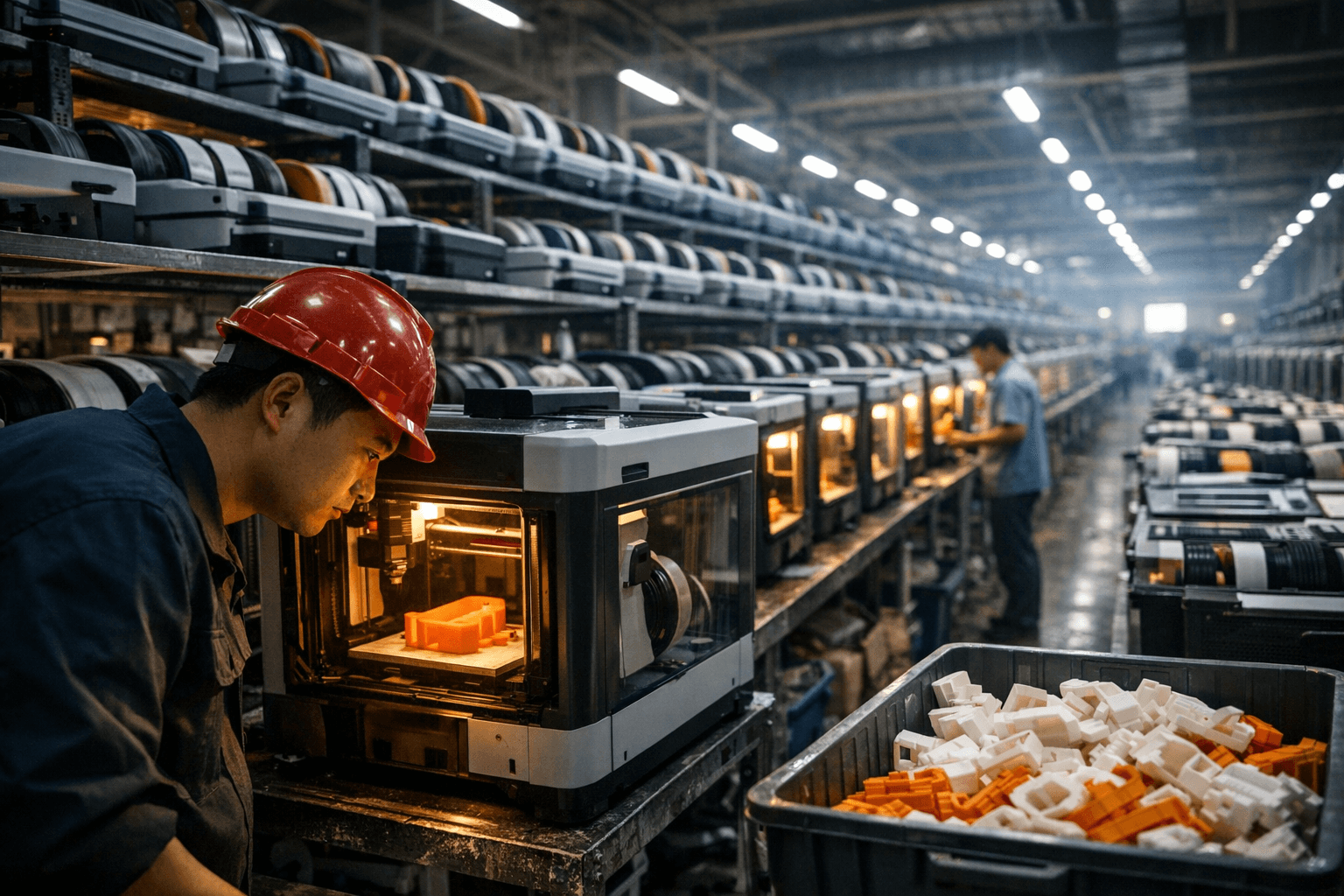
That ceiling is gone. According to Chia's reporting, "some massive print farms in China reportedly running upwards of ~5,000 printers (largely Bambu machines)." The equipment detail matters: Bambu Lab machines have become synonymous with high-speed, low-maintenance desktop FDM printing, and deploying them at five-thousand-unit scale transforms what was a prototyping and short-run production tool into something that begins to resemble a factory floor.
To put the throughput in concrete terms, Chia runs the math explicitly: "Assuming each printer runs a full build plate of four parts every 3 hours, across 5,000 machines, that's roughly 160,000 parts per day." The arithmetic behind that figure is worth tracing through. Each printer runs eight builds in a 24-hour period, producing 32 parts per machine per day. Multiply that across 5,000 machines and you arrive at 160,000 parts daily. That 40,000-ornament order would represent a quarter of a single day's output at full capacity, a sobering illustration of what these operations can absorb without breaking stride.
The Economics: Where 3D Printing Crosses Injection Molding
The reason this matters beyond raw throughput is what it does to per-part cost curves. Injection molding's economic advantage has always rested on tooling amortization: the upfront cost of a mold is brutal, but once you're running millions of identical parts, that cost per unit drops to a point that additive manufacturing couldn't touch. The crossover point, the unit volume at which 3D printing becomes cheaper than injection molding, has historically sat at a relatively low number and favored injection molding quickly.
That crossover is shifting. Hardware FYI's Weekend Wire #59 includes a section titled "Interesting Chart: Cost Curves for 3D Printing," which presents data drawn from an RFQ sent to a Chinese supplier. The part used for the comparison was a simple nylon component quoted across several manufacturing processes. As Chia summarizes the chart's implication, it "compares per-part costs for 3D printing versus injection molding and shows how quickly the economics of additive manufacturing are shifting, driven in part by the rise of massive-scale print farms."
The specific per-part cost figures from that RFQ are not publicly available in the excerpted reporting, and the exact unit volume at which the crossover occurs for the cited nylon part is similarly absent from the published summary. What the chart communicates directionally, though, is consistent with the operational reality: when a farm is running 160,000 parts per day across standardized, networked hardware, fixed overhead spreads dramatically. The per-part cost profile starts to resemble the long tail of injection molding's amortization curve without requiring a single dollar of tooling investment.
Chia's framing in the newsletter is direct: "The new generation of 3D printers and massive-scale print farms are shifting additive manufacturing cost curves."
Files Over Warehouses: The Supply Chain Implication
Drone pioneer Chris Anderson has been tracking this trend and frames it in terms of what it means for inventory and logistics, not just manufacturing. His observation, as reported, is that large-scale print farms in China are making production viable at higher volumes and are shifting the crossover point where 3D printing beats traditional molding for scale. The downstream consequence he identifies is the idea of "files over warehouses and local printing over shipping."
That phrase describes a supply chain architecture that the 3D printing community has long aspired to but rarely seen executed at scale. Instead of a manufacturer producing injection-molded parts in bulk, shipping them across oceans, and warehousing them against uncertain demand, the model becomes: send a validated print file to a farm, produce on demand, and deliver. Inventory risk collapses. Lead times compress. The 40,000-ornament example is precisely this in practice, a large consumer order fulfilled from a digital file through a distributed rack of printers in under seven days.
The implications for product businesses, particularly in consumer goods, replacement parts, and customized hardware, are significant. Injection molding's minimum viable run has always been a barrier to market entry and a source of overproduction waste. A print farm operating at this scale doesn't have that minimum in the same way.
What Remains Unverified
Responsible reading of these figures requires acknowledging what the reporting leaves open. The 5,000-printer figure is described by Hardware FYI as "reportedly," meaning it reflects secondhand claims rather than independently audited fleet counts. The operators of these farms are not named in the available reporting, nor are their locations within China specified.
The throughput calculation assumes continuous 24/7 operation with a full build plate of four parts printing on a three-hour cycle. Real-world farms contend with print failures, machine maintenance, setup time between jobs, post-processing labor, and quality control. How much those factors erode the theoretical 160,000-parts-per-day ceiling is not addressed in the available data.
Similarly, the cost-curve chart from the RFQ represents a single part geometry in a single material (nylon), quoted by a single unnamed supplier. Extrapolating from one data point to a general claim about additive versus injection molding economics requires caution. Tooling amortization schedules, part complexity, tolerance requirements, and material properties all affect where the crossover falls for any given application.
The buyer behind the 40,000-ornament order, the farm operator who fulfilled it, and the logistics chain that delivered it within a week are all unidentified in the available reporting.
Why This Moment Is Different
What makes the current situation distinct from earlier print farm announcements is the confluence of hardware and scale. Bambu Lab's machines are fast, relatively low-maintenance, and designed for unattended operation, qualities that make them tractable at fleet scale in a way that older desktop FDM hardware wasn't. Five thousand of those machines, networked and running continuously, represents a qualitatively different operation than a few hundred machines of the prior generation.
The additive manufacturing community has spent years arguing that the economics of 3D printing would eventually close the gap with injection molding. The argument was always theoretically sound but lacked the operational proof. Chinese print farms running at the scale Benji Chia describes are now providing that proof in the form of actual orders, actual delivery timelines, and an RFQ-based cost comparison that, even without the specific numbers visible, demonstrates the shifting competitive position of additive manufacturing.
Whether the crossover point has moved enough to genuinely displace injection molding for mid-volume production across a range of industries, or whether this remains a niche advantage for specific geometries and materials, is the question the manufacturing industry will be answering through the next several years of orders placed and tooling decisions deferred.
This article was produced by Prism’s automated news system from verified source data, official records, and press releases, then run through automated quality and moderation checks before publishing. The system is built and supervised by the people who set the standards it runs under. Read our full AI policy.
Did this article answer your question?