Chinese patent proposes FFF printer that also writes and draws
A Chinese patent sketches a printer-plotter hybrid that swaps between FFF and pen work on the frame, aiming to dodge the setup pain that makes most all-in-one tools feel compromised.
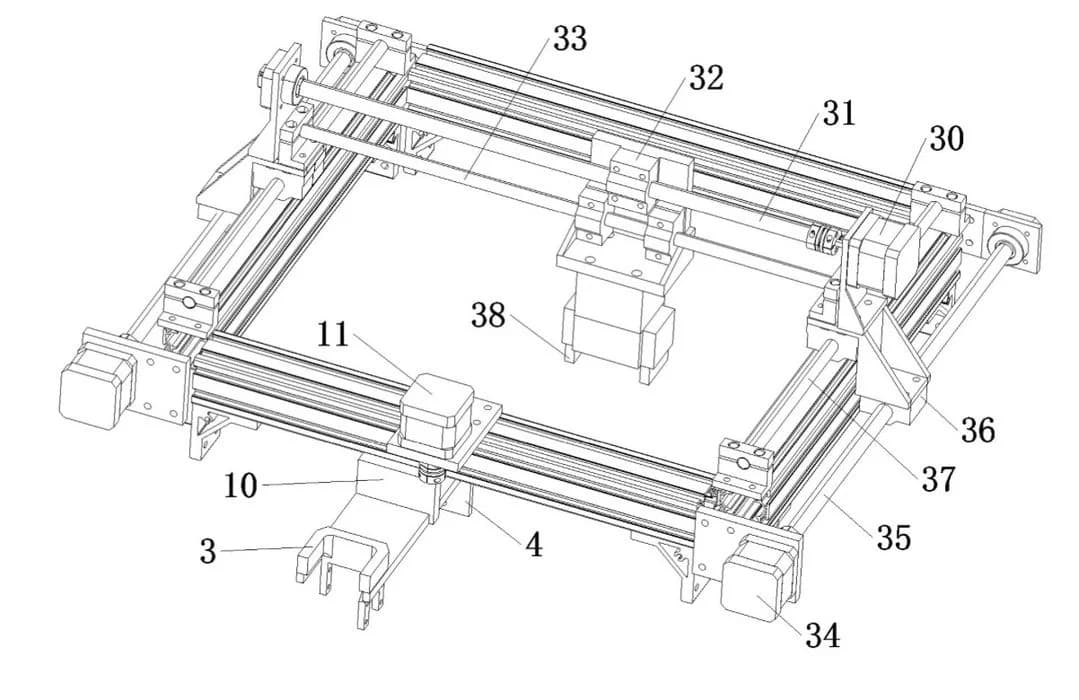
The real pitch of this Chinese patent is not novelty for novelty’s sake. It is a direct attack on the part of hybrid desktop fabrication that usually wastes the most time: tool changes. CN 122058536 A, assigned to Zhengzhou Gukate CNC Technology Co., Ltd., describes an FFF printer that can switch to pen-based writing or drawing without manual toolhead replacement, a small mechanical idea that could save the reset-and-relevel routine that usually follows every swap.
The design centers on a rotating tool-changing assembly mounted to the frame, with two dedicated fixtures, one for an extrusion head and one for a pen clamp. A clamping mechanism, described in coverage as a pneumatic gripper, handles the exchange. Around that, the patent lays out a support frame, heated bed, Z-axis lifting system, and X/Y motion systems, making it look less like a toy add-on and more like a purpose-built desktop fabrication platform. China’s patent office published the application on May 19, 2026.
What makes the concept interesting to anyone who actually uses these machines is the motion architecture. The X-axis and Y-axis systems are described as screw-driven rather than belt-driven, which points to positioning accuracy over raw speed. That choice makes sense for writing and plotting, where a clean line and repeatable placement matter more than fast travel. The writing mode is framed mainly as planar writing and drawing on the bed, not as direct marking on finished printed parts, so this is closer to a printer-plotter hybrid than a full post-processing marking station.

That distinction matters because makers have seen plenty of machines promise “everything” and then turn into maintenance projects. Desktop systems have already blended 3D printing with plotting, laser engraving, and CNC-style functions, but tool changing has remained the recurring bottleneck. If the exchange is slow, fussy, or alignment-sensitive, the machine stops feeling versatile and starts feeling like a compromise.
Still, the use cases are easy to picture. A single motion platform that can print a part, sketch a template, label a panel, or add mixed-media output would be useful on a hobby bench, in a classroom, or in a design studio where switching between machines is a drag. The patent does not make that machine a product yet, but it does show that manufacturers are still trying to solve the same old problem in a smarter way: how to make a desktop machine do more than one job without turning every job into a setup chore.
This article was produced by Prism’s automated news system from verified source data, official records, and press releases, then run through automated quality and moderation checks before publishing. The system is built and supervised by the people who set the standards it runs under. Read our full AI policy.
Did this article answer your question?