Columbia engineers 3D-print and laser-cook quiche tart, cauliflower pizza, key-lime pie
Columbia engineers 3D-printed and laser-cooked a full three-course meal, demonstrating millimeter-scale food fabrication with everyday supermarket ingredients.
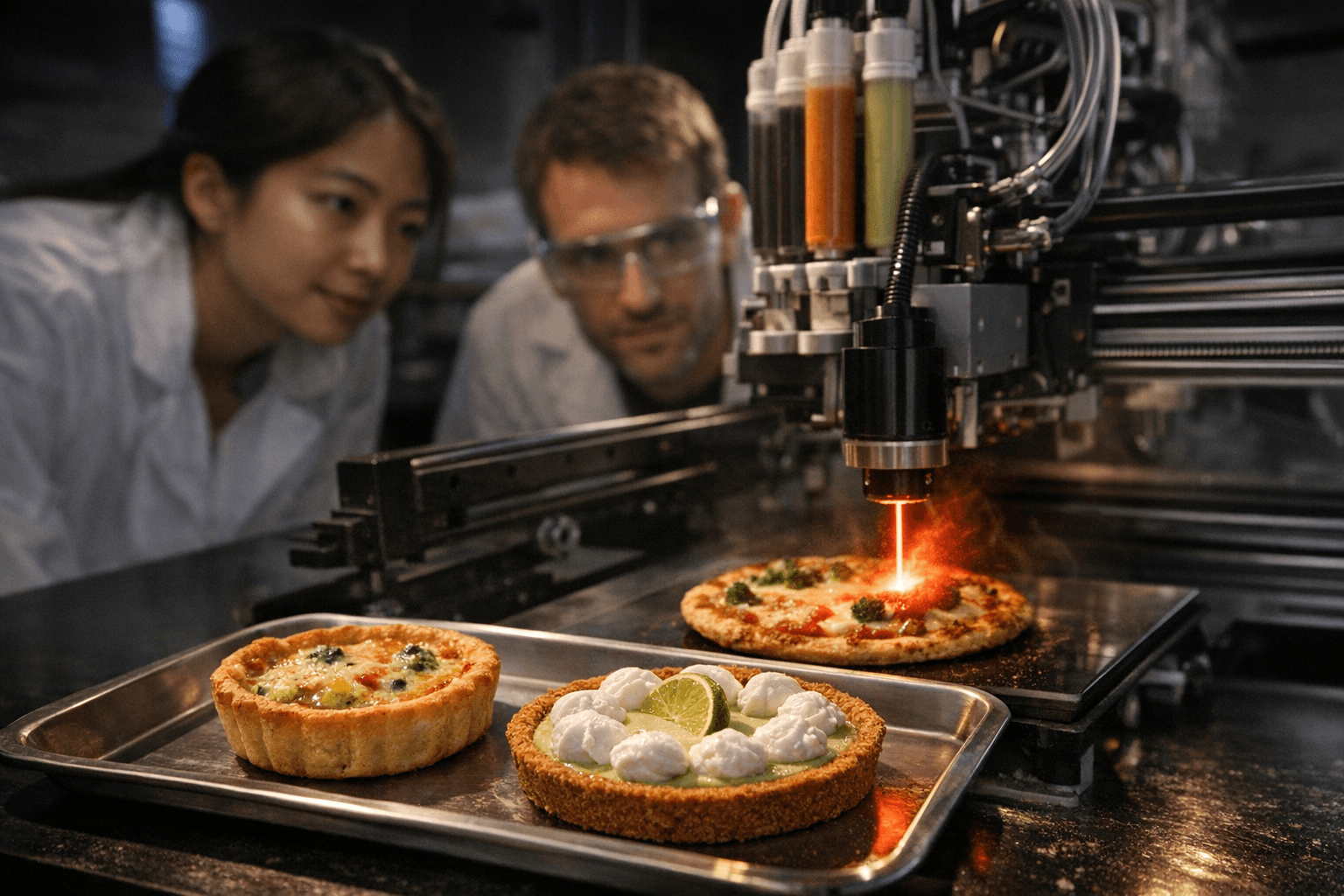
Columbia University engineers built and demonstrated a laser-assisted 3D printing pipeline that produced a complete three-course meal, a quiche-inspired tart, a cauliflower-dough pizza, and a key lime pie, using 14 ingredients sourced from Appletree Supermarket, Morton Williams, and Whole Foods Market in New York City. The project, led by doctoral researcher Jonathan Blutinger in Columbia’s Creative Machines Lab under Hod Lipson, spanned six years and scaled prior single-dish experiments into a multimaterial, cooked meal.
The team converted ordinary supermarket items into printable pastes using standard food processors and high-powered blenders, then deposited those pastes with millimeter-scale precision using multi-ingredient printheads. After printing, lasers with tuned wavelengths and pathing selectively cooked surfaces and layers. The group calibrated laser wavelength and exposure time per ingredient to control texture and structure, then measured elasticity, chewiness, and structural cohesion to quantify outcomes.
Blutinger framed the work as both technical and consumer-facing. “This kind of technology could help people, help you be more deliberate about what you’re eating, and give you more transparency in the food that you’re eating and track it in a much better way,” he said. He also emphasized the core engineering gap the project addresses: “We noted that, while printers can produce ingredients to a millimeter-precision, there is no heating method with this same degree of resolution.”
Earlier experiments in the lab printed and laser-cooked pureed chicken samples 3 mm thick with a 1 in² area, exposing them to blue light at 445 nm, infrared at 980 nm, and a value recorded in lab notes as “10.6 m.” Those tests showed laser-cooked meat shrank less than oven-broiled controls, retained about double the moisture, and was preferred in a very small blind taste trial of two tasters. The team found that laser pathing parameters such as circle diameter, circle density, path length, randomness, and laser speed could be tuned to optimize energy distribution, control heating resolution, and even produce decorative patterns like checkerboard or floral motifs.
Roughly 30 to 40 collaborators across mechanical engineering, computer science, materials science, and culinary technique contributed to the project. The lab built on a 2023 proof-of-concept cheesecake study and a long history of edible 3D printing in the group, moving now toward combined printing-and-cooking workflows with integrated software controls.
For the local maker and 3D printing community, the work matters because it shows complex, multi-ingredient prints can be cooked with spatial precision using accessible ingredients and kitchen tools, not just bespoke feeds. Remaining challenges include achieving simultaneous internal and external cooking, preventing cross-contamination between raw and cooked layers, and verifying exact laser specifications and safety for consumer use. The team’s long-term goal is a digital personal chef appliance that prints and cooks to user specifications; the next steps will be publishing full methods and recipe formulations and scaling experiments beyond lab conditions to address safety and reproducibility.
This article was produced by Prism’s automated news system from verified source data, official records, and press releases, then run through automated quality and moderation checks before publishing. The system is built and supervised by the people who set the standards it runs under. Read our full AI policy.
Did this article answer your question?